
Kingdom
Pseudomonadati
Phylum
Pseudomonadota
Class
Gammaproteobacteria
Order
Legionellales
Family
Legionellaceae
Genus
Legionella
Description
Taxonomy
| Kingdom | Pseudomonadati |
|---|---|
| Phylum | Pseudomonadota |
| Class | Gammaproteobacteria |
| Order | Legionellales |
| Family | Legionellaceae |
| Genus | Legionella |
| Species | Legionella oakridgensis |
| Strain | strain Oak Ridge-10 |
Profile
| Physiology | |
|---|---|
| Gram staining properties | Not Available |
| Shape | Rod |
| Mobility | Not Available |
| Flagellar presence | Yes |
| Number of membranes | Not Available |
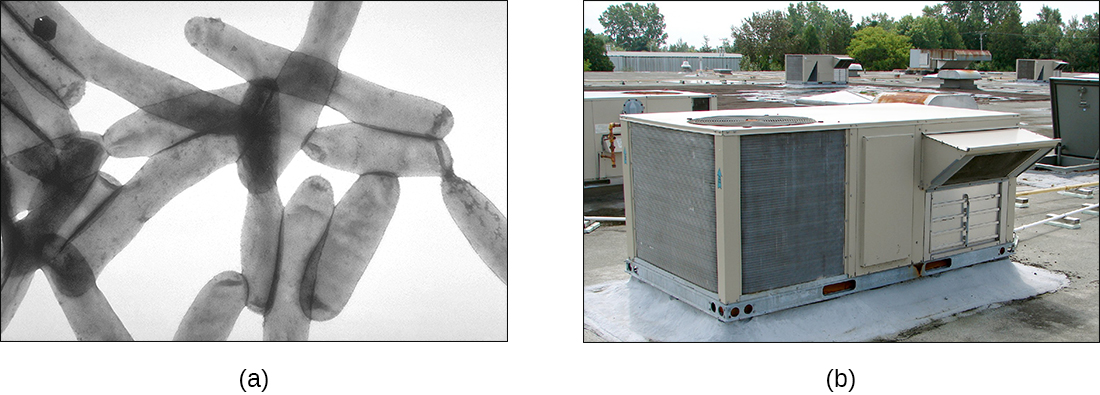
Image source: Wikipedia/Wikimedia
| Ecology, Host, and Life Cycle | |
|---|---|
| Oxygen requirements | Not Available |
| Optimal temperature | Not Available |
| Temperature range | Not Available |
| Habitat | aquatic environment; Groundwater |
| Biotic relationship | Not Available |
| Host(s) | Homo sapiens |
| Cell arrangement | Not Available |
| Sporulation | Not Available |
| Energy source | Not Available |
| Pathogenicity | Not Available |
Gene Summary
Adenine Count
784124 bp
Thymine Count
793951 bp
Guanine Count
553353 bp
Cytosine Count
535679 bp
Genome Length
2668211 bp
Protein-coding Genes
2469 genes
Non-Coding Genes
42 genes
# of Chromosomes/Plasmids
1
Genes
| Name | Locus Tag | UniProt ID | Strand Orientation | Gene Start/End | Protein Molecular Weight |
|---|---|---|---|---|---|
| hypothetical protein | Loak_0122 | Not Available | Negative | 140361 - 141353 | 37348.9 |
| spore maturation protein a | Loak_0123 | Not Available | Positive | 141443 - 142048 | 21237.5 |
| spore maturation protein b | Loak_0124 | Not Available | Positive | 142045 - 142578 | 18865.6 |
| m23/m37 family transporter peptidase | Loak_0125 | Not Available | Negative | 142589 - 144037 | 53989.5 |
| tyrosyl-trna synthetase | Loak_0126 | Not Available | Positive | 144261 - 145457 | 45127.1 |
| adenosyl-chloride synthase | Loak_0127 | Not Available | Negative | 145731 - 146651 | 34597.5 |
| endoglucanase precursor | Loak_0128 | Not Available | Negative | 146669 - 148297 | 60552.8 |
| substrate of the dot/icm secretion system | Loak_0129 | Not Available | Positive | 148600 - 149133 | 20752.5 |
| gtp-binding protein enga | Loak_0130 | Not Available | Negative | 149291 - 150679 | 51766.1 |
| pqq (pyrrolo quinoline) wd40-like repeat, enzyme repeat domain protein | Loak_0131 | Not Available | Negative | 150683 - 151840 | 41378.0 |
Pathways
0 pathways
No pathways found
No metabolic pathways have been associated with this bacterium yet.


