
Kingdom
Pseudomonadati
Phylum
Pseudomonadota
Class
Gammaproteobacteria
Order
Vibrionales
Family
Vibrionaceae
Genus
Vibrio
Description
Taxonomy
| Kingdom | Pseudomonadati |
|---|---|
| Phylum | Pseudomonadota |
| Class | Gammaproteobacteria |
| Order | Vibrionales |
| Family | Vibrionaceae |
| Genus | Vibrio |
| Species | Vibrio parahaemolyticus |
| Strain | strain HS-22-14 |
Profile
| Physiology | |
|---|---|
| Gram staining properties | Negative |
| Shape | Rod |
| Mobility | Yes |
| Flagellar presence | Yes |
| Number of membranes | 2 |
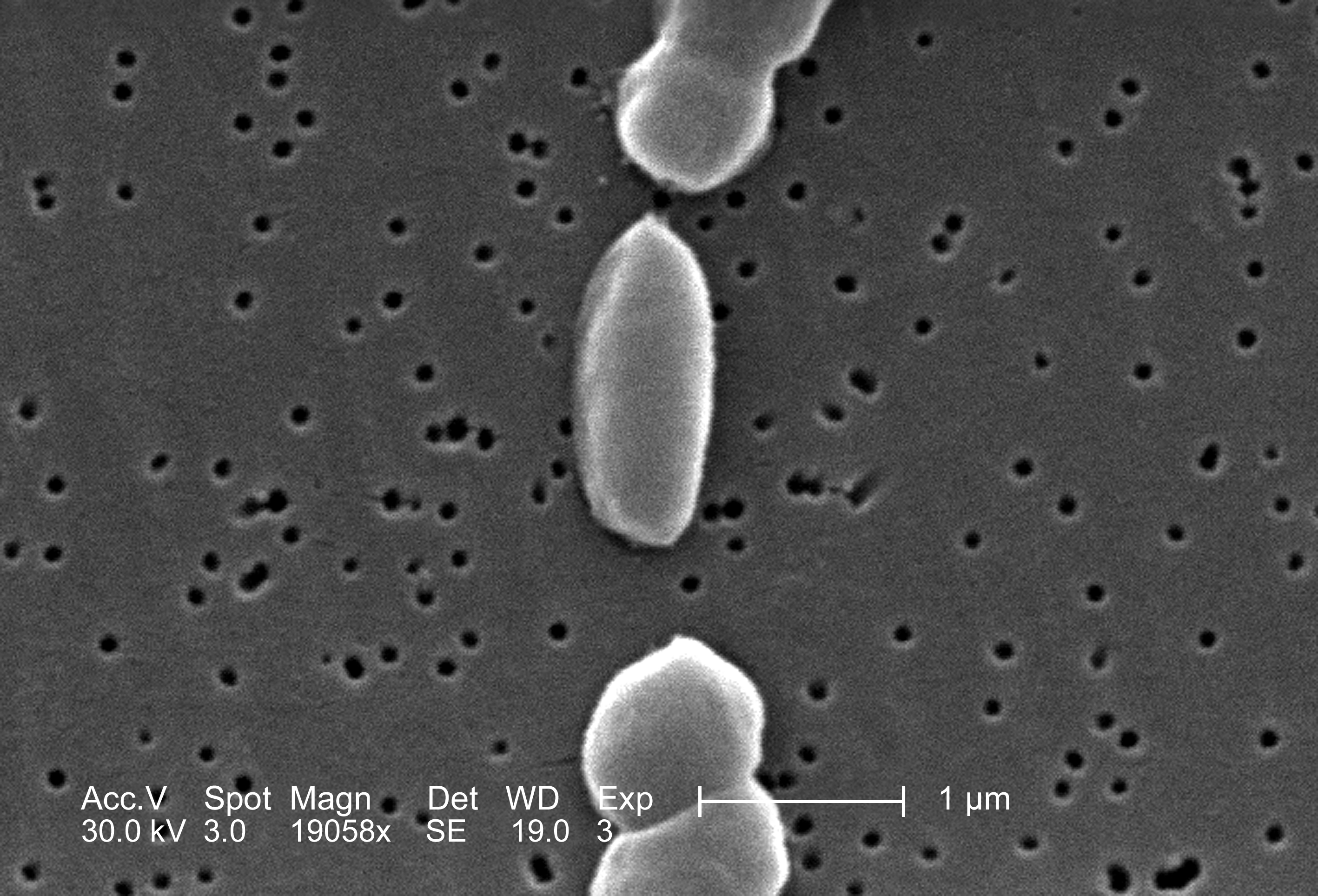
Image source: Wikipedia/Wikimedia
| Ecology, Host, and Life Cycle | |
|---|---|
| Oxygen requirements | Facultative anaerobe |
| Optimal temperature | 20 |
| Temperature range | Mesophilic |
| Habitat | Aquatic |
| Biotic relationship | Free living |
| Host(s) | Homo sapiens, Danio rerio, Pancrustacea |
| Cell arrangement | Singles |
| Sporulation | Nonsporulating |
| Energy source | Heterotroph |
| Pathogenicity | Human |
Gene Summary
Adenine Count
1593982 bp
Thymine Count
1596116 bp
Guanine Count
1294976 bp
Cytosine Count
1276541 bp
Genome Length
5761615 bp
Protein-coding Genes
5094 genes
Non-Coding Genes
176 genes
# of Chromosomes/Plasmids
1
Genes
| Name | Locus Tag | UniProt ID | Strand Orientation | Gene Start/End | Protein Molecular Weight |
|---|---|---|---|---|---|
| short-chain dehydrogenase | ACX03_17560 | Not Available | Negative | 3869788 - 3870477 | 24912.7 |
| histone deacetylase | ACX03_17565 | Not Available | Positive | 3870748 - 3871671 | 34579.4 |
| Trna-ser | Not Available | Not Available | Positive | 3871863 - 3871953 | Not Available |
| hydrolase | ACX03_17575 | Not Available | Negative | 3872108 - 3873916 | 68939.9 |
| hypothetical protein | ACX03_17580 | Not Available | Negative | 3873939 - 3874166 | 8149.89 |
| nucleoid-associated protein ndpa | ACX03_17585 | Not Available | Positive | 3874252 - 3875250 | 37756.3 |
| histidine phosphotransferase | ACX03_17590 | Not Available | Positive | 3875357 - 3876649 | 48550.6 |
| chemotaxis protein | ACX03_17595 | Not Available | Positive | 3876754 - 3877917 | 43683.8 |
| antiporter | ACX03_17600 | Not Available | Negative | 3878007 - 3879440 | 50833.3 |
| aspartate-semialdehyde dehydrogenase | ACX03_17605 | Not Available | Positive | 3879871 - 3880986 | 40224.5 |
Pathways
1153 pathways
Health Effects
| Health Condition | Relation | Reference |
|---|---|---|
| Vibriosis | Causes | PMC10472736 |
| Acute gastroenteritis | Causes | PMC11171697 |
| Wound infections | Causes | PMC11171697 |
| Septicemia | Causes | PMC11171697 |
| Food poisoning | Causes | PMC12108532 |
| Vibrio infections | Causes | PMC12108532 |
| Acute gastroenteritis | Causes | PMC12849298 |
| Wound infections | Causes | PMC12849298 |
| Ear infections | Causes | PMC12849298 |
| Septicemia | Causes | PMC12849298 |


