
Kingdom
Pseudomonadati
Phylum
Pseudomonadota
Class
Gammaproteobacteria
Order
Vibrionales
Family
Vibrionaceae
Genus
Vibrio
Description
Taxonomy
| Kingdom | Pseudomonadati |
|---|---|
| Phylum | Pseudomonadota |
| Class | Gammaproteobacteria |
| Order | Vibrionales |
| Family | Vibrionaceae |
| Genus | Vibrio |
| Species | Vibrio parahaemolyticus |
| Strain | strain HS-22-14 |
Profile
| Physiology | |
|---|---|
| Gram staining properties | Negative |
| Shape | Rod |
| Mobility | Yes |
| Flagellar presence | Yes |
| Number of membranes | 2 |
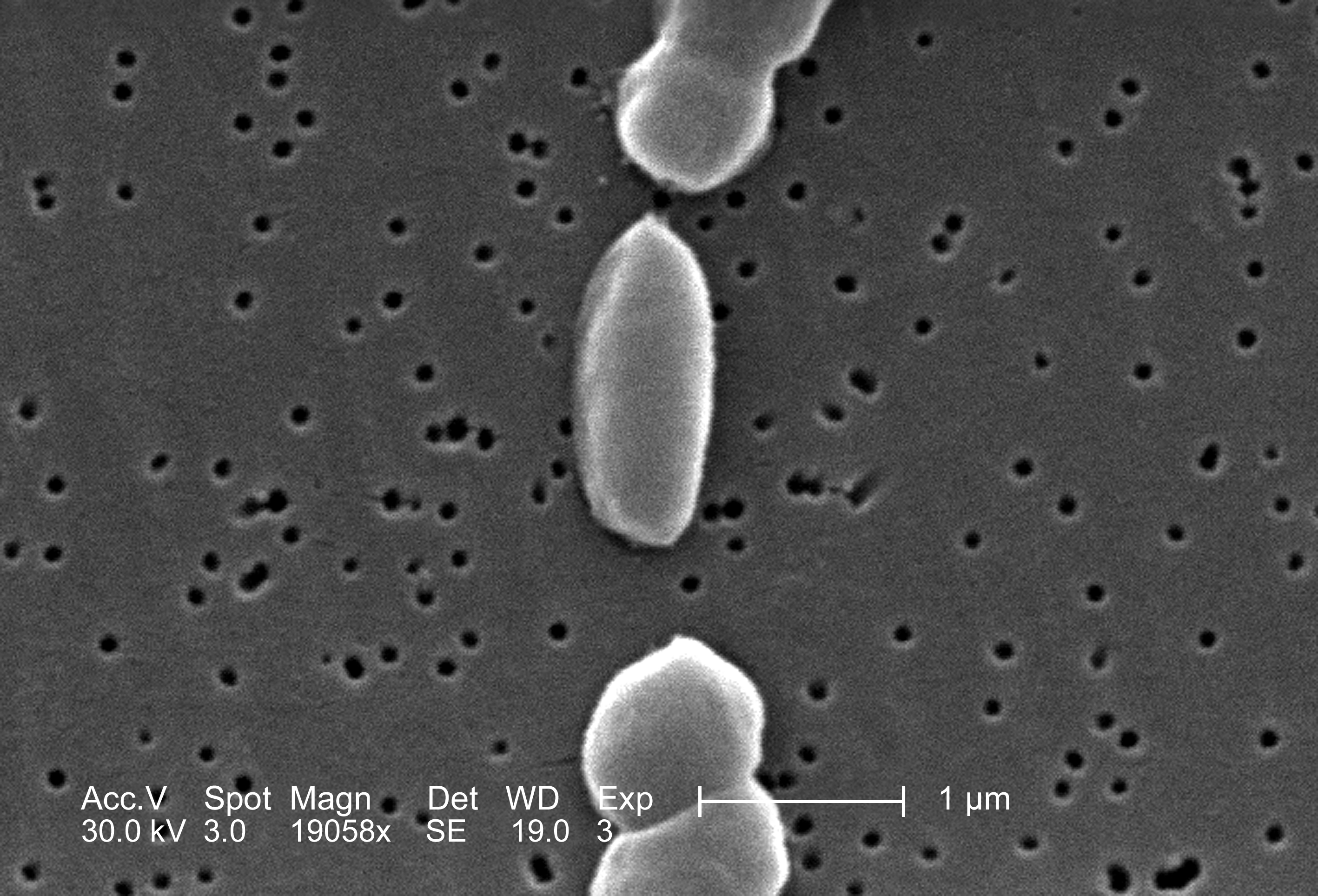
Image source: Wikipedia/Wikimedia
| Ecology, Host, and Life Cycle | |
|---|---|
| Oxygen requirements | Facultative anaerobe |
| Optimal temperature | 20 |
| Temperature range | Mesophilic |
| Habitat | Aquatic |
| Biotic relationship | Free living |
| Host(s) | Homo sapiens, Danio rerio, Pancrustacea |
| Cell arrangement | Singles |
| Sporulation | Nonsporulating |
| Energy source | Heterotroph |
| Pathogenicity | Human |
Gene Summary
Adenine Count
1593982 bp
Thymine Count
1596116 bp
Guanine Count
1294976 bp
Cytosine Count
1276541 bp
Genome Length
5761615 bp
Protein-coding Genes
5094 genes
Non-Coding Genes
176 genes
# of Chromosomes/Plasmids
1
Genes
| Name | Locus Tag | UniProt ID | Strand Orientation | Gene Start/End | Protein Molecular Weight |
|---|---|---|---|---|---|
| hydrolase | ACX03_11345 | Not Available | Negative | 2499576 - 2500685 | 41520.1 |
| cell division protein ftsx | ACX03_11350 | Not Available | Negative | 2500685 - 2503195 | 92169.6 |
| abc transporter atp-binding protein | ACX03_11355 | Not Available | Negative | 2503182 - 2503916 | 26926.9 |
| glutathione peroxidase | ACX03_11360 | Not Available | Negative | 2504143 - 2504388 | 9246.11 |
| hypothetical protein | ACX03_11365 | Not Available | Negative | 2504385 - 2504597 | 7976.52 |
| hypothetical protein | ACX03_11370 | Not Available | Positive | 2504693 - 2506414 | 65950.2 |
| glycosyl transferase | ACX03_11375 | Not Available | Positive | 2506454 - 2507455 | 37117.5 |
| hypothetical protein | ACX03_11380 | Not Available | Negative | 2507476 - 2508360 | 32384.2 |
| methyltransferase type 11 | ACX03_11385 | Not Available | Negative | 2508350 - 2508994 | 24643.3 |
| peptidase u32 | ACX03_11390 | Not Available | Negative | 2509147 - 2511138 | 74152.8 |
Pathways
1153 pathways
Health Effects
| Health Condition | Relation | Reference |
|---|---|---|
| Vibriosis | Causes | PMC10472736 |
| Acute gastroenteritis | Causes | PMC11171697 |
| Wound infections | Causes | PMC11171697 |
| Septicemia | Causes | PMC11171697 |
| Food poisoning | Causes | PMC12108532 |
| Vibrio infections | Causes | PMC12108532 |
| Acute gastroenteritis | Causes | PMC12849298 |
| Wound infections | Causes | PMC12849298 |
| Ear infections | Causes | PMC12849298 |
| Septicemia | Causes | PMC12849298 |


