
Kingdom
Pseudomonadati
Phylum
Pseudomonadota
Class
Gammaproteobacteria
Order
Lysobacterales
Family
Lysobacteraceae
Genus
Xanthomonas
Description
Taxonomy
| Kingdom | Pseudomonadati |
|---|---|
| Phylum | Pseudomonadota |
| Class | Gammaproteobacteria |
| Order | Lysobacterales |
| Family | Lysobacteraceae |
| Genus | Xanthomonas |
| Species | Xanthomonas arboricola |
| Strain | strain CFSAN033082 |
Profile
| Physiology | |
|---|---|
| Gram staining properties | Not Available |
| Shape | Rod |
| Mobility | Not Available |
| Flagellar presence | Yes |
| Number of membranes | Not Available |
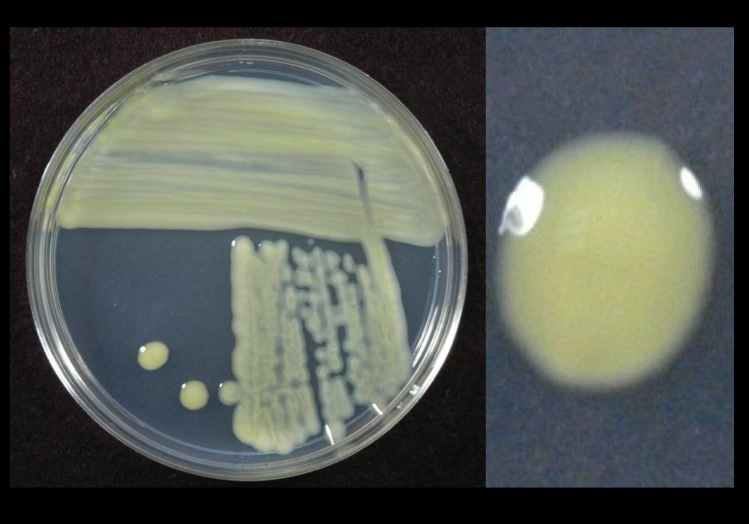
Image source: Wikipedia/Wikimedia
| Ecology, Host, and Life Cycle | |
|---|---|
| Oxygen requirements | Not Available |
| Optimal temperature | Not Available |
| Temperature range | Not Available |
| Habitat | Not Available |
| Biotic relationship | Not Available |
| Host(s) | Not Available |
| Cell arrangement | Not Available |
| Sporulation | Not Available |
| Energy source | Not Available |
| Pathogenicity | Not Available |
Gene Summary
Adenine Count
893421 bp
Thymine Count
897080 bp
Guanine Count
1695728 bp
Cytosine Count
1698175 bp
Genome Length
5184404 bp
Protein-coding Genes
4170 genes
Non-Coding Genes
164 genes
# of Chromosomes/Plasmids
1
Genes
| Name | Locus Tag | UniProt ID | Strand Orientation | Gene Start/End | Protein Molecular Weight |
|---|---|---|---|---|---|
| type ii secretion system protein j | AE925_07675 | Not Available | Negative | 1747726 - 1748349 | 22333.8 |
| general secretion pathway protein gspi | AE925_07680 | Not Available | Negative | 1748346 - 1748726 | 13038.8 |
| general secretion pathway protein gsph | AE925_07685 | Not Available | Negative | 1748710 - 1749192 | 17288.9 |
| general secretion pathway protein gspg | AE925_07690 | Not Available | Negative | 1749220 - 1749684 | 17137.4 |
| general secretion pathway protein gspf | AE925_07695 | Not Available | Negative | 1749713 - 1750909 | 42821.2 |
| general secretion pathway protein gspe | AE925_07700 | Not Available | Negative | 1750896 - 1752383 | 52897.0 |
| type ii secretion system protein d | AE925_07705 | Not Available | Negative | 1752388 - 1754469 | 73000.6 |
| type ii secretion system protein c | AE925_07710 | Not Available | Negative | 1754466 - 1755278 | 27516.0 |
| tonb-dependent receptor | AE925_07715 | Not Available | Negative | 1755437 - 1758088 | 97280.2 |
| hypothetical protein | AE925_07720 | Not Available | Negative | 1758168 - 1759646 | 50157.3 |
Pathways
0 pathways
No pathways found
No metabolic pathways have been associated with this bacterium yet.
Health Effects
No health effects information available for this bacterium.