Kingdom
Pseudomonadati
Phylum
Pseudomonadota
Class
Gammaproteobacteria
Order
Enterobacterales
Family
Enterobacteriaceae
Genus
Escherichia
Description
Taxonomy
| Kingdom | Pseudomonadati |
|---|---|
| Phylum | Pseudomonadota |
| Class | Gammaproteobacteria |
| Order | Enterobacterales |
| Family | Enterobacteriaceae |
| Genus | Escherichia |
| Species | Escherichia coli |
| Strain | strain BIDMC112 |
Profile
| Physiology | |
|---|---|
| Gram staining properties | Negative |
| Shape | Rod |
| Mobility | Yes |
| Flagellar presence | Yes |
| Number of membranes | 2 |

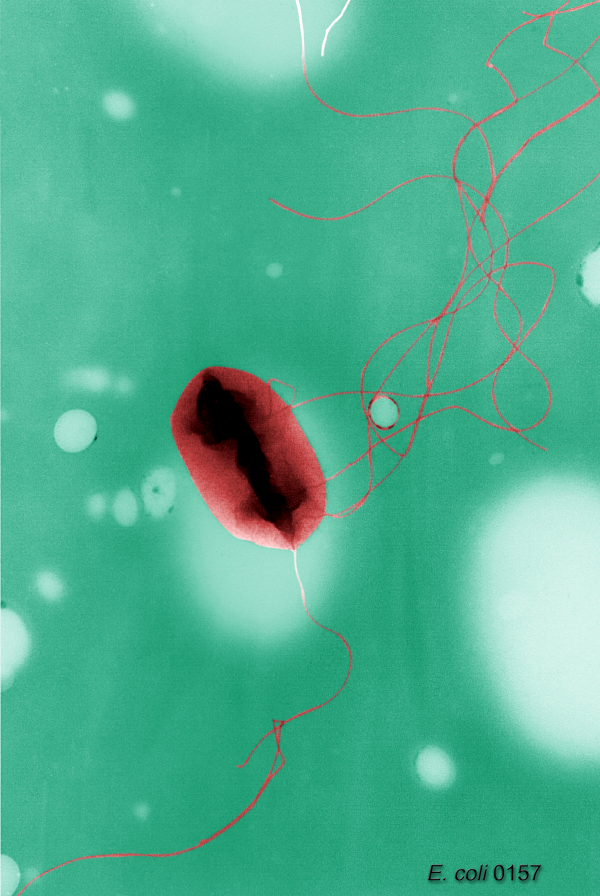
Image source: Wikipedia/Wikimedia
| Ecology, Host, and Life Cycle | |
|---|---|
| Oxygen requirements | Facultative anaerobe |
| Optimal temperature | 37 |
| Temperature range | Mesophilic |
| Habitat | HostAssociated |
| Biotic relationship | Free living |
| Host(s) | Homo sapiens, Gallus gallus, Bos taurus |
| Cell arrangement | Pairs - Singles |
| Sporulation | Not Available |
| Energy source | Not Available |
| Pathogenicity | Human |
Gene Summary
Adenine Count
1283364 bp
Thymine Count
1281198 bp
Guanine Count
1324998 bp
Cytosine Count
1318883 bp
Genome Length
5208446 bp
Protein-coding Genes
4697 genes
Non-Coding Genes
378 genes
# of Chromosomes/Plasmids
1
Genes
| Name | Locus Tag | UniProt ID | Strand Orientation | Gene Start/End | Protein Molecular Weight |
|---|---|---|---|---|---|
| Attl | Not Available | Not Available | Positive | 301889 - 301900 | Not Available |
| Integrase | SK85_00276 | P04890 | Negative | 302196 - 303050 | 33185.1 |
| Hypothetical protein | SK85_00277 | P76516 | Negative | 303277 - 303582 | 12133.4 |
| Hypothetical protein | SK85_00278 | P76515 | Negative | 303582 - 303944 | 13672.3 |
| Hypothetical protein | SK85_00279 | P76514 | Negative | 303935 - 304471 | 20272.5 |
| Hypothetical protein | SK85_00280 | P76513 | Negative | 304599 - 305423 | 30488.2 |
| Hypothetical protein | SK85_00281 | P76512 | Negative | 305489 - 305851 | 13088.6 |
| Prophage repressor | SK85_00282 | P18680 | Negative | 306554 - 307201 | 23770.4 |
| Putative antirepressor cro | SK85_00283 | Not Available | Positive | 307344 - 307604 | 9736.61 |
| Transcriptional regulator | SK85_00284 | P75976 | Positive | 307597 - 308154 | 20168.7 |
Pathways
0 pathways
No pathways found
No metabolic pathways have been associated with this bacterium yet.
Health Effects
| Health Condition | Relation | Reference |
|---|---|---|
| Gi disease | Causes | PMC11149725 |
| Utis | Causes | PMC11434687 |
| Colorectal cancer | Causes | PMC12198655 |
| Pyogenic liver abscesses | Causes | PMC12392612 |
| Uti | Causes | PMC13014981 |
| Colibacillosis | Causes | PMC13255289 |
| Enteric infections | Causes | PMC13255289 |
| Foodborne infections | Causes | PMC13255289 |
| Clinical mastitis | Causes | PMC13293316 |
| Diarrhea | Causes | PMC3035056 |