Kingdom
Pseudomonadati
Phylum
Pseudomonadota
Class
Gammaproteobacteria
Order
Enterobacterales
Family
Enterobacteriaceae
Genus
Escherichia
Description
Taxonomy
| Kingdom | Pseudomonadati |
|---|---|
| Phylum | Pseudomonadota |
| Class | Gammaproteobacteria |
| Order | Enterobacterales |
| Family | Enterobacteriaceae |
| Genus | Escherichia |
| Species | Escherichia coli |
| Strain | strain BIDMC112 |
Profile
| Physiology | |
|---|---|
| Gram staining properties | Negative |
| Shape | Rod |
| Mobility | Yes |
| Flagellar presence | Yes |
| Number of membranes | 2 |

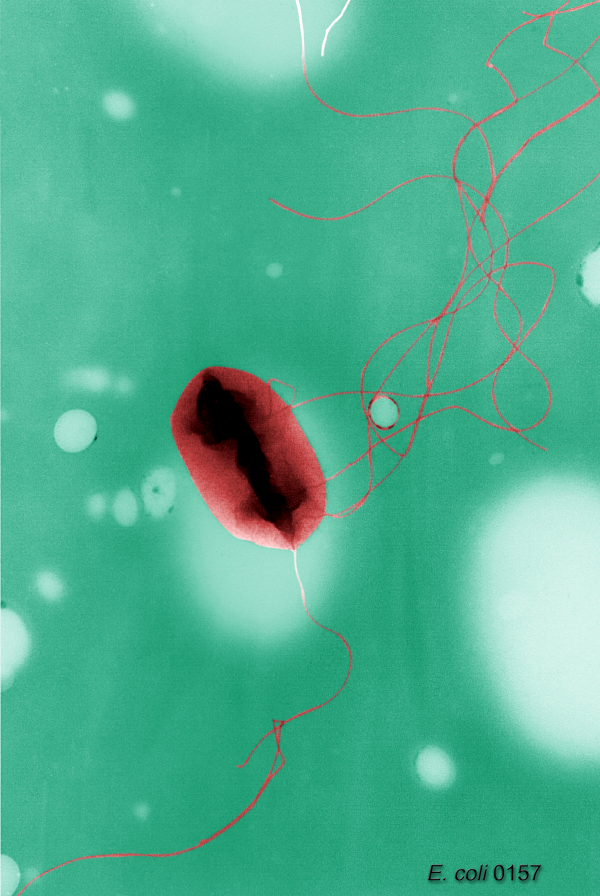
Image source: Wikipedia/Wikimedia
| Ecology, Host, and Life Cycle | |
|---|---|
| Oxygen requirements | Facultative anaerobe |
| Optimal temperature | 37 |
| Temperature range | Mesophilic |
| Habitat | HostAssociated |
| Biotic relationship | Free living |
| Host(s) | Homo sapiens, Gallus gallus, Bos taurus |
| Cell arrangement | Pairs - Singles |
| Sporulation | Not Available |
| Energy source | Not Available |
| Pathogenicity | Human |
Gene Summary
Adenine Count
1283364 bp
Thymine Count
1281198 bp
Guanine Count
1324998 bp
Cytosine Count
1318883 bp
Genome Length
5208446 bp
Protein-coding Genes
4697 genes
Non-Coding Genes
378 genes
# of Chromosomes/Plasmids
1
Genes
| Name | Locus Tag | UniProt ID | Strand Orientation | Gene Start/End | Protein Molecular Weight |
|---|---|---|---|---|---|
| Outer membrane protein lom precursor | SK85_00329 | Not Available | Negative | 349173 - 349772 | 21828.1 |
| Putative tail tip assembly protein | SK85_00330 | P03749 | Negative | 349842 - 350672 | 29143.7 |
| Putative transposase orfb | SK85_00331 | Not Available | Negative | 350924 - 351811 | 33679.1 |
| Putative transposase orfa protein of is629 | SK85_00332 | Not Available | Negative | 351811 - 352137 | 12644.0 |
| Attl | Not Available | Not Available | Positive | 894776 - 894789 | Not Available |
| Tyrosine-type recombinase/integrase | SK85_00851 | P06723 | Negative | 903562 - 904614 | 39957.7 |
| hypothetical protein | SK85_00852 | Not Available | Negative | 904803 - 904994 | 6775.33 |
| Repressor protein ci | SK85_00853 | P21323 | Negative | 905010 - 905579 | 21229.3 |
| Regulator | SK85_00854 | P21315 | Positive | 905705 - 905926 | 8336.26 |
| Regulatory cii family protein | SK85_00855 | P21316 | Positive | 905959 - 906468 | 18130.0 |
Pathways
0 pathways
No pathways found
No metabolic pathways have been associated with this bacterium yet.
Health Effects
| Health Condition | Relation | Reference |
|---|---|---|
| Gi disease | Causes | PMC11149725 |
| Utis | Causes | PMC11434687 |
| Colorectal cancer | Causes | PMC12198655 |
| Pyogenic liver abscesses | Causes | PMC12392612 |
| Uti | Causes | PMC13014981 |
| Colibacillosis | Causes | PMC13255289 |
| Enteric infections | Causes | PMC13255289 |
| Foodborne infections | Causes | PMC13255289 |
| Clinical mastitis | Causes | PMC13293316 |
| Diarrhea | Causes | PMC3035056 |