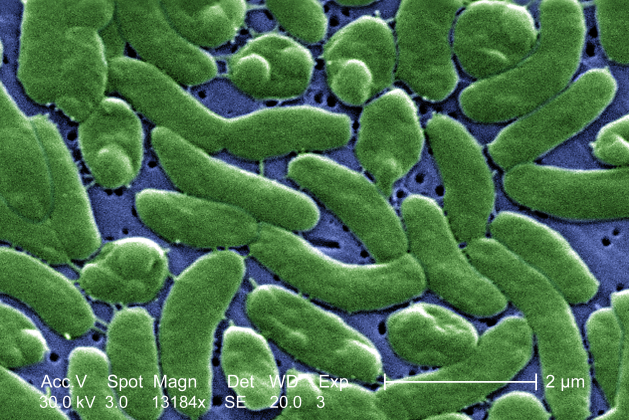
Vibrio vulnificus strain 101/4

Gram-negativeRodMotileFacultative anaerobe

Kingdom

Pseudomonadati

Phylum

Pseudomonadota

Class

Gammaproteobacteria

Order

Vibrionales

Family

Vibrionaceae

Genus

Vibrio

Description

Vibrio vulnificus strain 101/4 is a Gram-negative, rod-shaped bacterium that thrives in aquatic environments as a heterotrophic organism. This strain is characterized by its facultative anaerobic metabolism, allowing it to survive in both oxygen-rich and oxygen-poor conditions. It is motile, possessing flagella that facilitate movement, and typically exists as single cells. This strain is mesophilic, with an optimal growth temperature of 20°C, which supports its proliferation in warm marine and estuarine environments. The organism has a single replicon and is surrounded by two membranes, indicative of its classification within the Proteobacteria phylum. Vibrio vulnificus strain 101/4 exhibits a free-living biotic relationship, primarily interacting with various hosts, including Homo sapiens, Penaeus vannamei (Pacific white shrimp), Ostreidae (oysters), Tegillarca granosa (a species of clam), and Anguilla japonica (Japanese eel). Notably, this strain is pathogenic to humans, capable of causing severe health effects such as pneumonia, peritonitis, wound infections, septicaemia, necrotizing fasciitis, sepsis, vibriosis, gastroenteritis, septic shock, and myositis, among others. The severity of these infections can lead to life-threatening conditions, including necrotizing soft tissue infections and death. Ecologically, the presence of Vibrio vulnificus in aquatic habitats underscores the importance of monitoring environmental conditions, especially concerning public health risks associated with seafood consumption and exposure to contaminated water, particularly in warmer climates where the bacterium flourishes.

Taxonomy

KingdomPseudomonadati
PhylumPseudomonadota
ClassGammaproteobacteria
OrderVibrionales
FamilyVibrionaceae
GenusVibrio
SpeciesVibrio vulnificus
Strainstrain 101/4

Profile

Physiology
Gram staining propertiesNegative
ShapeRod
MobilityYes
Flagellar presenceYes
Number of membranes2
Image of Vibrio vulnificus strain 101/4
Image source: Wikipedia/Wikimedia
Ecology, Host, and Life Cycle
Oxygen requirementsFacultative anaerobe
Optimal temperature20
Temperature rangeMesophilic
HabitatAquatic
Biotic relationshipFree living
Host(s)Homo sapiens, Penaeus vannamei, Ostreidae
Cell arrangementSingles
SporulationNot Available
Energy sourceHeterotroph
PathogenicityHuman

Genome Summary

Vibrio vulnificus strain 101/4


Gene Summary

Adenine Count

1476179 bp

Thymine Count

1468962 bp

Guanine Count

1251224 bp

Cytosine Count

1288133 bp

Genome Length

5484498 bp

Protein-coding Genes

4697 genes

Non-Coding Genes

156 genes

# of Chromosomes/Plasmids

1

Genes

NameLocus TagUniProt IDStrand OrientationGene Start/EndProtein Molecular Weight
AttlNot AvailableNot AvailablePositive1746304 - 1746316Not Available
AttlNot AvailableNot AvailablePositive1747428 - 1747439Not Available
Hypothetical proteinJS86_07900Not AvailableNegative1748767 - 1761747478671.0
Hypothetical proteinJS86_07910Not AvailableNegative1763367 - 17636278827.69
Hypothetical proteinJS86_07915Not AvailableNegative1763631 - 176400213447.7
Hypothetical proteinJS86_07920Not AvailableNegative1764064 - 176472023356.8
Hypothetical proteinJS86_07925Not AvailableNegative1764721 - 176514916094.4
hypothetical proteinJS86_07930Not AvailableNegative1765121 - 176569021162.9
hypothetical proteinJS86_07935Not AvailableNegative1765707 - 176693944855.1
Putative tail tip fiber proteinJS86_07940Not AvailableNegative1766936 - 1769905103503.0

Displaying genes 1 – 10 of 4853 in total

Pathways

0 pathways

No pathways found

No metabolic pathways have been associated with this bacterium yet.

Metabolites

135 records
Metabolite IDMetabolite nameStructureCAS number
BASm0000217alpha-ribazoleC14H18N2O4Chemical structure of alpha-ribazoleNot available
Average278.3037Da
Monoisotopic278.126657074Da
BASm0000237(R)-4'-phosphopantothenateC9H18NO8PChemical structure of (R)-4'-phosphopantothenateNot available
Average299.2149Da
Monoisotopic299.0770031Da
BASm00002512-dehydropantoateC6H9O4Chemical structure of 2-dehydropantoateNot available
Average145.1333Da
Monoisotopic145.050083776Da
BASm0000274aldehydo-D-galacturonateC6H9O7Chemical structure of aldehydo-D-galacturonateNot available
Average193.132Da
Monoisotopic193.0353762Da
BASm0000377(S)-malateC4H4O5Chemical structure of (S)-malateNot available
Average132.0716Da
Monoisotopic132.005873238Da
BASm0000387(6R)-5,10-methylene-5,6,7,8-tetrahydrofolateC20H21N7O6Chemical structure of (6R)-5,10-methylene-5,6,7,8-tetrahydrofolateNot available
Average455.432Da
Monoisotopic455.1564286Da
BASm0000989GlycerolC3H8O3Chemical structure of Glycerol56-81-5
Average92.0938Da
Monoisotopic92.04734412Da
BASm0001111keto-D-tagaturonateC6H9O7Chemical structure of keto-D-tagaturonateNot available
Average193.132Da
Monoisotopic193.0353762Da
BASm0001279(6S)-5-methyl-5,6,7,8-tetrahydrofolateC20H23N7O6Chemical structure of (6S)-5-methyl-5,6,7,8-tetrahydrofolateNot available
Average457.4399Da
Monoisotopic457.1709815Da
BASm0001697(S)-4,5-dihydroxypentane-2,3-dioneC5H8O4Chemical structure of (S)-4,5-dihydroxypentane-2,3-dioneNot available
Average132.1146Da
Monoisotopic132.042258744Da

Displaying 1–10 of 135 metabolites

Health Effects

Health ConditionRelationReference
VibriosisCausesPMC10472736
PneumoniaCausesPMC12801787
Wound infectionsCausesPMC13070559
SepticemiaCausesPMC13070559
Necrotizing soft tissue infectionCausesPMC13070559
Primary septicemiaCausesPMC13070559
PeritonitisCausesPMC7146884
SepticemiaCausesPMC7146884
MyositisCausesPMC7146884
Necrotizing fasciitisCausesPMC7146884

Displaying health effects 1 – 10 of 20 in total