
Kingdom
Pseudomonadati
Phylum
Pseudomonadota
Class
Betaproteobacteria
Order
Burkholderiales
Family
Burkholderiaceae
Genus
Burkholderia
Description
Taxonomy
| Kingdom | Pseudomonadati |
|---|---|
| Phylum | Pseudomonadota |
| Class | Betaproteobacteria |
| Order | Burkholderiales |
| Family | Burkholderiaceae |
| Genus | Burkholderia |
| Species | Burkholderia cepacia |
| Strain | strain DWS 37UF10B-2 |
Profile
| Physiology | |
|---|---|
| Gram staining properties | Negative |
| Shape | Not Available |
| Mobility | Not Available |
| Flagellar presence | Not Available |
| Number of membranes | Not Available |
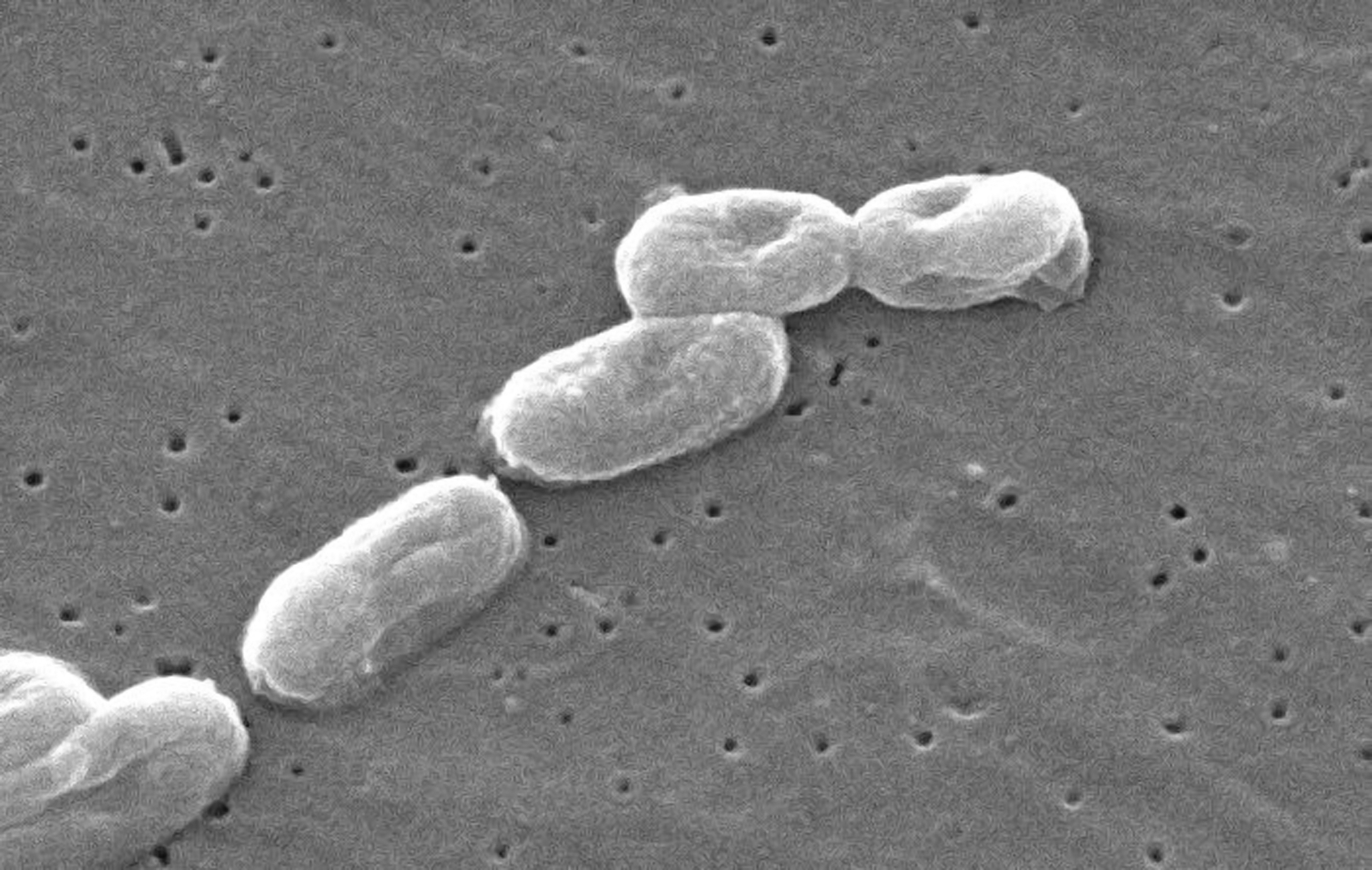
Image source: Wikipedia/Wikimedia
| Ecology, Host, and Life Cycle | |
|---|---|
| Oxygen requirements | Microaerophile |
| Optimal temperature | Not Available |
| Temperature range | Not Available |
| Habitat | rhizosphere |
| Biotic relationship | Not Available |
| Host(s) | Homo sapiens, Viridiplantae, Anura |
| Cell arrangement | Not Available |
| Sporulation | Not Available |
| Energy source | Not Available |
| Pathogenicity | Not Available |
Gene Summary
Adenine Count
1178948 bp
Thymine Count
1174996 bp
Guanine Count
2415790 bp
Cytosine Count
2412297 bp
Genome Length
7182032 bp
Protein-coding Genes
6340 genes
Non-Coding Genes
130 genes
# of Chromosomes/Plasmids
1
Genes
| Name | Locus Tag | UniProt ID | Strand Orientation | Gene Start/End | Protein Molecular Weight |
|---|---|---|---|---|---|
| n-(5'phosphoribosyl)anthranilate (pra) isomerase family protein | DM43_1264 | Not Available | Negative | 5958179 - 5958880 | 24502.3 |
| trna pseudouridine(38-40) synthase | DM43_1265 | Not Available | Negative | 5958877 - 5959689 | 30120.8 |
| putative fimv c-domain protein | DM43_1266 | Not Available | Negative | 5959689 - 5960705 | 34353.4 |
| flagellar hook-basal body family protein | DM43_1267 | Not Available | Positive | 5962627 - 5963871 | 42662.4 |
| aspartate-semialdehyde dehydrogenase | DM43_1268 | Not Available | Negative | 5963983 - 5965104 | 40254.9 |
| 3-isopropylmalate dehydrogenase | DM43_1269 | Not Available | Negative | 5965428 - 5966495 | 38250.0 |
| 3-isopropylmalate dehydratase, small subunit | DM43_1270 | Not Available | Negative | 5966569 - 5967219 | 24634.3 |
| entericidin ecna/b family protein | DM43_1271 | Not Available | Negative | 5967285 - 5967431 | 4692.73 |
| 3-isopropylmalate dehydratase, large subunit | DM43_1272 | Not Available | Negative | 5967435 - 5968844 | 50750.7 |
| putative tat (twin-arginine translocation) pathway signal sequence domain protein | DM43_1273 | Not Available | Negative | 5969121 - 5969879 | 25637.6 |
Pathways
1357 pathways
Health Effects
| Health Condition | Relation | Reference |
|---|---|---|
| Infective endocarditis | Causes | PMC3112426 |
| Native valve endocarditis | Causes | PMC3112426 |
| Pneumonia | Causes | PMC9294674 |



