
Kingdom
Pseudomonadati
Phylum
Pseudomonadota
Class
Betaproteobacteria
Order
Burkholderiales
Family
Burkholderiaceae
Genus
Burkholderia
Description
Taxonomy
| Kingdom | Pseudomonadati |
|---|---|
| Phylum | Pseudomonadota |
| Class | Betaproteobacteria |
| Order | Burkholderiales |
| Family | Burkholderiaceae |
| Genus | Burkholderia |
| Species | Burkholderia cepacia |
| Strain | strain DWS 37UF10B-2 |
Profile
| Physiology | |
|---|---|
| Gram staining properties | Negative |
| Shape | Not Available |
| Mobility | Not Available |
| Flagellar presence | Not Available |
| Number of membranes | Not Available |
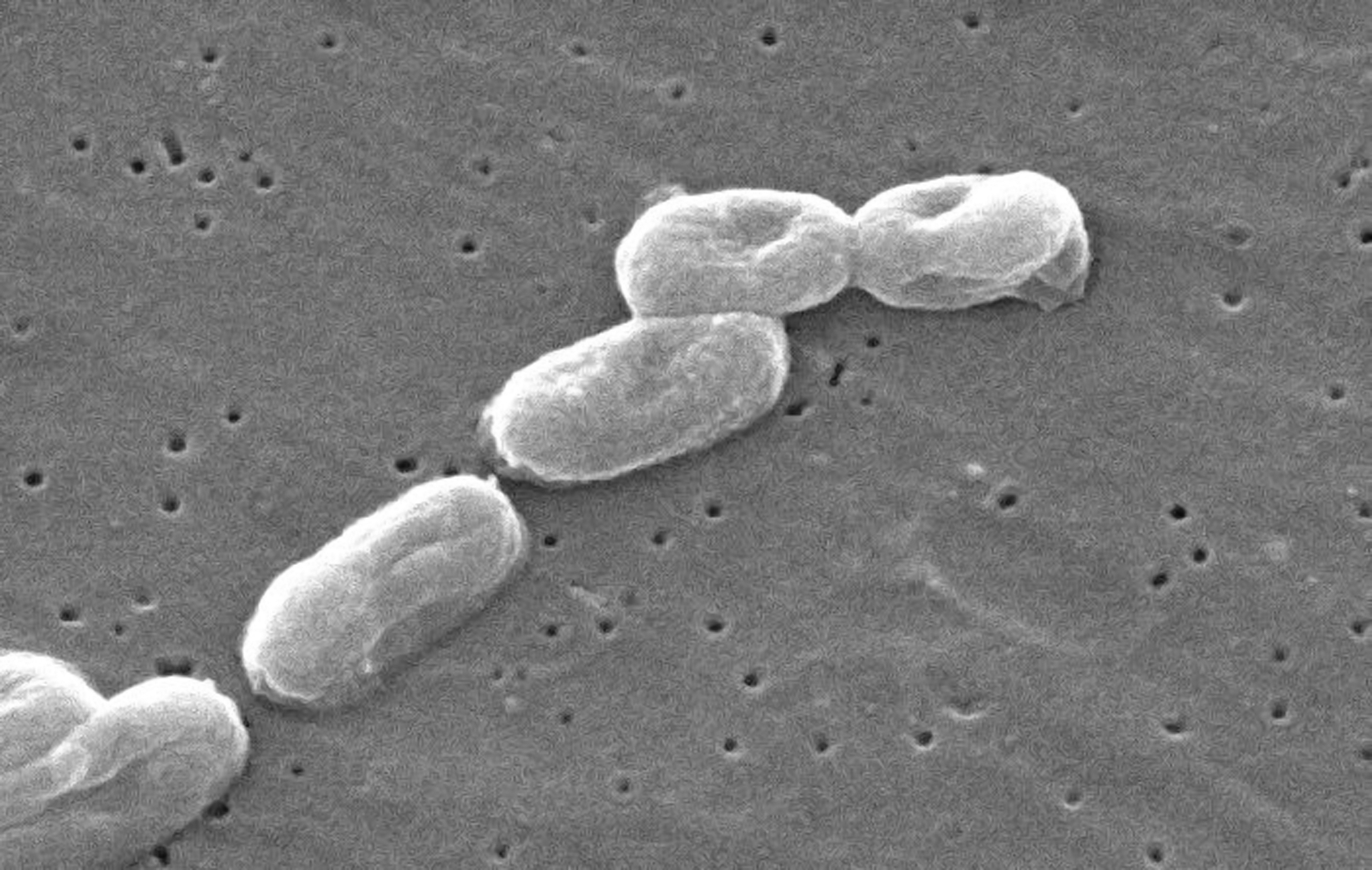
Image source: Wikipedia/Wikimedia
| Ecology, Host, and Life Cycle | |
|---|---|
| Oxygen requirements | Microaerophile |
| Optimal temperature | Not Available |
| Temperature range | Not Available |
| Habitat | rhizosphere |
| Biotic relationship | Not Available |
| Host(s) | Homo sapiens, Viridiplantae, Anura |
| Cell arrangement | Not Available |
| Sporulation | Not Available |
| Energy source | Not Available |
| Pathogenicity | Not Available |
Gene Summary
Adenine Count
1178948 bp
Thymine Count
1174996 bp
Guanine Count
2415790 bp
Cytosine Count
2412297 bp
Genome Length
7182032 bp
Protein-coding Genes
6340 genes
Non-Coding Genes
130 genes
# of Chromosomes/Plasmids
1
Genes
| Name | Locus Tag | UniProt ID | Strand Orientation | Gene Start/End | Protein Molecular Weight |
|---|---|---|---|---|---|
| chemotaxis phosphatase chex family protein | DM43_1174 | Not Available | Negative | 5850712 - 5851671 | 35487.5 |
| hypothetical protein | DM43_1175 | Not Available | Negative | 5851694 - 5852272 | 20489.3 |
| methyl-accepting chemotaxis (mcp) signaling domain protein | DM43_1176 | Not Available | Negative | 5852269 - 5853009 | 26030.8 |
| hamp domain protein | DM43_1177 | Not Available | Negative | 5853020 - 5855407 | 86152.6 |
| pin domain protein | DM43_1178 | Not Available | Negative | 5855809 - 5856216 | 14782.8 |
| antidote-toxin recognition maze family protein | DM43_1179 | Not Available | Negative | 5856213 - 5856455 | 8863.43 |
| phospholipase/carboxylesterase family protein | DM43_1180 | Not Available | Positive | 5856713 - 5857402 | 24135.0 |
| amino acid permease family protein | DM43_1181 | Not Available | Negative | 5857460 - 5858965 | 53269.0 |
| aspartate ammonia-lyase | DM43_1182 | Not Available | Negative | 5859069 - 5860475 | 50383.6 |
| bacterial regulatory helix-turn-helix, lysr family protein | DM43_1183 | Not Available | Positive | 5860617 - 5861591 | 35797.0 |
Pathways
1357 pathways
Health Effects
| Health Condition | Relation | Reference |
|---|---|---|
| Infective endocarditis | Causes | PMC3112426 |
| Native valve endocarditis | Causes | PMC3112426 |
| Pneumonia | Causes | PMC9294674 |



