
Kingdom
Pseudomonadati
Phylum
Pseudomonadota
Class
Betaproteobacteria
Order
Burkholderiales
Family
Burkholderiaceae
Genus
Burkholderia
Description
Taxonomy
| Kingdom | Pseudomonadati |
|---|---|
| Phylum | Pseudomonadota |
| Class | Betaproteobacteria |
| Order | Burkholderiales |
| Family | Burkholderiaceae |
| Genus | Burkholderia |
| Species | Burkholderia cepacia |
| Strain | strain DWS 37UF10B-2 |
Profile
| Physiology | |
|---|---|
| Gram staining properties | Negative |
| Shape | Not Available |
| Mobility | Not Available |
| Flagellar presence | Not Available |
| Number of membranes | Not Available |
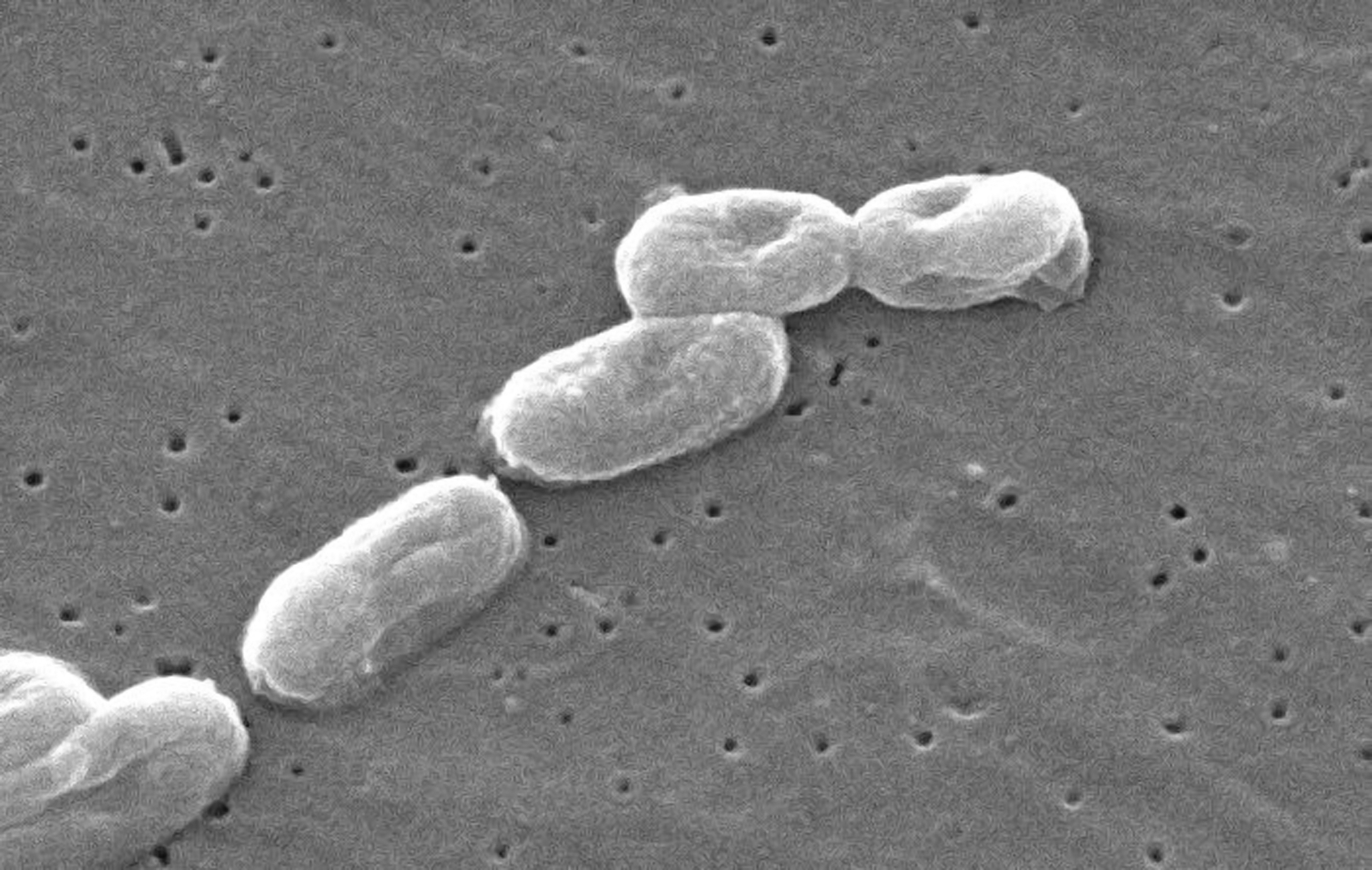
Image source: Wikipedia/Wikimedia
| Ecology, Host, and Life Cycle | |
|---|---|
| Oxygen requirements | Microaerophile |
| Optimal temperature | Not Available |
| Temperature range | Not Available |
| Habitat | rhizosphere |
| Biotic relationship | Not Available |
| Host(s) | Homo sapiens, Viridiplantae, Anura |
| Cell arrangement | Not Available |
| Sporulation | Not Available |
| Energy source | Not Available |
| Pathogenicity | Not Available |
Gene Summary
Adenine Count
1178948 bp
Thymine Count
1174996 bp
Guanine Count
2415790 bp
Cytosine Count
2412297 bp
Genome Length
7182032 bp
Protein-coding Genes
6340 genes
Non-Coding Genes
130 genes
# of Chromosomes/Plasmids
1
Genes
| Name | Locus Tag | UniProt ID | Strand Orientation | Gene Start/End | Protein Molecular Weight |
|---|---|---|---|---|---|
| 4-hydroxyphenylacetate degradation bifunctional isomerase/decarboxylase | DM43_1014 | Not Available | Negative | 5655028 - 5655717 | 23257.0 |
| homoprotocatechuate degradation operon regulator, hpar | DM43_1015 | Not Available | Positive | 5655870 - 5656310 | 16855.5 |
| nad dependent epimerase/dehydratase family protein | DM43_1016 | Not Available | Negative | 5656366 - 5657577 | 43138.0 |
| hypothetical protein | DM43_1017 | Not Available | Positive | 5658228 - 5658575 | 12611.8 |
| penicillin binding transpeptidase domain protein | DM43_1018 | Not Available | Positive | 5658993 - 5660888 | 67880.6 |
| fimbrial family protein | DM43_1019 | Not Available | Negative | 5661107 - 5662141 | 36487.2 |
| ketopantoate reductase pane/apba family protein | DM43_1020 | Not Available | Negative | 5662775 - 5664490 | 59653.8 |
| gluconate 2-dehydrogenase cytochrome c subunit | DM43_1021 | Not Available | Negative | 5664690 - 5666096 | 49807.1 |
| gluconate 2-dehydrogenase flavoprotein | DM43_1022 | Not Available | Negative | 5666093 - 5667871 | 65020.0 |
| gluconate 2-dehydrogenase subunit 3 family protein | DM43_1023 | Not Available | Negative | 5667871 - 5668611 | 26536.3 |
Pathways
1357 pathways
Health Effects
| Health Condition | Relation | Reference |
|---|---|---|
| Infective endocarditis | Causes | PMC3112426 |
| Native valve endocarditis | Causes | PMC3112426 |
| Pneumonia | Causes | PMC9294674 |



