
Kingdom
Pseudomonadati
Phylum
Pseudomonadota
Class
Betaproteobacteria
Order
Burkholderiales
Family
Burkholderiaceae
Genus
Burkholderia
Description
Taxonomy
| Kingdom | Pseudomonadati |
|---|---|
| Phylum | Pseudomonadota |
| Class | Betaproteobacteria |
| Order | Burkholderiales |
| Family | Burkholderiaceae |
| Genus | Burkholderia |
| Species | Burkholderia cepacia |
| Strain | strain DWS 37UF10B-2 |
Profile
| Physiology | |
|---|---|
| Gram staining properties | Negative |
| Shape | Not Available |
| Mobility | Not Available |
| Flagellar presence | Not Available |
| Number of membranes | Not Available |
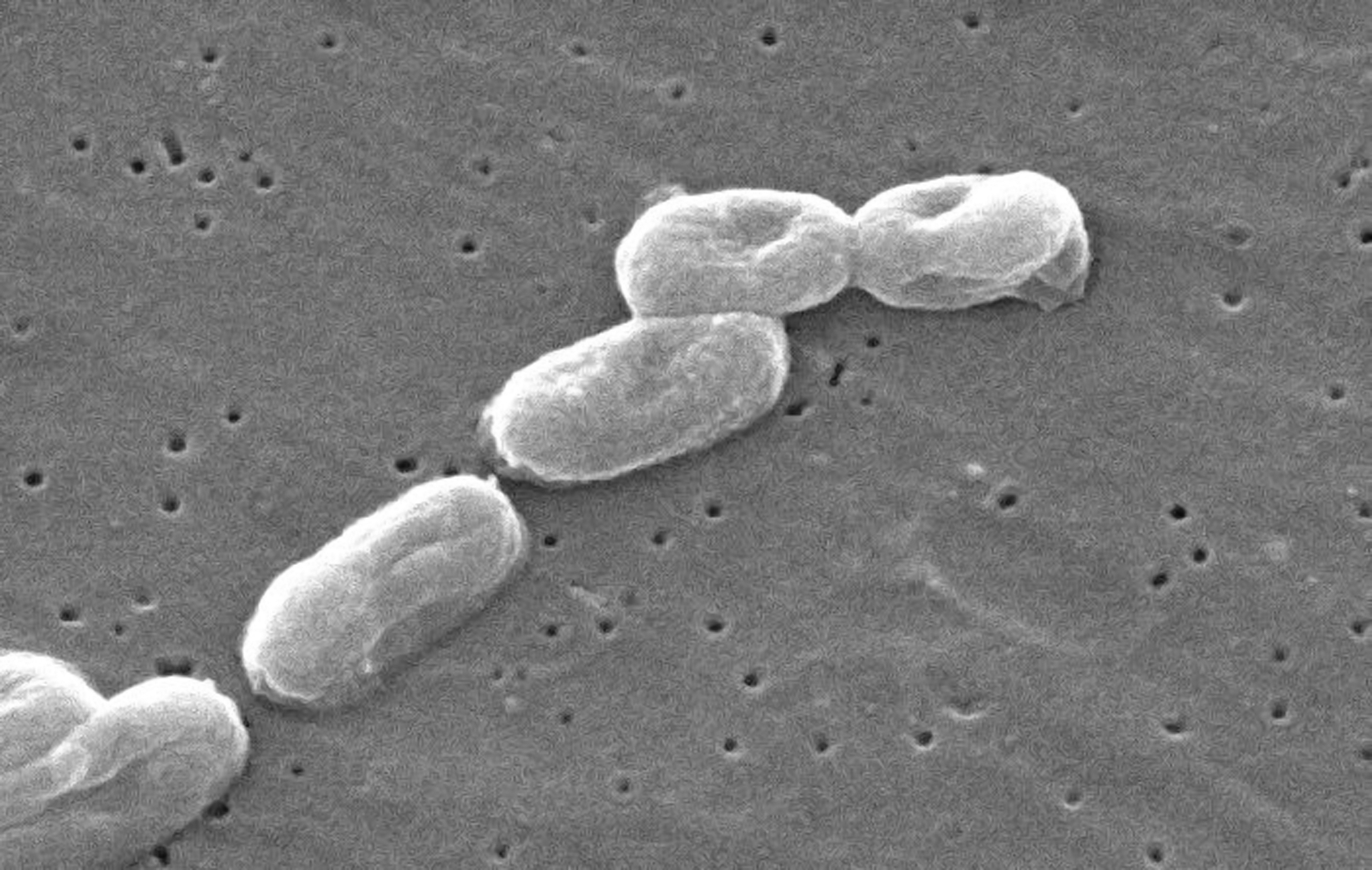
Image source: Wikipedia/Wikimedia
| Ecology, Host, and Life Cycle | |
|---|---|
| Oxygen requirements | Microaerophile |
| Optimal temperature | Not Available |
| Temperature range | Not Available |
| Habitat | rhizosphere |
| Biotic relationship | Not Available |
| Host(s) | Homo sapiens, Viridiplantae, Anura |
| Cell arrangement | Not Available |
| Sporulation | Not Available |
| Energy source | Not Available |
| Pathogenicity | Not Available |
Gene Summary
Adenine Count
1178948 bp
Thymine Count
1174996 bp
Guanine Count
2415790 bp
Cytosine Count
2412297 bp
Genome Length
7182032 bp
Protein-coding Genes
6340 genes
Non-Coding Genes
130 genes
# of Chromosomes/Plasmids
1
Genes
| Name | Locus Tag | UniProt ID | Strand Orientation | Gene Start/End | Protein Molecular Weight |
|---|---|---|---|---|---|
| short chain dehydrogenase family protein | DM43_924 | Not Available | Positive | 5551877 - 5552683 | 27901.8 |
| hypothetical protein | DM43_925 | Not Available | Positive | 5552719 - 5553651 | 33758.7 |
| major facilitator superfamily protein | DM43_926 | Not Available | Positive | 5553847 - 5555175 | 46570.5 |
| short-chain fatty acids transporter | DM43_927 | Not Available | Negative | 5555240 - 5556562 | 46628.2 |
| hypothetical protein | DM43_928 | Not Available | Negative | 5556905 - 5557252 | 13139.6 |
| hypothetical protein | DM43_929 | Not Available | Negative | 5557245 - 5557682 | 15886.8 |
| voltage gated chloride channel family protein | DM43_930 | Not Available | Negative | 5557958 - 5559229 | 43271.9 |
| amidohydrolase family protein | DM43_931 | Not Available | Negative | 5559457 - 5560698 | 45511.5 |
| gram-negative porin family protein | DM43_932 | Not Available | Positive | 5561034 - 5562176 | 39763.2 |
| hypothetical protein | DM43_933 | Not Available | Positive | 5562428 - 5562730 | 10298.2 |
Pathways
1357 pathways
Health Effects
| Health Condition | Relation | Reference |
|---|---|---|
| Infective endocarditis | Causes | PMC3112426 |
| Native valve endocarditis | Causes | PMC3112426 |
| Pneumonia | Causes | PMC9294674 |



