
Kingdom
Pseudomonadati
Phylum
Pseudomonadota
Class
Betaproteobacteria
Order
Burkholderiales
Family
Burkholderiaceae
Genus
Burkholderia
Description
Taxonomy
| Kingdom | Pseudomonadati |
|---|---|
| Phylum | Pseudomonadota |
| Class | Betaproteobacteria |
| Order | Burkholderiales |
| Family | Burkholderiaceae |
| Genus | Burkholderia |
| Species | Burkholderia cepacia |
| Strain | strain DWS 37UF10B-2 |
Profile
| Physiology | |
|---|---|
| Gram staining properties | Negative |
| Shape | Not Available |
| Mobility | Not Available |
| Flagellar presence | Not Available |
| Number of membranes | Not Available |
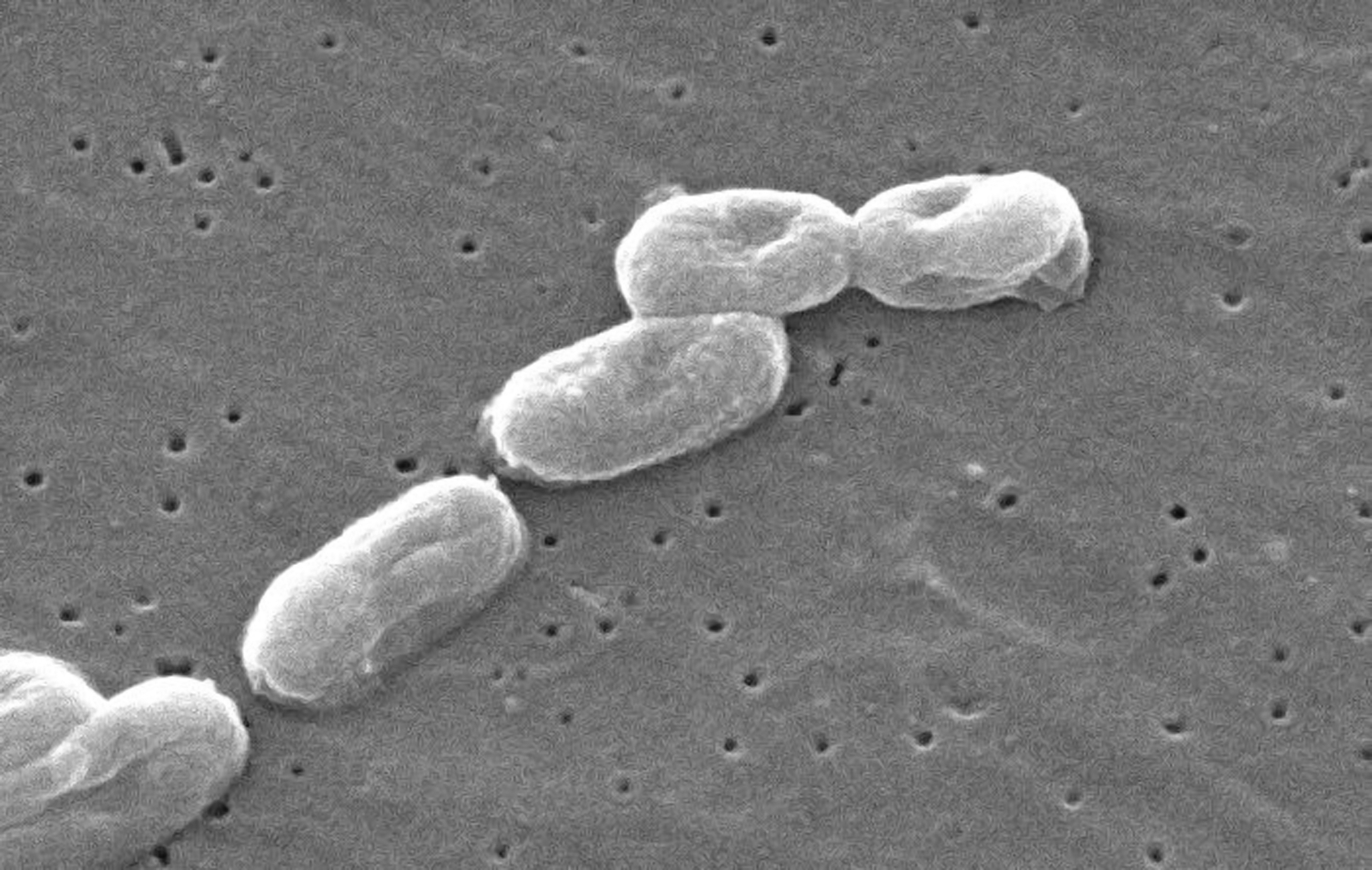
Image source: Wikipedia/Wikimedia
| Ecology, Host, and Life Cycle | |
|---|---|
| Oxygen requirements | Microaerophile |
| Optimal temperature | Not Available |
| Temperature range | Not Available |
| Habitat | rhizosphere |
| Biotic relationship | Not Available |
| Host(s) | Homo sapiens, Viridiplantae, Anura |
| Cell arrangement | Not Available |
| Sporulation | Not Available |
| Energy source | Not Available |
| Pathogenicity | Not Available |
Gene Summary
Adenine Count
1178948 bp
Thymine Count
1174996 bp
Guanine Count
2415790 bp
Cytosine Count
2412297 bp
Genome Length
7182032 bp
Protein-coding Genes
6340 genes
Non-Coding Genes
130 genes
# of Chromosomes/Plasmids
1
Genes
| Name | Locus Tag | UniProt ID | Strand Orientation | Gene Start/End | Protein Molecular Weight |
|---|---|---|---|---|---|
| hypothetical protein | DM43_4232 | Not Available | Negative | 4440512 - 4441252 | 27583.6 |
| toxic anion resistance family protein | DM43_4233 | Not Available | Negative | 4441273 - 4442370 | 40312.7 |
| putative transmembrane protein | DM43_4234 | Not Available | Negative | 4442714 - 4444003 | 46098.5 |
| paar motif family protein | DM43_4235 | Not Available | Negative | 4444097 - 4444360 | 8737.47 |
| putative transmembrane protein | DM43_4236 | Not Available | Negative | 4444370 - 4445851 | 53475.4 |
| hypothetical protein | DM43_4237 | Not Available | Negative | 4445848 - 4448109 | 84619.4 |
| rhs element vgr family protein | DM43_4238 | Not Available | Negative | 4448133 - 4450910 | 99329.4 |
| lyse type translocator family protein | DM43_4239 | Not Available | Negative | 4451329 - 4451958 | 21939.5 |
| ferrichrome receptor fcua | DM43_4240 | Not Available | Positive | 4452429 - 4454477 | 73260.2 |
| Trna-ser | Not Available | Not Available | Positive | 4454535 - 4454625 | Not Available |
Pathways
1357 pathways
Health Effects
| Health Condition | Relation | Reference |
|---|---|---|
| Infective endocarditis | Causes | PMC3112426 |
| Native valve endocarditis | Causes | PMC3112426 |
| Pneumonia | Causes | PMC9294674 |



