
Kingdom
Pseudomonadati
Phylum
Pseudomonadota
Class
Gammaproteobacteria
Order
Moraxellales
Family
Moraxellaceae
Genus
Acinetobacter
Description
Taxonomy
| Kingdom | Pseudomonadati |
|---|---|
| Phylum | Pseudomonadota |
| Class | Gammaproteobacteria |
| Order | Moraxellales |
| Family | Moraxellaceae |
| Genus | Acinetobacter |
| Species | Acinetobacter baumannii |
| Strain | 99063 |
Profile
| Physiology | |
|---|---|
| Gram staining properties | Negative |
| Shape | Rod |
| Mobility | No |
| Flagellar presence | Yes |
| Number of membranes | 2 |
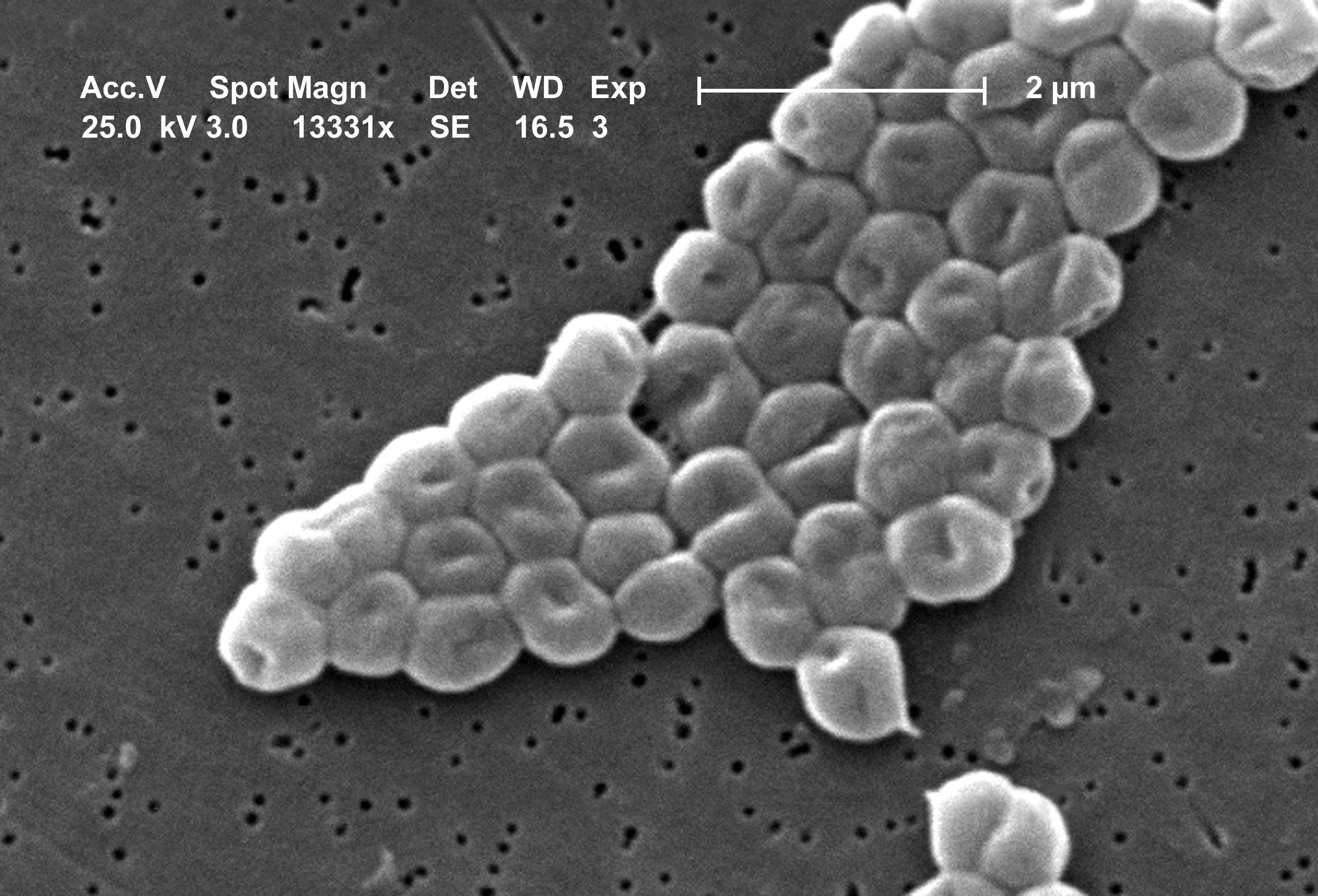
Image source: Wikipedia/Wikimedia
| Ecology, Host, and Life Cycle | |
|---|---|
| Oxygen requirements | Aerobe |
| Optimal temperature | 37 |
| Temperature range | Mesophilic |
| Habitat | Multiple |
| Biotic relationship | Free living |
| Host(s) | Not Available |
| Cell arrangement | Singles |
| Sporulation | Not Available |
| Energy source | Heterotroph - Chemoheterotroph |
| Pathogenicity | Not Available |
Gene Summary
Adenine Count
1346822 bp
Thymine Count
1343934 bp
Guanine Count
862067 bp
Cytosine Count
864389 bp
Genome Length
4417212 bp
Protein-coding Genes
4563 genes
Non-Coding Genes
234 genes
# of Chromosomes/Plasmids
1
Genes
| Name | Locus Tag | UniProt ID | Strand Orientation | Gene Start/End | Protein Molecular Weight |
|---|---|---|---|---|---|
| 2,3-dihydro-2,3-dihydroxybenzoate dehydrogenase | J529_2360 | Not Available | Positive | 2431553 - 2432323 | 27968.8 |
| isochorismatase family protein | J529_2361 | Not Available | Positive | 2432396 - 2433037 | 24335.2 |
| ferric uptake regulator family protein | J529_2362 | Not Available | Positive | 2433565 - 2433966 | 15175.7 |
| calcineurin-like phosphoesterase family protein | J529_2363 | Not Available | Negative | 2434034 - 2435767 | 61572.8 |
| polyphosphate kinase 1 | J529_2364 | Not Available | Positive | 2436215 - 2438197 | 75044.0 |
| coenzyme pqq peptide pqqa | J529_2365 | Not Available | Positive | 2438364 - 2438495 | 5241.53 |
| coenzyme pqq biosynthesis protein b | J529_2366 | Not Available | Positive | 2438571 - 2439482 | 33699.3 |
| coenzyme pqq biosynthesis protein c | J529_2367 | Not Available | Positive | 2439491 - 2440249 | 29667.1 |
| coenzyme pqq biosynthesis protein pqqd | J529_2368 | Not Available | Positive | 2440246 - 2440530 | 10762.8 |
| coenzyme pqq biosynthesis enzyme pqqe | J529_2369 | Not Available | Positive | 2440527 - 2441681 | 43884.3 |
Pathways
0 pathways
No pathways found
No metabolic pathways have been associated with this bacterium yet.
Health Effects
No health effects information available for this bacterium.

