Kingdom
Pseudomonadati
Phylum
Spirochaetota
Class
Spirochaetia
Order
Spirochaetales
Family
Treponemataceae
Genus
Treponema
Description
Taxonomy
| Kingdom | Pseudomonadati |
|---|---|
| Phylum | Spirochaetota |
| Class | Spirochaetia |
| Order | Spirochaetales |
| Family | Treponemataceae |
| Genus | Treponema |
| Species | Treponema bryantii |
| Strain | strain XBD1002 |
Profile
| Physiology | |
|---|---|
| Gram staining properties | Negative |
| Shape | Spirilla |
| Mobility | Yes |
| Flagellar presence | Yes |
| Number of membranes | Not Available |

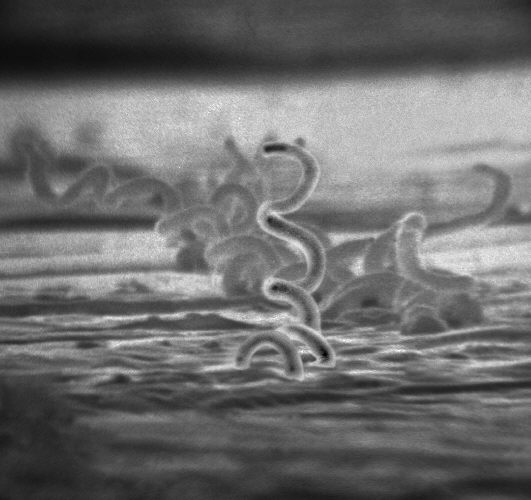
AI-generated image based on bacteria physiology
| Ecology, Host, and Life Cycle | |
|---|---|
| Oxygen requirements | Anaerobic |
| Optimal temperature | 37 |
| Temperature range | Mesophilic |
| Habitat | Animal intestinal microflora |
| Biotic relationship | Not Available |
| Host(s) | Bos taurus, Equidae |
| Cell arrangement | Not Available |
| Sporulation | Nonsporulating |
| Energy source | Chemoheterotroph |
| Pathogenicity | Not Available |
Gene Summary
Adenine Count
958160 bp
Thymine Count
957500 bp
Guanine Count
646558 bp
Cytosine Count
629127 bp
Genome Length
3191470 bp
Protein-coding Genes
2751 genes
Non-Coding Genes
69 genes
# of Chromosomes/Plasmids
1
Genes
| Name | Locus Tag | UniProt ID | Strand Orientation | Gene Start/End | Protein Molecular Weight |
|---|---|---|---|---|---|
| 4fe-4s binding domain-containing protein | SAMN04487775_10860 | Not Available | Negative | 2466744 - 2467502 | 28371.2 |
| transposase | SAMN04487775_10861 | Not Available | Positive | 2467827 - 2468936 | 42180.9 |
| methyl-accepting chemotaxis sensory transducer with cache sensor | SAMN04487775_10862 | Not Available | Positive | 2468984 - 2471185 | 80971.4 |
| hypothetical protein | SAMN04487775_10863 | Not Available | Positive | 2471262 - 2472299 | 38530.6 |
| cdp-diacylglycerol---serine o-phosphatidyltransferase | SAMN04487775_10864 | Not Available | Positive | 2472296 - 2473006 | 26415.3 |
| phosphatidylserine decarboxylase | SAMN04487775_10865 | Not Available | Positive | 2473007 - 2473819 | 30344.1 |
| undecaprenyl-diphosphatase | SAMN04487775_10866 | Not Available | Positive | 2473833 - 2474459 | 23213.4 |
| nadh-fmn oxidoreductase rutf, flavin reductase (dim6/ntab) family | SAMN04487775_10867 | Not Available | Negative | 2474463 - 2475020 | 20254.2 |
| phosphoglycolate phosphatase | SAMN04487775_10868 | Not Available | Negative | 2475037 - 2475666 | 23881.7 |
| trna pseudouridine32 synthase / 23s rrna pseudouridine746 synthase | SAMN04487775_10869 | Not Available | Negative | 2475731 - 2477122 | 51933.8 |
Pathways
0 pathways
No pathways found
No metabolic pathways have been associated with this bacterium yet.
Health Effects
No health effects information available for this bacterium.