Kingdom
Pseudomonadati
Phylum
Spirochaetota
Class
Spirochaetia
Order
Spirochaetales
Family
Treponemataceae
Genus
Treponema
Description
Taxonomy
| Kingdom | Pseudomonadati |
|---|---|
| Phylum | Spirochaetota |
| Class | Spirochaetia |
| Order | Spirochaetales |
| Family | Treponemataceae |
| Genus | Treponema |
| Species | Treponema bryantii |
| Strain | strain XBD1002 |
Profile
| Physiology | |
|---|---|
| Gram staining properties | Negative |
| Shape | Spirilla |
| Mobility | Yes |
| Flagellar presence | Yes |
| Number of membranes | Not Available |

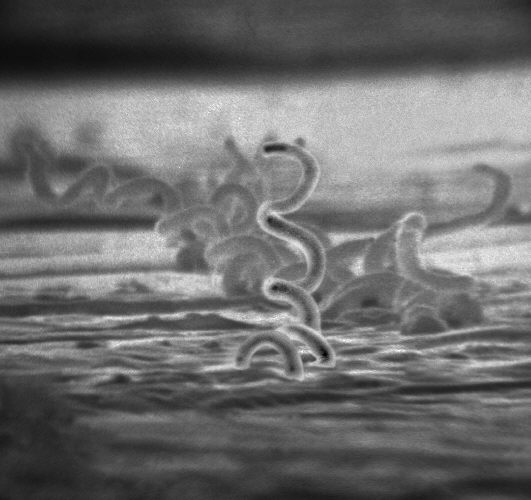
AI-generated image based on bacteria physiology
| Ecology, Host, and Life Cycle | |
|---|---|
| Oxygen requirements | Anaerobic |
| Optimal temperature | 37 |
| Temperature range | Mesophilic |
| Habitat | Animal intestinal microflora |
| Biotic relationship | Not Available |
| Host(s) | Bos taurus, Equidae |
| Cell arrangement | Not Available |
| Sporulation | Nonsporulating |
| Energy source | Chemoheterotroph |
| Pathogenicity | Not Available |
Gene Summary
Adenine Count
958160 bp
Thymine Count
957500 bp
Guanine Count
646558 bp
Cytosine Count
629127 bp
Genome Length
3191470 bp
Protein-coding Genes
2751 genes
Non-Coding Genes
69 genes
# of Chromosomes/Plasmids
1
Genes
| Name | Locus Tag | UniProt ID | Strand Orientation | Gene Start/End | Protein Molecular Weight |
|---|---|---|---|---|---|
| dna-binding transcriptional regulator, laci/purr family | SAMN04487775_10840 | Not Available | Negative | 2437414 - 2439510 | 79666.6 |
| two component transcriptional regulator, luxr family | SAMN04487775_10841 | Not Available | Positive | 2439558 - 2440208 | 24046.2 |
| two-component system, chemotaxis family, response regulator chey | SAMN04487775_10842 | Not Available | Negative | 2440273 - 2440707 | 15971.6 |
| chemotaxis protein chex | SAMN04487775_10843 | Not Available | Negative | 2440730 - 2441212 | 17159.9 |
| purine-binding chemotaxis protein chew | SAMN04487775_10844 | Not Available | Negative | 2441239 - 2442660 | 52479.4 |
| two-component system, chemotaxis family, sensor kinase chea | SAMN04487775_10845 | Not Available | Negative | 2442675 - 2445149 | 89894.0 |
| hypothetical protein | SAMN04487775_10846 | Not Available | Positive | 2445321 - 2446532 | 45158.5 |
| mfs transporter, ofa family, oxalate/formate antiporter | SAMN04487775_10847 | Not Available | Positive | 2446573 - 2447916 | 47892.5 |
| diguanylate cyclase (ggdef) domain-containing protein | SAMN04487775_10848 | Not Available | Negative | 2447990 - 2451424 | 128751.0 |
| uncharacterized conserved protein, contains fist_n domain | SAMN04487775_10849 | Not Available | Negative | 2451432 - 2452544 | 41373.0 |
Pathways
0 pathways
No pathways found
No metabolic pathways have been associated with this bacterium yet.
Health Effects
No health effects information available for this bacterium.