Kingdom
Pseudomonadati
Phylum
Spirochaetota
Class
Spirochaetia
Order
Spirochaetales
Family
Treponemataceae
Genus
Treponema
Description
Taxonomy
| Kingdom | Pseudomonadati |
|---|---|
| Phylum | Spirochaetota |
| Class | Spirochaetia |
| Order | Spirochaetales |
| Family | Treponemataceae |
| Genus | Treponema |
| Species | Treponema bryantii |
| Strain | strain XBD1002 |
Profile
| Physiology | |
|---|---|
| Gram staining properties | Negative |
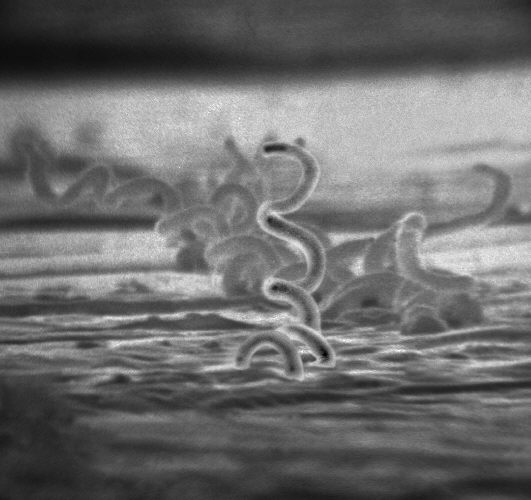
| Shape | Spirilla |
| Mobility | Yes |
| Flagellar presence | Yes |
| Number of membranes | Not Available |

AI-generated image based on bacteria physiology
| Ecology, Host, and Life Cycle | |
|---|---|
| Oxygen requirements | Anaerobic |
| Optimal temperature | 37 |
| Temperature range | Mesophilic |
| Habitat | Animal intestinal microflora |
| Biotic relationship | Not Available |
| Host(s) | Bos taurus, Equidae |
| Cell arrangement | Not Available |
| Sporulation | Nonsporulating |
| Energy source | Chemoheterotroph |
| Pathogenicity | Not Available |
Gene Summary
Adenine Count
958160 bp
Thymine Count
957500 bp
Guanine Count
646558 bp
Cytosine Count
629127 bp
Genome Length
3191470 bp
Protein-coding Genes
2751 genes
Non-Coding Genes
69 genes
# of Chromosomes/Plasmids
1
Genes
| Name | Locus Tag | UniProt ID | Strand Orientation | Gene Start/End | Protein Molecular Weight |
|---|---|---|---|---|---|
| glucose-6-phosphate isomerase | SAMN04487775_10589 | Not Available | Positive | 1739953 - 1741536 | 57146.2 |
| 4fe-4s binding domain-containing protein | SAMN04487775_10590 | Not Available | Negative | 1741692 - 1742528 | 30704.9 |
| thiol-disulfide isomerase or thioredoxin | SAMN04487775_10591 | Not Available | Negative | 1742690 - 1743223 | 19801.2 |
| transcriptional regulator, argr family | SAMN04487775_10592 | Not Available | Positive | 1743363 - 1743833 | 17180.6 |
| threonine synthase | SAMN04487775_10593 | Not Available | Positive | 1743895 - 1745205 | 48171.5 |
| pimeloyl-acp methyl ester carboxylesterase | SAMN04487775_10594 | Not Available | Negative | 1745195 - 1746775 | 59595.5 |
| alpha amylase, catalytic domain | SAMN04487775_10595 | Not Available | Negative | 1746896 - 1750606 | 141307.0 |
| 4-alpha-glucanotransferase | SAMN04487775_10596 | Not Available | Negative | 1750675 - 1752666 | 75931.7 |
| putative pyruvate formate lyase activating enzyme | SAMN04487775_10597 | Not Available | Negative | 1752740 - 1753768 | 38349.6 |
| hypothetical protein | SAMN04487775_10598 | Not Available | Negative | 1753768 - 1754172 | 15742.0 |
Pathways
0 pathways
No pathways found
No metabolic pathways have been associated with this bacterium yet.
Health Effects
No health effects information available for this bacterium.