Kingdom
Pseudomonadati
Phylum
Spirochaetota
Class
Spirochaetia
Order
Spirochaetales
Family
Treponemataceae
Genus
Treponema
Description
Taxonomy
| Kingdom | Pseudomonadati |
|---|---|
| Phylum | Spirochaetota |
| Class | Spirochaetia |
| Order | Spirochaetales |
| Family | Treponemataceae |
| Genus | Treponema |
| Species | Treponema bryantii |
| Strain | strain XBD1002 |
Profile
| Physiology | |
|---|---|
| Gram staining properties | Negative |
| Shape | Spirilla |
| Mobility | Yes |
| Flagellar presence | Yes |
| Number of membranes | Not Available |

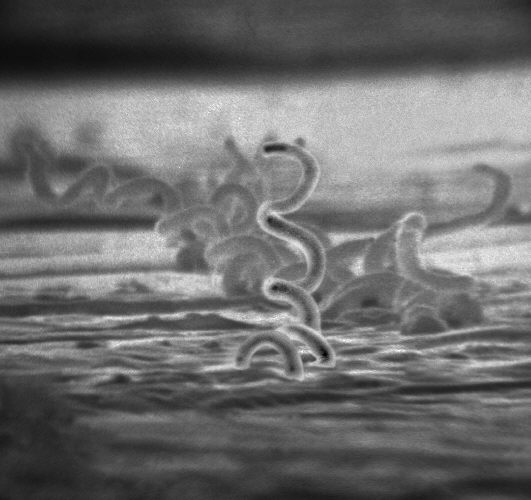
AI-generated image based on bacteria physiology
| Ecology, Host, and Life Cycle | |
|---|---|
| Oxygen requirements | Anaerobic |
| Optimal temperature | 37 |
| Temperature range | Mesophilic |
| Habitat | Animal intestinal microflora |
| Biotic relationship | Not Available |
| Host(s) | Bos taurus, Equidae |
| Cell arrangement | Not Available |
| Sporulation | Nonsporulating |
| Energy source | Chemoheterotroph |
| Pathogenicity | Not Available |
Gene Summary
Adenine Count
958160 bp
Thymine Count
957500 bp
Guanine Count
646558 bp
Cytosine Count
629127 bp
Genome Length
3191470 bp
Protein-coding Genes
2751 genes
Non-Coding Genes
69 genes
# of Chromosomes/Plasmids
1
Genes
| Name | Locus Tag | UniProt ID | Strand Orientation | Gene Start/End | Protein Molecular Weight |
|---|---|---|---|---|---|
| d-xylose transport system substrate-binding protein | SAMN04487775_10569 | Not Available | Negative | 1719566 - 1720612 | 39172.2 |
| two-component system, response regulator yesn | SAMN04487775_10570 | Not Available | Negative | 1720616 - 1722181 | 59092.5 |
| hamp domain-containing protein | SAMN04487775_10571 | Not Available | Negative | 1722174 - 1723676 | 57821.5 |
| ribose transport system substrate-binding protein | SAMN04487775_10572 | Not Available | Negative | 1723684 - 1724631 | 35169.8 |
| atp-dependent clp protease atp-binding subunit clpa | SAMN04487775_10573 | Not Available | Negative | 1724612 - 1726969 | 86761.9 |
| atp-dependent clp protease adaptor protein clps | SAMN04487775_10574 | Not Available | Negative | 1727016 - 1727363 | 12981.3 |
| membrane associated serine protease, rhomboid family | SAMN04487775_10575 | Not Available | Positive | 1727430 - 1728200 | 27706.6 |
| hypothetical protein | SAMN04487775_10576 | Not Available | Negative | 1728267 - 1729409 | 42854.2 |
| adp-ribose pyrophosphatase yjhb, nudix family | SAMN04487775_10577 | Not Available | Positive | 1729487 - 1730014 | 20547.5 |
| hypothetical protein | SAMN04487775_10578 | Not Available | Negative | 1730035 - 1730859 | 31648.9 |
Pathways
0 pathways
No pathways found
No metabolic pathways have been associated with this bacterium yet.
Health Effects
No health effects information available for this bacterium.