Kingdom
Pseudomonadati
Phylum
Spirochaetota
Class
Spirochaetia
Order
Spirochaetales
Family
Treponemataceae
Genus
Treponema
Description
Taxonomy
| Kingdom | Pseudomonadati |
|---|---|
| Phylum | Spirochaetota |
| Class | Spirochaetia |
| Order | Spirochaetales |
| Family | Treponemataceae |
| Genus | Treponema |
| Species | Treponema bryantii |
| Strain | strain XBD1002 |
Profile
| Physiology | |
|---|---|
| Gram staining properties | Negative |
| Shape | Spirilla |
| Mobility | Yes |
| Flagellar presence | Yes |
| Number of membranes | Not Available |

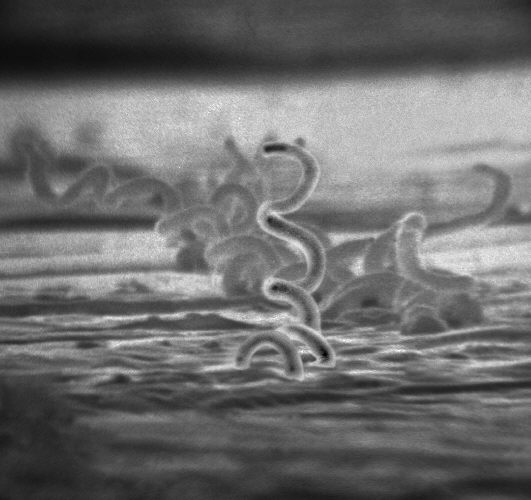
AI-generated image based on bacteria physiology
| Ecology, Host, and Life Cycle | |
|---|---|
| Oxygen requirements | Anaerobic |
| Optimal temperature | 37 |
| Temperature range | Mesophilic |
| Habitat | Animal intestinal microflora |
| Biotic relationship | Not Available |
| Host(s) | Bos taurus, Equidae |
| Cell arrangement | Not Available |
| Sporulation | Nonsporulating |
| Energy source | Chemoheterotroph |
| Pathogenicity | Not Available |
Gene Summary
Adenine Count
958160 bp
Thymine Count
957500 bp
Guanine Count
646558 bp
Cytosine Count
629127 bp
Genome Length
3191470 bp
Protein-coding Genes
2751 genes
Non-Coding Genes
69 genes
# of Chromosomes/Plasmids
1
Genes
| Name | Locus Tag | UniProt ID | Strand Orientation | Gene Start/End | Protein Molecular Weight |
|---|---|---|---|---|---|
| tldd protein | SAMN04487775_10420 | Not Available | Negative | 1396339 - 1397685 | 50670.1 |
| s-adenosylmethionine:trna ribosyltransferase-isomerase | SAMN04487775_10421 | Not Available | Positive | 1397771 - 1398844 | 40570.2 |
| co or xanthine dehydrogenase, fad-binding subunit | SAMN04487775_10422 | Not Available | Negative | 1398837 - 1399634 | 29586.6 |
| carbon-monoxide dehydrogenase small subunit | SAMN04487775_10423 | Not Available | Negative | 1399656 - 1400132 | 17166.1 |
| co or xanthine dehydrogenase, mo-binding subunit | SAMN04487775_10424 | Not Available | Negative | 1400129 - 1402420 | 84760.6 |
| dtdp-4-amino-4,6-dideoxygalactose transaminase | SAMN04487775_10425 | Not Available | Negative | 1402424 - 1403671 | 46316.2 |
| ndp-sugar epimerase, includes udp-glcnac-inverting 4,6-dehydratase flaa1 and capsular polysaccharide biosynthesis protein epsc | SAMN04487775_10426 | Not Available | Negative | 1403692 - 1405209 | 56128.1 |
| hypothetical protein | SAMN04487775_10427 | Not Available | Positive | 1405334 - 1405840 | 18677.1 |
| hypothetical protein | SAMN04487775_10428 | Not Available | Positive | 1405855 - 1407531 | 62162.4 |
| branched-chain amino acid aminotransferase | SAMN04487775_10429 | Not Available | Negative | 1407612 - 1408634 | 37885.4 |
Pathways
0 pathways
No pathways found
No metabolic pathways have been associated with this bacterium yet.
Health Effects
No health effects information available for this bacterium.