Kingdom
Pseudomonadati
Phylum
Spirochaetota
Class
Spirochaetia
Order
Spirochaetales
Family
Treponemataceae
Genus
Treponema
Description
Taxonomy
| Kingdom | Pseudomonadati |
|---|---|
| Phylum | Spirochaetota |
| Class | Spirochaetia |
| Order | Spirochaetales |
| Family | Treponemataceae |
| Genus | Treponema |
| Species | Treponema bryantii |
| Strain | strain XBD1002 |
Profile
| Physiology | |
|---|---|
| Gram staining properties | Negative |
| Shape | Spirilla |
| Mobility | Yes |
| Flagellar presence | Yes |
| Number of membranes | Not Available |

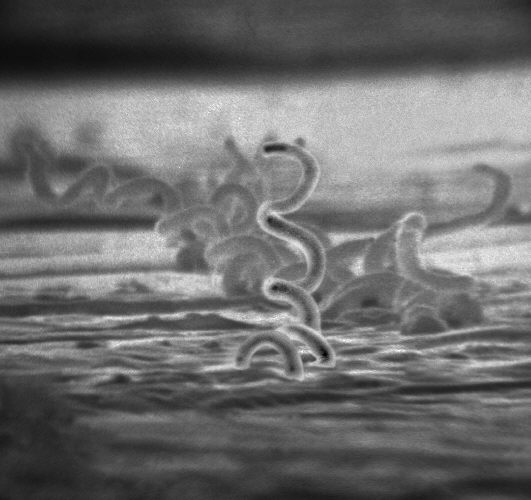
AI-generated image based on bacteria physiology
| Ecology, Host, and Life Cycle | |
|---|---|
| Oxygen requirements | Anaerobic |
| Optimal temperature | 37 |
| Temperature range | Mesophilic |
| Habitat | Animal intestinal microflora |
| Biotic relationship | Not Available |
| Host(s) | Bos taurus, Equidae |
| Cell arrangement | Not Available |
| Sporulation | Nonsporulating |
| Energy source | Chemoheterotroph |
| Pathogenicity | Not Available |
Gene Summary
Adenine Count
958160 bp
Thymine Count
957500 bp
Guanine Count
646558 bp
Cytosine Count
629127 bp
Genome Length
3191470 bp
Protein-coding Genes
2751 genes
Non-Coding Genes
69 genes
# of Chromosomes/Plasmids
1
Genes
| Name | Locus Tag | UniProt ID | Strand Orientation | Gene Start/End | Protein Molecular Weight |
|---|---|---|---|---|---|
| hdig domain-containing protein | SAMN04487775_103142 | Not Available | Negative | 1225441 - 1226565 | 42542.3 |
| predicted oxidoreductase of the aldo/keto reductase family | SAMN04487775_103143 | Not Available | Positive | 1226614 - 1227657 | 39085.2 |
| protein of unknown function | SAMN04487775_103144 | Not Available | Positive | 1227713 - 1227928 | 8115.54 |
| hypothetical protein | SAMN04487775_103145 | Not Available | Positive | 1227928 - 1228122 | 7561.0 |
| hypothetical protein | SAMN04487775_103146 | Not Available | Positive | 1228148 - 1228636 | 18682.3 |
| dna helicase-4 | SAMN04487775_103147 | Not Available | Positive | 1228682 - 1231570 | 111131.0 |
| topoisomerase-4 subunit a | SAMN04487775_103148 | Not Available | Positive | 1231836 - 1233755 | 72908.5 |
| uncharacterized protein, yigz family | SAMN04487775_103149 | Not Available | Positive | 1233755 - 1234354 | 21605.8 |
| endo-1,4-beta-xylanase, gh35 family | SAMN04487775_103150 | Not Available | Positive | 1234483 - 1235658 | 44881.8 |
| haloacid dehalogenase superfamily, subfamily ia, variant 3 with third motif having dd or ed | SAMN04487775_103151 | Not Available | Negative | 1235675 - 1236310 | 23722.5 |
Pathways
0 pathways
No pathways found
No metabolic pathways have been associated with this bacterium yet.
Health Effects
No health effects information available for this bacterium.