
Kingdom
Pseudomonadati
Phylum
Pseudomonadota
Class
Gammaproteobacteria
Order
Enterobacterales
Family
Yersiniaceae
Genus
Yersinia
Description
Taxonomy
| Kingdom | Pseudomonadati |
|---|---|
| Phylum | Pseudomonadota |
| Class | Gammaproteobacteria |
| Order | Enterobacterales |
| Family | Yersiniaceae |
| Genus | Yersinia |
| Species | Yersinia kristensenii |
| Strain | No strain |
Profile
| Physiology | |
|---|---|
| Gram staining properties | Not Available |
| Shape | Rod |
| Mobility | Not Available |
| Flagellar presence | Yes |
| Number of membranes | Not Available |
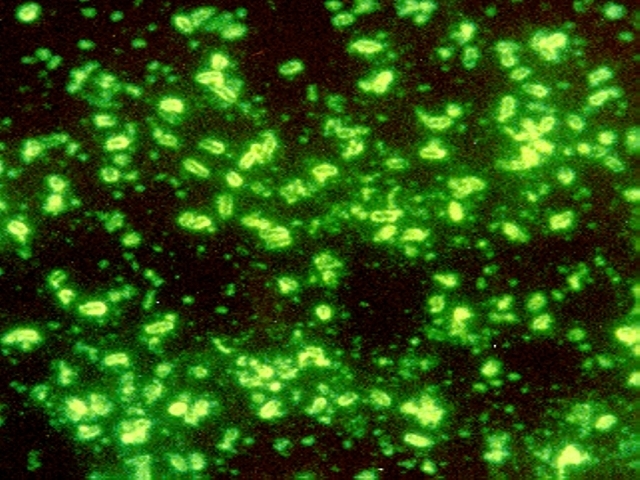
Image source: Wikipedia/Wikimedia
| Ecology, Host, and Life Cycle | |
|---|---|
| Oxygen requirements | Not Available |
| Optimal temperature | Not Available |
| Temperature range | Not Available |
| Habitat | environment; food |
| Biotic relationship | Not Available |
| Host(s) | Homo sapiens |
| Cell arrangement | Not Available |
| Sporulation | Not Available |
| Energy source | Not Available |
| Pathogenicity | Not Available |
Genome Summary
Yersinia kristensenii genome assembly 5139_5#5, scaffold
Gene Summary
Adenine Count
1152032 bp
Thymine Count
1127446 bp
Guanine Count
998346 bp
Cytosine Count
1046858 bp
Genome Length
4324694 bp
Protein-coding Genes
3779 genes
Non-Coding Genes
170 genes
# of Chromosomes/Plasmids
3
Genes
| Name | Locus Tag | UniProt ID | Strand Orientation | Gene Start/End | Protein Molecular Weight |
|---|---|---|---|---|---|
| type iv pilus biogenesis protein piln | ERS008500_02583 | Not Available | Negative | 2784399 - 2784947 | 21670.2 |
| type iv pilus assembly protein pilm | ERS008500_02584 | Not Available | Negative | 2784947 - 2785837 | 33562.5 |
| peptidoglycan synthetase | ERS008500_02585 | P02918 | Positive | 2785957 - 2788512 | 93531.7 |
| adp-ribose diphosphatase nude | ERS008500_02586 | P45799 | Negative | 2788619 - 2789176 | 20885.4 |
| intracellular growth attenuator family protein | ERS008500_02587 | P58722 | Positive | 2789668 - 2791926 | 83680.1 |
| putative hydrolase | ERS008500_02588 | P64636 | Positive | 2792052 - 2792729 | 26117.9 |
| heat shock protein 15 | ERS008500_02589 | P0ACH0 | Positive | 2792763 - 2793170 | 15657.7 |
| hsp33-like chaperonin | ERS008500_02590 | A7FNU7 | Positive | 2793200 - 2794114 | 33764.8 |
| phosphoenolpyruvate carboxykinase | ERS008500_02591 | A1JSE7 | Positive | 2794314 - 2795933 | 59245.3 |
| osmolarity sensor protein | ERS008500_02592 | A0A0H3NIL4 | Negative | 2796172 - 2797524 | 50261.0 |
Pathways
0 pathways
No pathways found
No metabolic pathways have been associated with this bacterium yet.
Health Effects
No health effects information available for this bacterium.


