
Kingdom
Pseudomonadati
Phylum
Pseudomonadota
Class
Gammaproteobacteria
Order
Enterobacterales
Family
Yersiniaceae
Genus
Yersinia
Description
Taxonomy
| Kingdom | Pseudomonadati |
|---|---|
| Phylum | Pseudomonadota |
| Class | Gammaproteobacteria |
| Order | Enterobacterales |
| Family | Yersiniaceae |
| Genus | Yersinia |
| Species | Yersinia kristensenii |
| Strain | No strain |
Profile
| Physiology | |
|---|---|
| Gram staining properties | Not Available |
| Shape | Rod |
| Mobility | Not Available |
| Flagellar presence | Yes |
| Number of membranes | Not Available |
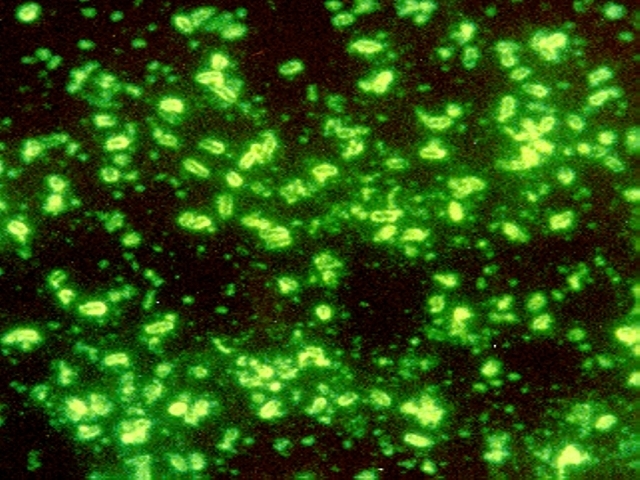
Image source: Wikipedia/Wikimedia
| Ecology, Host, and Life Cycle | |
|---|---|
| Oxygen requirements | Not Available |
| Optimal temperature | Not Available |
| Temperature range | Not Available |
| Habitat | environment; food |
| Biotic relationship | Not Available |
| Host(s) | Homo sapiens |
| Cell arrangement | Not Available |
| Sporulation | Not Available |
| Energy source | Not Available |
| Pathogenicity | Not Available |
Genome Summary
Yersinia kristensenii genome assembly 5139_5#5, scaffold
Gene Summary
Adenine Count
1152032 bp
Thymine Count
1127446 bp
Guanine Count
998346 bp
Cytosine Count
1046858 bp
Genome Length
4324694 bp
Protein-coding Genes
3779 genes
Non-Coding Genes
170 genes
# of Chromosomes/Plasmids
3
Genes
| Name | Locus Tag | UniProt ID | Strand Orientation | Gene Start/End | Protein Molecular Weight |
|---|---|---|---|---|---|
| putative phosphotransferase system protein | ERS008500_01865 | Not Available | Positive | 2021806 - 2023410 | 55088.4 |
| bifunctional hexulose-6-phosphate synthase/ribonuclease regulator | ERS008500_01866 | Not Available | Positive | 2023453 - 2024292 | 29293.3 |
| putative haloacid dehalogenase-like hydrolase | ERS008500_01867 | P54947 | Positive | 2024364 - 2025173 | 30211.8 |
| deor family regulatory protein | ERS008500_01868 | P94591 | Positive | 2025252 - 2026013 | 28113.1 |
| putative drug efflux protein | ERS008500_01869 | Q8XC49 | Negative | 2026146 - 2027333 | 41339.9 |
| beta-lactamase class c and other penicillin binding proteins | ERS008500_01870 | Q9KX40 | Negative | 2027333 - 2028526 | 42689.7 |
| lysr family transcriptional regulator | ERS008500_01871 | P30864 | Positive | 2028660 - 2029541 | 32440.6 |
| putative chemotaxis protein | ERS008500_01872 | O25154 | Positive | 2029670 - 2030644 | 35880.3 |
| Trna-asn | Not Available | Not Available | Positive | 2030896 - 2030971 | Not Available |
| pili assembly chaperone | ERS008500_01874 | Not Available | Negative | 2031139 - 2031879 | 28002.7 |
Pathways
0 pathways
No pathways found
No metabolic pathways have been associated with this bacterium yet.
Health Effects
No health effects information available for this bacterium.


