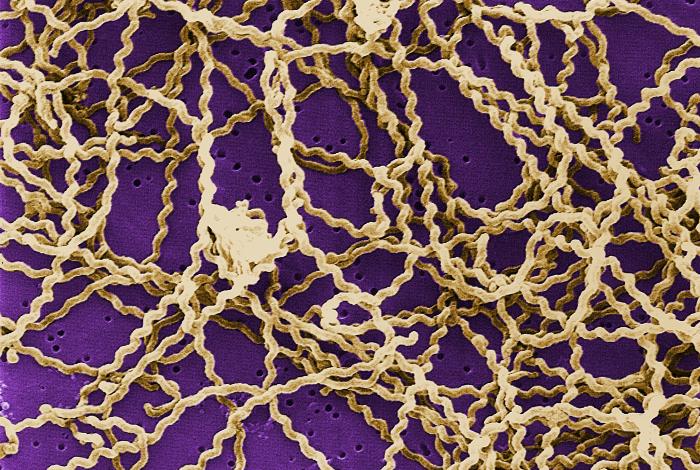
Leptospira weilii serovar Ranarum str. ICFT

Kingdom

Pseudomonadati

Phylum

Spirochaetota

Class

Leptospiria

Order

Leptospirales

Family

Leptospiraceae

Genus

Leptospira

Description

Leptospira weilii serovar Ranarum str. ICFT is a species of spirochete bacteria characterized by the presence of flagella, which contribute to its motility and ability to navigate through various environments. This bacterium has one replicon, indicating a singular circular chromosome that houses its genetic material. The genomic sequence of Leptospira weilii serovar Ranarum str. ICFT is cataloged under the accession number AOHC00000000.2, providing a reference for researchers interested in studying its genetic makeup and potential pathogenic features. As a member of the Leptospira genus, this species is known to be associated with water-dwelling environments, which can play a crucial role in the ecology of leptospirosis transmission. The presence of flagella not only aids in locomotion but also enhances the bacterium's ability to invade host tissues, which is essential for its survival and propagation in aquatic habitats. Understanding the biological and ecological traits of Leptospira weilii serovar Ranarum str. ICFT is vital for developing strategies to monitor and control leptospirosis, especially in areas where water sources may be contaminated. The ecological implications of its motility and habitat preferences underscore the importance of water quality in preventing disease transmission.

Taxonomy

KingdomPseudomonadati
PhylumSpirochaetota
ClassLeptospiria
OrderLeptospirales
FamilyLeptospiraceae
GenusLeptospira
SpeciesLeptospira weilii
Strainserovar Ranarum ICFT

Profile

Physiology
Gram staining propertiesNot Available
ShapeNot Available
MobilityNot Available
Flagellar presenceYes
Number of membranesNot Available
Image of Leptospira weilii serovar Ranarum str. ICFT
Image source: Wikipedia/Wikimedia
Ecology, Host, and Life Cycle
Oxygen requirementsNot Available
Optimal temperatureNot Available
Temperature rangeNot Available
HabitatNot Available
Biotic relationshipNot Available
Host(s)Not Available
Cell arrangementNot Available
SporulationNot Available
Energy sourceNot Available
PathogenicityNot Available

Genome Summary

Leptospira weilii serovar Ranarum str. ICFT ctg7180000034493,

Gene Summary

Adenine Count

1154953 bp

Thymine Count

1153803 bp

Guanine Count

847783 bp

Cytosine Count

870181 bp

Genome Length

4026722 bp

Protein-coding Genes

3927 genes

Non-Coding Genes

43 genes

# of Chromosomes/Plasmids

1

Genes

NameLocus TagUniProt IDStrand OrientationGene Start/EndProtein Molecular Weight
gdp-mannose 4,6-dehydrataseLEP1GSC060_2685Not AvailableNegative2006256 - 200727838175.7
mate efflux family proteinLEP1GSC060_2686Not AvailableNegative2007556 - 200892949889.9
adenosine/amp deaminaseLEP1GSC060_2687Not AvailablePositive2009171 - 201047249836.9
hypothetical proteinLEP1GSC060_2688Not AvailablePositive2010530 - 201145334946.7
cation transport proteinLEP1GSC060_2689Not AvailablePositive2011453 - 201325266224.2
trk system potassium uptake protein trkaLEP1GSC060_2690Not AvailablePositive2013266 - 201397926902.4
hypothetical proteinLEP1GSC060_2691Not AvailablePositive2014509 - 201609261784.3
putative toxin-antitoxin system, antitoxin component, phd familyLEP1GSC060_2692Not AvailablePositive2016399 - 20166389074.02
pin domain proteinLEP1GSC060_2693Not AvailablePositive2016635 - 201703315472.9
acylphosphataseLEP1GSC060_2694Not AvailableNegative2017056 - 201734310768.9

Displaying genes 1951 – 1960 of 3970 in total

Pathways

0 pathways

No pathways found

No metabolic pathways have been associated with this bacterium yet.

Metabolites

15 records
Metabolite IDMetabolite nameStructureCAS number
BASm0000387(6R)-5,10-methylene-5,6,7,8-tetrahydrofolateC20H21N7O6Chemical structure of (6R)-5,10-methylene-5,6,7,8-tetrahydrofolateNot available
Average455.432Da
Monoisotopic455.1564286Da
BASm0001865diphosphateHO7P2Chemical structure of diphosphateNot available
Average174.95Da
Monoisotopic174.9213971Da
BASm00027107,8-dihydrofolateC19H19N7O6Chemical structure of 7,8-dihydrofolateNot available
Average441.405Da
Monoisotopic441.1407785Da
BASm0002715(6S)-5-formyl-5,6,7,8-tetrahydrofolateC20H21N7O7Chemical structure of (6S)-5-formyl-5,6,7,8-tetrahydrofolateNot available
Average471.431Da
Monoisotopic471.1513432Da
BASm0002826(2R)-3-phospho-glyceroyl phosphateC3H4O10P2Chemical structure of (2R)-3-phospho-glyceroyl phosphateNot available
Average262.005Da
Monoisotopic261.9301646Da
BASm0003333(2R)-3-phosphoglycerateC3H4O7PChemical structure of (2R)-3-phosphoglycerateNot available
Average183.033Da
Monoisotopic182.9711102Da
BASm0003334aldehydo-D-ribose 5-phosphateC5H11O8PChemical structure of aldehydo-D-ribose 5-phosphateNot available
Average230.1098Da
Monoisotopic230.0191538Da
BASm0003346(2R)-2-phosphoglycerateC3H4O7PChemical structure of (2R)-2-phosphoglycerateNot available
Average183.033Da
Monoisotopic182.9711102Da
BASm0003389NADP(+)C21H25N7O17P3Chemical structure of NADP(+)Not available
Average740.386Da
Monoisotopic740.053624107Da
BASm0003701L-methionine (S)-S-oxideC5H11NO3SChemical structure of L-methionine (S)-S-oxide62697-73-8
Average165.21Da
Monoisotopic165.045964392Da

Displaying 1–10 of 15 metabolites

Health Effects

No health effects information available for this bacterium.