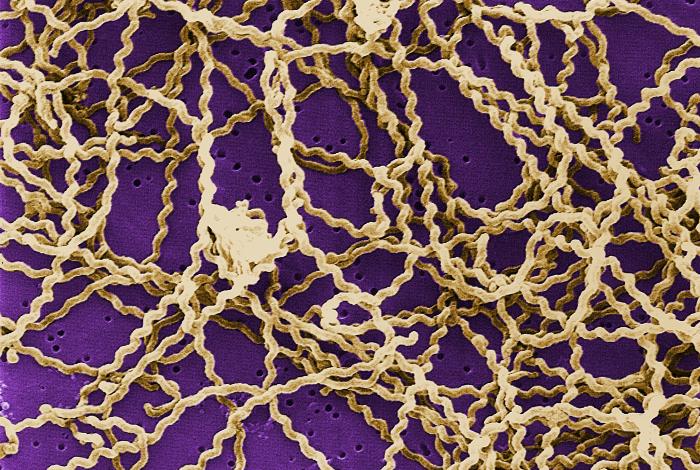
Kingdom
Pseudomonadati
Phylum
Spirochaetota
Class
Leptospiria
Order
Leptospirales
Family
Leptospiraceae
Genus
Leptospira
Description
Taxonomy
| Kingdom | Pseudomonadati |
|---|---|
| Phylum | Spirochaetota |
| Class | Leptospiria |
| Order | Leptospirales |
| Family | Leptospiraceae |
| Genus | Leptospira |
| Species | Leptospira borgpetersenii |
| Strain | 200701203 |
Profile
| Physiology | |
|---|---|
| Gram staining properties | Negative |
| Shape | Spirilla |
| Mobility | No |
| Flagellar presence | Yes |
| Number of membranes | 2 |

Image source: Wikipedia/Wikimedia
| Ecology, Host, and Life Cycle | |
|---|---|
| Oxygen requirements | Aerobe |
| Optimal temperature | Not Available |
| Temperature range | Mesophilic |
| Habitat | HostAssociated |
| Biotic relationship | Free living |
| Host(s) | Not Available |
| Cell arrangement | Not Available |
| Sporulation | Nonsporulating |
| Energy source | Not Available |
| Pathogenicity | Not Available |
Gene Summary
Adenine Count
1192417 bp
Thymine Count
1181579 bp
Guanine Count
787950 bp
Cytosine Count
811268 bp
Genome Length
3973215 bp
Protein-coding Genes
4776 genes
Non-Coding Genes
45 genes
# of Chromosomes/Plasmids
1
Genes
| Name | Locus Tag | UniProt ID | Strand Orientation | Gene Start/End | Protein Molecular Weight |
|---|---|---|---|---|---|
| hypothetical protein | LEP1GSC123_4084 | Not Available | Negative | 3645837 - 3646193 | 13646.8 |
| hypothetical protein | LEP1GSC123_4086 | Not Available | Negative | 3646206 - 3646325 | 4346.18 |
| hypothetical protein | LEP1GSC123_4085 | Not Available | Positive | 3646290 - 3646469 | 7076.51 |
| 23s rrna m2a2503 methyltransferase | LEP1GSC123_4087 | Not Available | Negative | 3646518 - 3647603 | 40555.3 |
| hypothetical protein | LEP1GSC123_4088 | Not Available | Positive | 3647727 - 3648290 | 21253.4 |
| hypothetical protein | LEP1GSC123_4089 | Not Available | Negative | 3648551 - 3648688 | 5380.52 |
| putative lipoprotein | LEP1GSC123_4090 | Not Available | Positive | 3648730 - 3648858 | 4684.89 |
| hypothetical protein | LEP1GSC123_4092 | Not Available | Positive | 3649187 - 3649666 | 17600.9 |
| hypothetical protein | LEP1GSC123_4093 | Not Available | Negative | 3649795 - 3650061 | 10107.3 |
| hypothetical protein | LEP1GSC123_4094 | Not Available | Negative | 3650039 - 3650248 | 7595.47 |
Pathways
0 pathways
No pathways found
No metabolic pathways have been associated with this bacterium yet.
Health Effects
No health effects information available for this bacterium.