
Kingdom
Pseudomonadati
Phylum
Spirochaetota
Class
Leptospiria
Order
Leptospirales
Family
Leptospiraceae
Genus
Leptospira
Description
Taxonomy
| Kingdom | Pseudomonadati |
|---|---|
| Phylum | Spirochaetota |
| Class | Leptospiria |
| Order | Leptospirales |
| Family | Leptospiraceae |
| Genus | Leptospira |
| Species | Leptospira noguchii |
| Strain | strain HAI1536 |
Profile
| Physiology | |
|---|---|
| Gram staining properties | Not Available |
| Shape | Not Available |
| Mobility | Not Available |
| Flagellar presence | Yes |
| Number of membranes | Not Available |
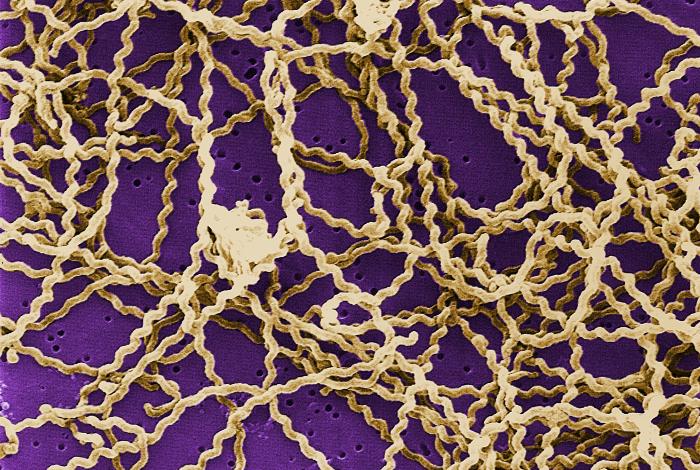
Image source: Wikipedia/Wikimedia
| Ecology, Host, and Life Cycle | |
|---|---|
| Oxygen requirements | Not Available |
| Optimal temperature | Not Available |
| Temperature range | Not Available |
| Habitat | Not Available |
| Biotic relationship | Not Available |
| Host(s) | Homo sapiens |
| Cell arrangement | Not Available |
| Sporulation | Not Available |
| Energy source | Not Available |
| Pathogenicity | Not Available |
Gene Summary
Adenine Count
1530498 bp
Thymine Count
1506782 bp
Guanine Count
810085 bp
Cytosine Count
847587 bp
Genome Length
4694952 bp
Protein-coding Genes
4271 genes
Non-Coding Genes
64 genes
# of Chromosomes/Plasmids
1
Genes
| Name | Locus Tag | UniProt ID | Strand Orientation | Gene Start/End | Protein Molecular Weight |
|---|---|---|---|---|---|
| fatty acid hydroxylase family protein | LEP1GSC172_3630 | Not Available | Negative | 4315228 - 4316556 | 51164.4 |
| hypothetical protein | LEP1GSC172_3631 | Not Available | Negative | 4317135 - 4317248 | 4433.3 |
| hypothetical protein | LEP1GSC172_3632 | Not Available | Negative | 4317254 - 4317451 | 7733.77 |
| glycine hydroxymethyltransferase | LEP1GSC172_3633 | Not Available | Negative | 4317641 - 4318888 | 45050.2 |
| biotin/lipoate a/b protein ligase family protein | LEP1GSC172_3634 | Not Available | Negative | 4318928 - 4319776 | 32258.8 |
| hypothetical protein | LEP1GSC172_3635 | Not Available | Negative | 4319895 - 4320899 | 37430.6 |
| endonuclease/exonuclease/phosphatase family protein | LEP1GSC172_3636 | Not Available | Positive | 4321030 - 4322118 | 41489.5 |
| phosphoenolpyruvate mutase | LEP1GSC172_3638 | Not Available | Positive | 4322542 - 4323315 | 27883.3 |
| hypothetical protein | LEP1GSC172_3639 | Not Available | Negative | 4323393 - 4323515 | 4703.74 |
| glyoxalase/bleomycin resistance protein/dioxygenase family protein | LEP1GSC172_3640 | Not Available | Positive | 4323637 - 4324095 | 16923.5 |
Pathways
0 pathways
No pathways found
No metabolic pathways have been associated with this bacterium yet.
Health Effects
No health effects information available for this bacterium.


