Kingdom
Pseudomonadati
Phylum
Pseudomonadota
Class
Gammaproteobacteria
Order
Enterobacterales
Family
Enterobacteriaceae
Genus
Escherichia
Description
Taxonomy
| Kingdom | Pseudomonadati |
|---|---|
| Phylum | Pseudomonadota |
| Class | Gammaproteobacteria |
| Order | Enterobacterales |
| Family | Enterobacteriaceae |
| Genus | Escherichia |
| Species | Escherichia sp. E2586 |
| Strain | No strain |
Profile
| Physiology | |
|---|---|
| Gram staining properties | Negative |
| Shape | Not Available |
| Mobility | Not Available |
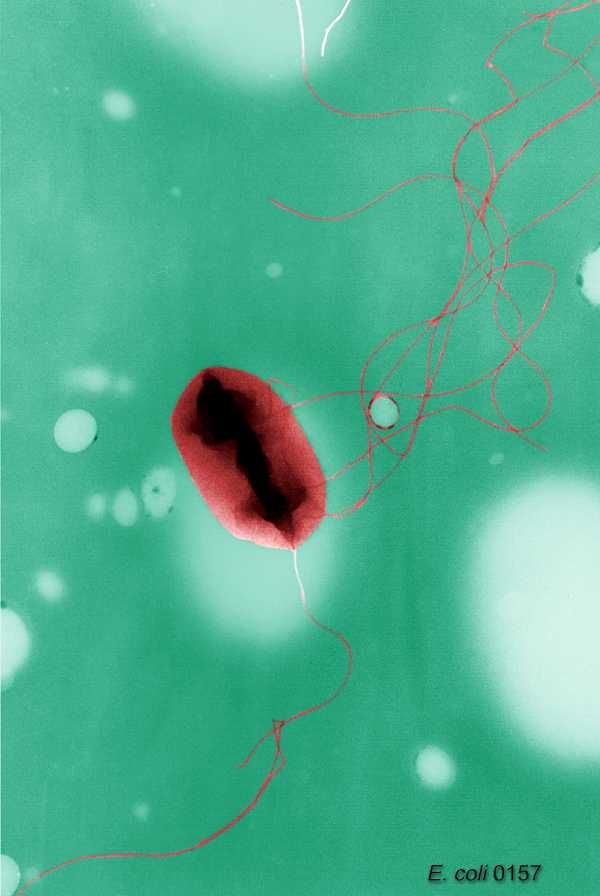
| Flagellar presence | Yes |
| Number of membranes | Not Available |

Image source: Wikipedia/Wikimedia
| Ecology, Host, and Life Cycle | |
|---|---|
| Oxygen requirements | Not Available |
| Optimal temperature | Not Available |
| Temperature range | Not Available |
| Habitat | Not Available |
| Biotic relationship | Not Available |
| Host(s) | Not Available |
| Cell arrangement | Not Available |
| Sporulation | Not Available |
| Energy source | Not Available |
| Pathogenicity | Not Available |
Gene Summary
Adenine Count
1221824 bp
Thymine Count
1231751 bp
Guanine Count
1255621 bp
Cytosine Count
1242880 bp
Genome Length
4952661 bp
Protein-coding Genes
4517 genes
Non-Coding Genes
183 genes
# of Chromosomes/Plasmids
1
Genes
| Name | Locus Tag | UniProt ID | Strand Orientation | Gene Start/End | Protein Molecular Weight |
|---|---|---|---|---|---|
| aida-i family autotransporter yfal | FEK50_06265 | Not Available | Negative | 1365380 - 1369120 | 130440.0 |
| ribonucleoside-diphosphate reductase subunit alpha | FEK50_06270 | Not Available | Positive | 1369809 - 1372094 | 85701.0 |
| ribonucleotide-diphosphate reductase subunit beta | FEK50_06275 | Not Available | Positive | 1372250 - 1373380 | 43616.8 |
| ferredoxin-like diferric-tyrosyl radical cofactor maintenance protein yfae | FEK50_06280 | Not Available | Positive | 1373380 - 1373634 | 9305.28 |
| lipopolysaccharide kinase inaa | FEK50_06285 | Not Available | Negative | 1373688 - 1374338 | 25366.3 |
| glycerophosphodiester phosphodiesterase | FEK50_06290 | Not Available | Negative | 1374490 - 1375569 | 40870.8 |
| glycerol-3-phosphate transporter | FEK50_06295 | Not Available | Negative | 1375574 - 1376932 | 50377.3 |
| anaerobic glycerol-3-phosphate dehydrogenase subunit a | FEK50_06300 | Not Available | Positive | 1377204 - 1378832 | 58977.8 |
| glycerol-3-phosphate dehydrogenase subunit glpb | FEK50_06305 | Not Available | Positive | 1378822 - 1380078 | 45189.7 |
| anaerobic glycerol-3-phosphate dehydrogenase subunit c | FEK50_06310 | Not Available | Positive | 1380078 - 1381268 | 44124.5 |
Pathways
12367 pathways
Health Effects
No health effects information available for this bacterium.