
Kingdom
Pseudomonadati
Phylum
Pseudomonadota
Class
Alphaproteobacteria
Order
Rhodospirillales
Family
Rhodospirillaceae
Genus
Magnetospirillum
Description
Taxonomy
| Kingdom | Pseudomonadati |
|---|---|
| Phylum | Pseudomonadota |
| Class | Alphaproteobacteria |
| Order | Rhodospirillales |
| Family | Rhodospirillaceae |
| Genus | Magnetospirillum |
| Species | Magnetospirillum sp. 64-120 |
| Strain | No strain |
Profile
| Physiology | |
|---|---|
| Gram staining properties | Not Available |
| Shape | curved/spiral |
| Mobility | Not Available |
| Flagellar presence | Not Available |
| Number of membranes | Not Available |
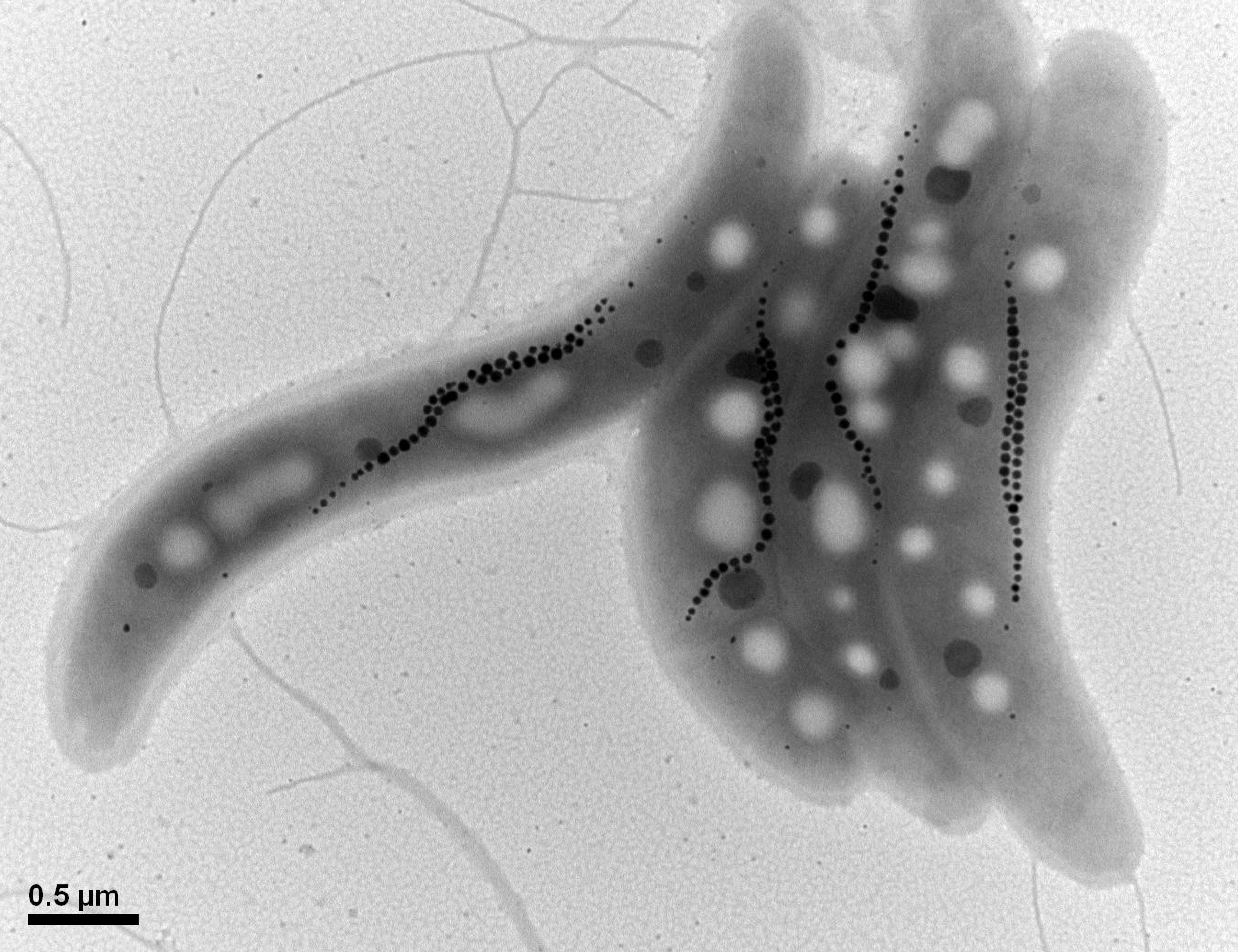
Image source: Wikipedia/Wikimedia
| Ecology, Host, and Life Cycle | |
|---|---|
| Oxygen requirements | Not Available |
| Optimal temperature | Not Available |
| Temperature range | Not Available |
| Habitat | Not Available |
| Biotic relationship | Not Available |
| Host(s) | Not Available |
| Cell arrangement | Not Available |
| Sporulation | Not Available |
| Energy source | Not Available |
| Pathogenicity | Not Available |
Gene Summary
Adenine Count
772658 bp
Thymine Count
766812 bp
Guanine Count
1362619 bp
Cytosine Count
1371429 bp
Genome Length
4273527 bp
Protein-coding Genes
3987 genes
Non-Coding Genes
80 genes
# of Chromosomes/Plasmids
1
Genes
| Name | Locus Tag | UniProt ID | Strand Orientation | Gene Start/End | Protein Molecular Weight |
|---|---|---|---|---|---|
| dna polymerase iii subunit delta | BGO92_05705 | Not Available | Positive | 3985999 - 3987024 | 36365.8 |
| nad-glutamate dehydrogenase | BGO92_05710 | Not Available | Positive | 3987104 - 3991894 | 174846.0 |
| phosphoheptose isomerase | BGO92_05715 | Not Available | Positive | 3991952 - 3992539 | 20357.4 |
| hypothetical protein | BGO92_05720 | Not Available | Positive | 3992649 - 3993029 | 13871.7 |
| hypothetical protein | BGO92_05725 | Not Available | Positive | 3993208 - 3995049 | 67964.2 |
| hypothetical protein | BGO92_05730 | Not Available | Negative | 3995022 - 3995585 | 20463.1 |
| mannose-1-phosphate guanylyltransferase/mannose-6-phosphate isomerase | BGO92_05735 | Not Available | Negative | 3995582 - 3996973 | 50956.6 |
| hypothetical protein | BGO92_05740 | Not Available | Negative | 3996970 - 3997890 | 32809.0 |
| glycosyl transferase | BGO92_05745 | Not Available | Negative | 3997887 - 3998861 | 33807.1 |
| theronine dehydrogenase | BGO92_05750 | Not Available | Negative | 3998863 - 4001016 | 75725.4 |
Pathways
0 pathways
No pathways found
No metabolic pathways have been associated with this bacterium yet.
Health Effects
No health effects information available for this bacterium.
