
Kingdom
Pseudomonadati
Phylum
Pseudomonadota
Class
Alphaproteobacteria
Order
Rhodospirillales
Family
Rhodospirillaceae
Genus
Magnetospirillum
Description
Taxonomy
| Kingdom | Pseudomonadati |
|---|---|
| Phylum | Pseudomonadota |
| Class | Alphaproteobacteria |
| Order | Rhodospirillales |
| Family | Rhodospirillaceae |
| Genus | Magnetospirillum |
| Species | Magnetospirillum sp. 64-120 |
| Strain | No strain |
Profile
| Physiology | |
|---|---|
| Gram staining properties | Not Available |
| Shape | curved/spiral |
| Mobility | Not Available |
| Flagellar presence | Not Available |
| Number of membranes | Not Available |
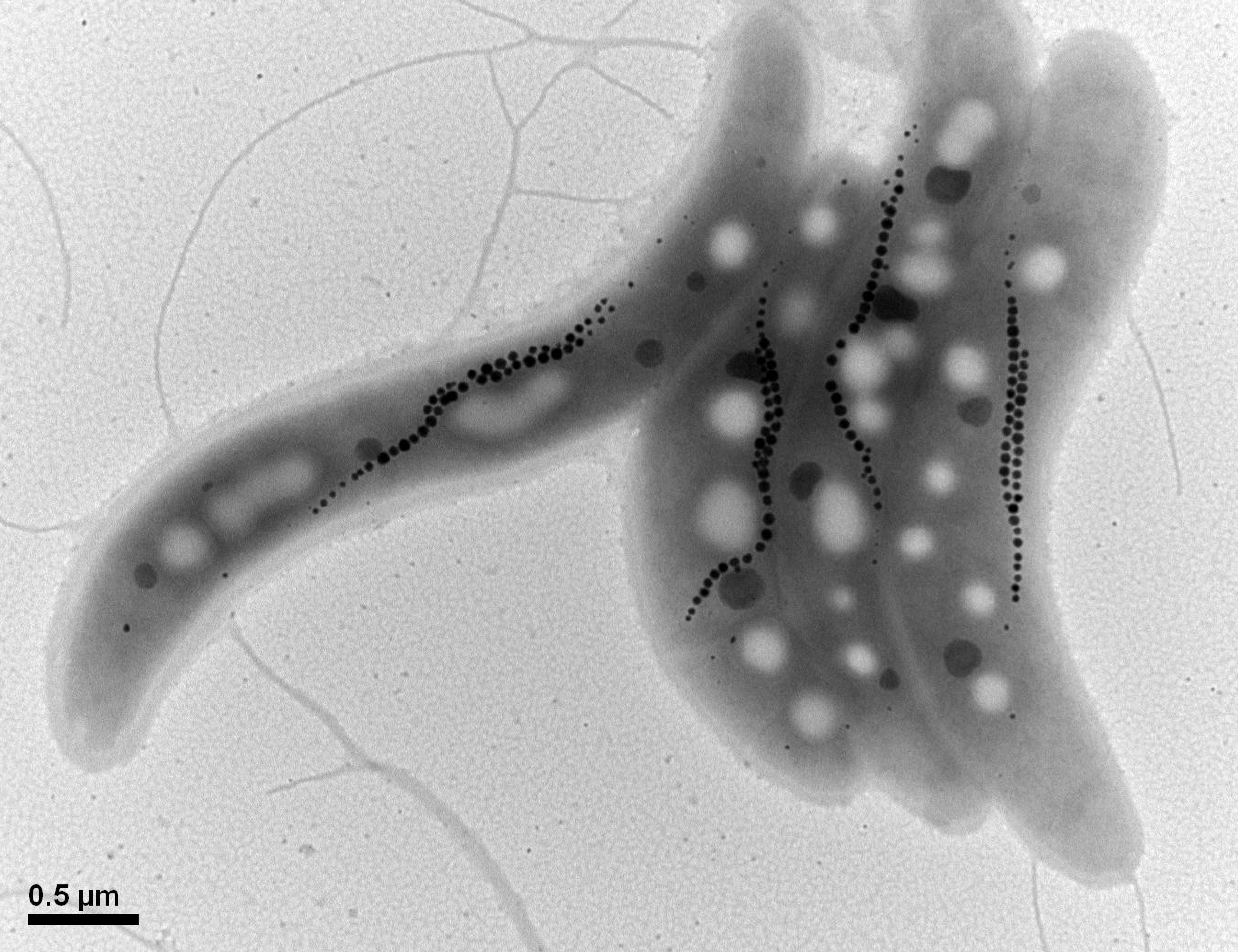
Image source: Wikipedia/Wikimedia
| Ecology, Host, and Life Cycle | |
|---|---|
| Oxygen requirements | Not Available |
| Optimal temperature | Not Available |
| Temperature range | Not Available |
| Habitat | Not Available |
| Biotic relationship | Not Available |
| Host(s) | Not Available |
| Cell arrangement | Not Available |
| Sporulation | Not Available |
| Energy source | Not Available |
| Pathogenicity | Not Available |
Gene Summary
Adenine Count
772658 bp
Thymine Count
766812 bp
Guanine Count
1362619 bp
Cytosine Count
1371429 bp
Genome Length
4273527 bp
Protein-coding Genes
3987 genes
Non-Coding Genes
80 genes
# of Chromosomes/Plasmids
1
Genes
| Name | Locus Tag | UniProt ID | Strand Orientation | Gene Start/End | Protein Molecular Weight |
|---|---|---|---|---|---|
| flagellar biosynthetic protein flip | BGO92_05150 | Not Available | Negative | 3882217 - 3882978 | 27600.7 |
| hypothetical protein | BGO92_05155 | Not Available | Negative | 3882975 - 3883274 | 10797.5 |
| hypothetical protein | BGO92_05160 | Not Available | Negative | 3883261 - 3883557 | 10466.8 |
| flagellar protein fhlb | BGO92_05165 | Not Available | Negative | 3883554 - 3883880 | 10946.1 |
| flagellar basal-body rod protein flgb | BGO92_05170 | Not Available | Positive | 3884097 - 3884489 | 14627.6 |
| flagellar basal body rod protein flgc | BGO92_05175 | Not Available | Positive | 3884493 - 3884906 | 15519.5 |
| flagellar hook-basal body protein flie | BGO92_05180 | Not Available | Positive | 3884932 - 3885249 | 10905.1 |
| flagellar biosynthetic protein fliq | BGO92_05185 | Not Available | Positive | 3885274 - 3885543 | 9664.31 |
| flagellar biosynthetic protein flir | BGO92_05190 | Not Available | Positive | 3885584 - 3886348 | 27612.9 |
| flagellar biosynthesis protein flhb | BGO92_05195 | Not Available | Positive | 3886352 - 3887422 | 39640.6 |
Pathways
0 pathways
No pathways found
No metabolic pathways have been associated with this bacterium yet.
Health Effects
No health effects information available for this bacterium.
