
Kingdom
Pseudomonadati
Phylum
Thermodesulfobacteriota
Class
Desulfovibrionia
Order
Desulfovibrionales
Family
Desulfovibrionaceae
Genus
Desulfovibrio
Description
Taxonomy
| Kingdom | Pseudomonadati |
|---|---|
| Phylum | Thermodesulfobacteriota |
| Class | Desulfovibrionia |
| Order | Desulfovibrionales |
| Family | Desulfovibrionaceae |
| Genus | Desulfovibrio |
| Species | Candidatus Desulfovibrio trichonymphae |
| Strain | No strain |
Profile
| Physiology | |
|---|---|
| Gram staining properties | Negative |
| Shape | Coccus |
| Mobility | Not Available |
| Flagellar presence | Yes |
| Number of membranes | 2 |
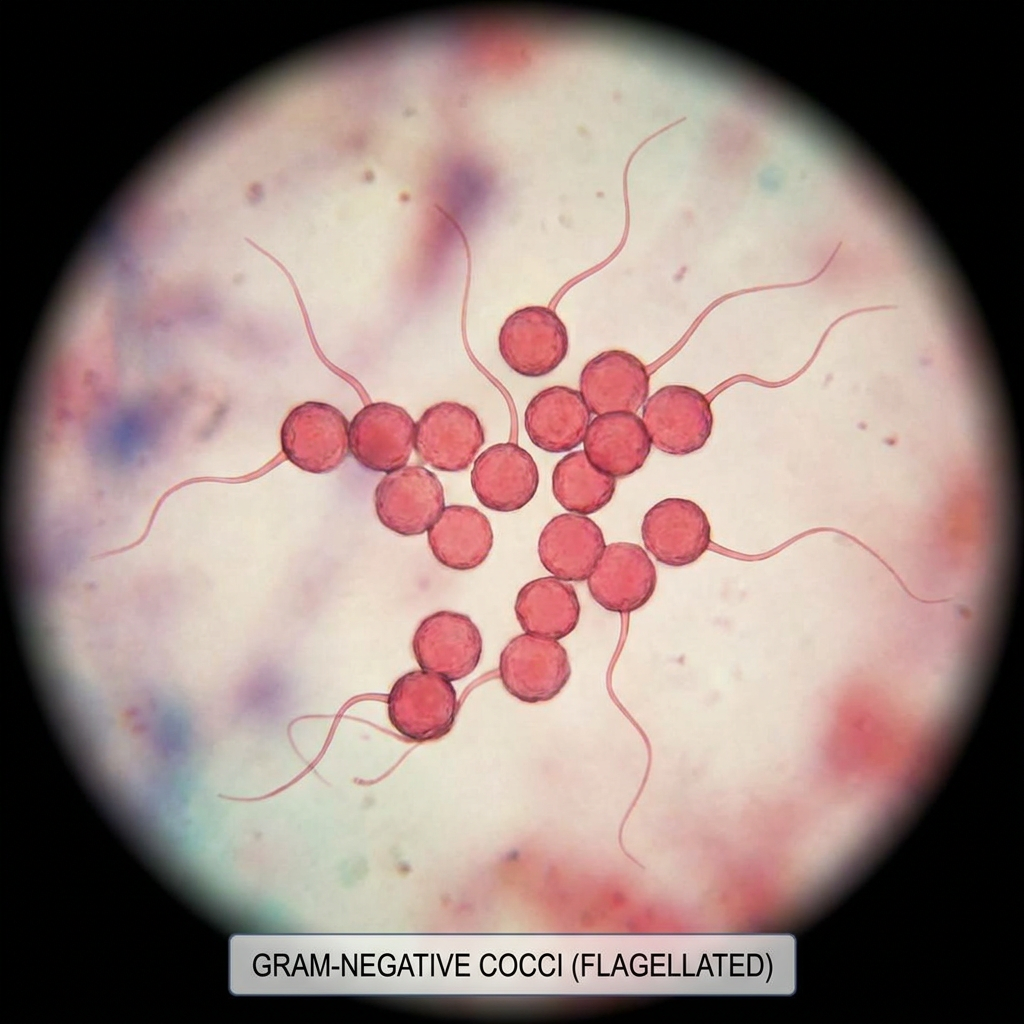
AI-generated image based on bacteria physiology
| Ecology, Host, and Life Cycle | |
|---|---|
| Oxygen requirements | Not Available |
| Optimal temperature | Not Available |
| Temperature range | Not Available |
| Habitat | protist cell |
| Biotic relationship | Not Available |
| Host(s) | Trichonympha agilis, Trichonympha |
| Cell arrangement | Not Available |
| Sporulation | Not Available |
| Energy source | Not Available |
| Pathogenicity | Not Available |
Gene Summary
Adenine Count
320101 bp
Thymine Count
316987 bp
Guanine Count
385101 bp
Cytosine Count
387867 bp
Genome Length
1410056 bp
Protein-coding Genes
1338 genes
Non-Coding Genes
59 genes
# of Chromosomes/Plasmids
1
Genes
| Name | Locus Tag | UniProt ID | Strand Orientation | Gene Start/End | Protein Molecular Weight |
|---|---|---|---|---|---|
| lyse family transporter | RSDT_RS07745 | Not Available | Negative | 874877 - 875215 | 11096.8 |
| giy-yig nuclease family protein | RSDT_RS04265 | Not Available | Negative | 875209 - 875496 | 10141.3 |
| single-stranded-dna-specific exonuclease recj | RSDT_RS04270 | Not Available | Negative | 875539 - 877257 | 61770.0 |
| orotidine-5'-phosphate decarboxylase | RSDT_RS04280 | Not Available | Negative | 877531 - 878214 | 23767.3 |
| guanylate kinase | RSDT_RS04285 | Not Available | Negative | 878239 - 878847 | 22803.2 |
| duf370 domain-containing protein | RSDT_RS04290 | Not Available | Negative | 878837 - 879169 | 12110.2 |
| yicc/yloc family endoribonuclease | RSDT_RS04295 | Not Available | Negative | 879253 - 880131 | 33137.5 |
| fmdb family zinc ribbon protein | RSDT_RS04300 | Not Available | Negative | 880295 - 880555 | 8704.73 |
| nad+ synthase | RSDT_RS04305 | Not Available | Negative | 880640 - 882280 | 59314.9 |
| 5s ribosomal rna | Not Available | Not Available | Positive | 882464 - 882577 | Not Available |
Pathways
0 pathways
No pathways found
No metabolic pathways have been associated with this bacterium yet.
Health Effects
No health effects information available for this bacterium.
