Kingdom
Pseudomonadati
Phylum
Campylobacterota
Class
Epsilonproteobacteria
Order
Campylobacterales
Family
Helicobacteraceae
Genus
Helicobacter
Description
Taxonomy
| Kingdom | Pseudomonadati |
|---|---|
| Phylum | Campylobacterota |
| Class | Epsilonproteobacteria |
| Order | Campylobacterales |
| Family | Helicobacteraceae |
| Genus | Helicobacter |
| Species | Helicobacter pylori |
| Strain | BM012S |
Profile
| Physiology | |
|---|---|
| Gram staining properties | Negative |
| Shape | Spirilla |
| Mobility | No |
| Flagellar presence | Yes |
| Number of membranes | 2 |

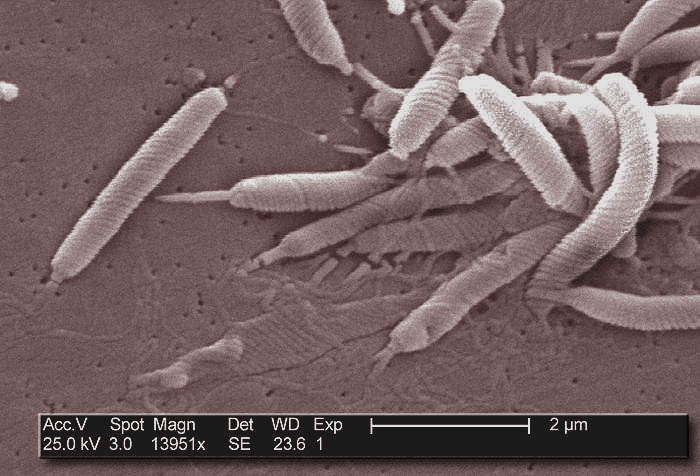
Image source: Wikipedia/Wikimedia
| Ecology, Host, and Life Cycle | |
|---|---|
| Oxygen requirements | Microaerophilic |
| Optimal temperature | 37 |
| Temperature range | Mesophilic |
| Habitat | HostAssociated |
| Biotic relationship | Free living |
| Host(s) | Not Available |
| Cell arrangement | Singles |
| Sporulation | Not Available |
| Energy source | Not Available |
| Pathogenicity | Not Available |
Gene Summary
Adenine Count
507194 bp
Thymine Count
507763 bp
Guanine Count
328090 bp
Cytosine Count
317422 bp
Genome Length
1660469 bp
Protein-coding Genes
1569 genes
Non-Coding Genes
45 genes
# of Chromosomes/Plasmids
1
Genes
| Name | Locus Tag | UniProt ID | Strand Orientation | Gene Start/End | Protein Molecular Weight |
|---|---|---|---|---|---|
| disulfide bond formation protein b | U064_RS04525 | Not Available | Positive | 903431 - 904903 | 55525.2 |
| Ncrna_class:rnase_p_rna | Not Available | Not Available | Positive | 904939 - 905254 | Not Available |
| tumor necrosis factor alpha-inducing protein | U064_RS04530 | Not Available | Positive | 905378 - 905956 | 21849.7 |
| transglycosylase domain-containing protein | U064_RS04535 | Not Available | Negative | 905959 - 907938 | 74142.6 |
| pyridoxal phosphate-dependent aminotransferase family protein | U064_RS04540 | Not Available | Negative | 907939 - 909060 | 41898.8 |
| chemotaxis chemoreceptor tlpd | U064_RS04545 | Not Available | Negative | 909083 - 910384 | 48407.0 |
| abc transporter atp-binding protein | U064_RS04550 | Not Available | Negative | 910456 - 912225 | 67901.3 |
| flagellin a | U064_RS04555 | Not Available | Positive | 912401 - 913933 | 53260.6 |
| 3-methyladenine dna glycosylase | U064_RS04560 | Not Available | Positive | 914051 - 914707 | 25218.6 |
| hypothetical protein | U064_RS04565 | Not Available | Positive | 914704 - 915321 | 23211.7 |
Pathways
0 pathways
No pathways found
No metabolic pathways have been associated with this bacterium yet.
Health Effects
No health effects information available for this bacterium.