Kingdom
Pseudomonadati
Phylum
Campylobacterota
Class
Epsilonproteobacteria
Order
Campylobacterales
Family
Helicobacteraceae
Genus
Helicobacter
Description
Taxonomy
| Kingdom | Pseudomonadati |
|---|---|
| Phylum | Campylobacterota |
| Class | Epsilonproteobacteria |
| Order | Campylobacterales |
| Family | Helicobacteraceae |
| Genus | Helicobacter |
| Species | Helicobacter pylori |
| Strain | BM012S |
Profile
| Physiology | |
|---|---|
| Gram staining properties | Negative |
| Shape | Spirilla |
| Mobility | No |
| Flagellar presence | Yes |
| Number of membranes | 2 |

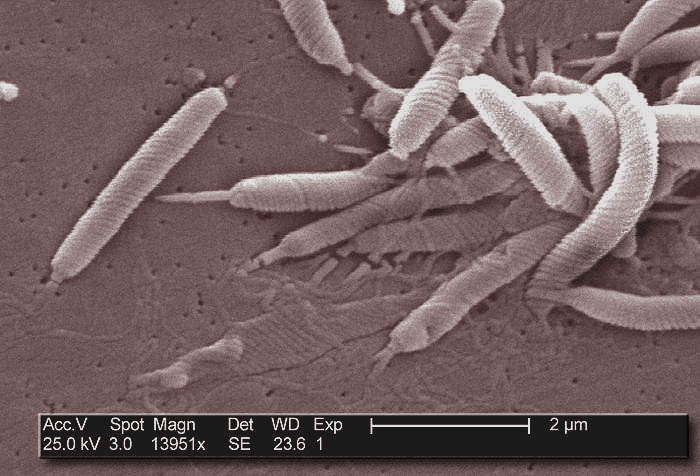
Image source: Wikipedia/Wikimedia
| Ecology, Host, and Life Cycle | |
|---|---|
| Oxygen requirements | Microaerophilic |
| Optimal temperature | 37 |
| Temperature range | Mesophilic |
| Habitat | HostAssociated |
| Biotic relationship | Free living |
| Host(s) | Not Available |
| Cell arrangement | Singles |
| Sporulation | Not Available |
| Energy source | Not Available |
| Pathogenicity | Not Available |
Gene Summary
Adenine Count
507194 bp
Thymine Count
507763 bp
Guanine Count
328090 bp
Cytosine Count
317422 bp
Genome Length
1660469 bp
Protein-coding Genes
1569 genes
Non-Coding Genes
45 genes
# of Chromosomes/Plasmids
1
Genes
| Name | Locus Tag | UniProt ID | Strand Orientation | Gene Start/End | Protein Molecular Weight |
|---|---|---|---|---|---|
| fumarate reductase iron-sulfur subunit | U064_RS02695 | Not Available | Negative | 519820 - 520557 | 27612.3 |
| fumarate reductase flavoprotein subunit | U064_RS02700 | Not Available | Negative | 520550 - 522694 | 80183.0 |
| fumarate reductase cytochrome b subunit | U064_RS02705 | Not Available | Negative | 522704 - 523471 | 28831.8 |
| triose-phosphate isomerase | U064_RS02710 | Not Available | Positive | 523684 - 524388 | 26585.2 |
| enoyl-acp reductase fabi | U064_RS02715 | Not Available | Positive | 524398 - 525225 | 30092.3 |
| udp-3-o-(3-hydroxymyristoyl)glucosamine n-acyltransferase | U064_RS02720 | Not Available | Positive | 525235 - 526245 | 36629.2 |
| methionine adenosyltransferase | U064_RS02725 | Not Available | Positive | 526311 - 527468 | 42344.5 |
| nucleoside-diphosphate kinase | U064_RS02730 | Not Available | Positive | 527534 - 527947 | 15300.6 |
| hypothetical protein | U064_RS02735 | Not Available | Positive | 527972 - 528328 | 13433.0 |
| 50s ribosomal protein l32 | U064_RS02740 | Not Available | Positive | 528344 - 528490 | 5660.97 |
Pathways
0 pathways
No pathways found
No metabolic pathways have been associated with this bacterium yet.
Health Effects
No health effects information available for this bacterium.