
Kingdom
Bacillati
Phylum
Bacillota
Class
Clostridia
Order
Eubacteriales
Family
Clostridiaceae
Genus
Clostridium
Description
Taxonomy
| Kingdom | Bacillati |
|---|---|
| Phylum | Bacillota |
| Class | Clostridia |
| Order | Eubacteriales |
| Family | Clostridiaceae |
| Genus | Clostridium |
| Species | Clostridium botulinum |
| Strain | B2 433 |
Profile
| Physiology | |
|---|---|
| Gram staining properties | Positive |
| Shape | Rod |
| Mobility | Yes |
| Flagellar presence | Yes |
| Number of membranes | 1 |
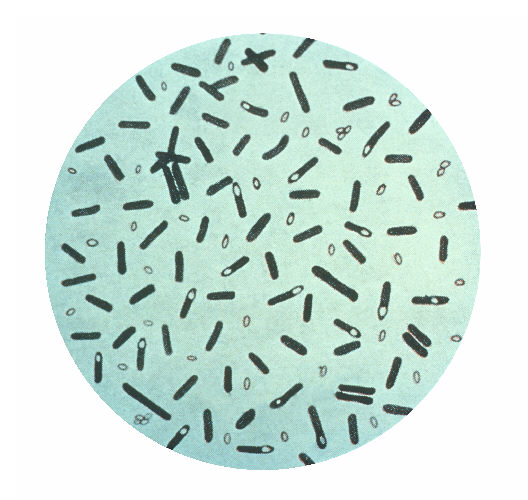
Image source: Wikipedia/Wikimedia
| Ecology, Host, and Life Cycle | |
|---|---|
| Oxygen requirements | Anaerobe |
| Optimal temperature | 37 |
| Temperature range | Mesophilic |
| Habitat | Multiple |
| Biotic relationship | Free living |
| Host(s) | Not Available |
| Cell arrangement | Pairs - Singles - Chains |
| Sporulation | Not Available |
| Energy source | Chemoorganotroph |
| Pathogenicity | Not Available |
Genome Summary
Clostridium botulinum B2 433 plasmid p1_433B2, whole genome
Gene Summary
Adenine Count
87236 bp
Thymine Count
111320 bp
Guanine Count
27382 bp
Cytosine Count
40757 bp
Genome Length
266695 bp
Protein-coding Genes
349 genes
Non-Coding Genes
0 genes
# of Chromosomes/Plasmids
3
Genes
| Name | Locus Tag | UniProt ID | Strand Orientation | Gene Start/End | Protein Molecular Weight |
|---|---|---|---|---|---|
| flagellin | N493_13035 | Not Available | Negative | 2754026 - 2754847 | 29866.2 |
| hypothetical protein | N493_13040 | Not Available | Negative | 2754965 - 2755462 | 19291.4 |
| carbamoyl phosphate synthase-like protein | N493_13045 | Not Available | Negative | 2755681 - 2756709 | 39174.4 |
| hypothetical protein | N493_13055 | Not Available | Negative | 2756919 - 2758169 | 48186.6 |
| hypothetical protein | N493_13060 | Not Available | Negative | 2758196 - 2758516 | 12408.0 |
| lipopolysaccharide biosynthesis protein rfbh | N493_13065 | Not Available | Negative | 2758969 - 2760306 | 50613.5 |
| cdp-glucose 4,6-dehydratase | N493_13070 | Not Available | Negative | 2760308 - 2761396 | 41557.2 |
| family 2 glycosyl transferase | N493_13075 | Not Available | Negative | 2761408 - 2763093 | 64673.9 |
| hypothetical protein | N493_13080 | Not Available | Negative | 2763536 - 2765002 | 56333.8 |
| hypothetical protein | N493_13090 | Not Available | Negative | 2766442 - 2767329 | 33810.9 |
Pathways
0 pathways
No pathways found
No metabolic pathways have been associated with this bacterium yet.
Health Effects
No health effects information available for this bacterium.


