
Kingdom
Pseudomonadati
Phylum
Pseudomonadota
Class
Gammaproteobacteria
Order
Vibrionales
Family
Vibrionaceae
Genus
Vibrio
Description
Taxonomy
| Kingdom | Pseudomonadati |
|---|---|
| Phylum | Pseudomonadota |
| Class | Gammaproteobacteria |
| Order | Vibrionales |
| Family | Vibrionaceae |
| Genus | Vibrio |
| Species | Vibrio parahaemolyticus |
| Strain | O1:Kuk FDA_R31 |
Profile
| Physiology | |
|---|---|
| Gram staining properties | Negative |
| Shape | Rod |
| Mobility | Yes |
| Flagellar presence | Yes |
| Number of membranes | 2 |
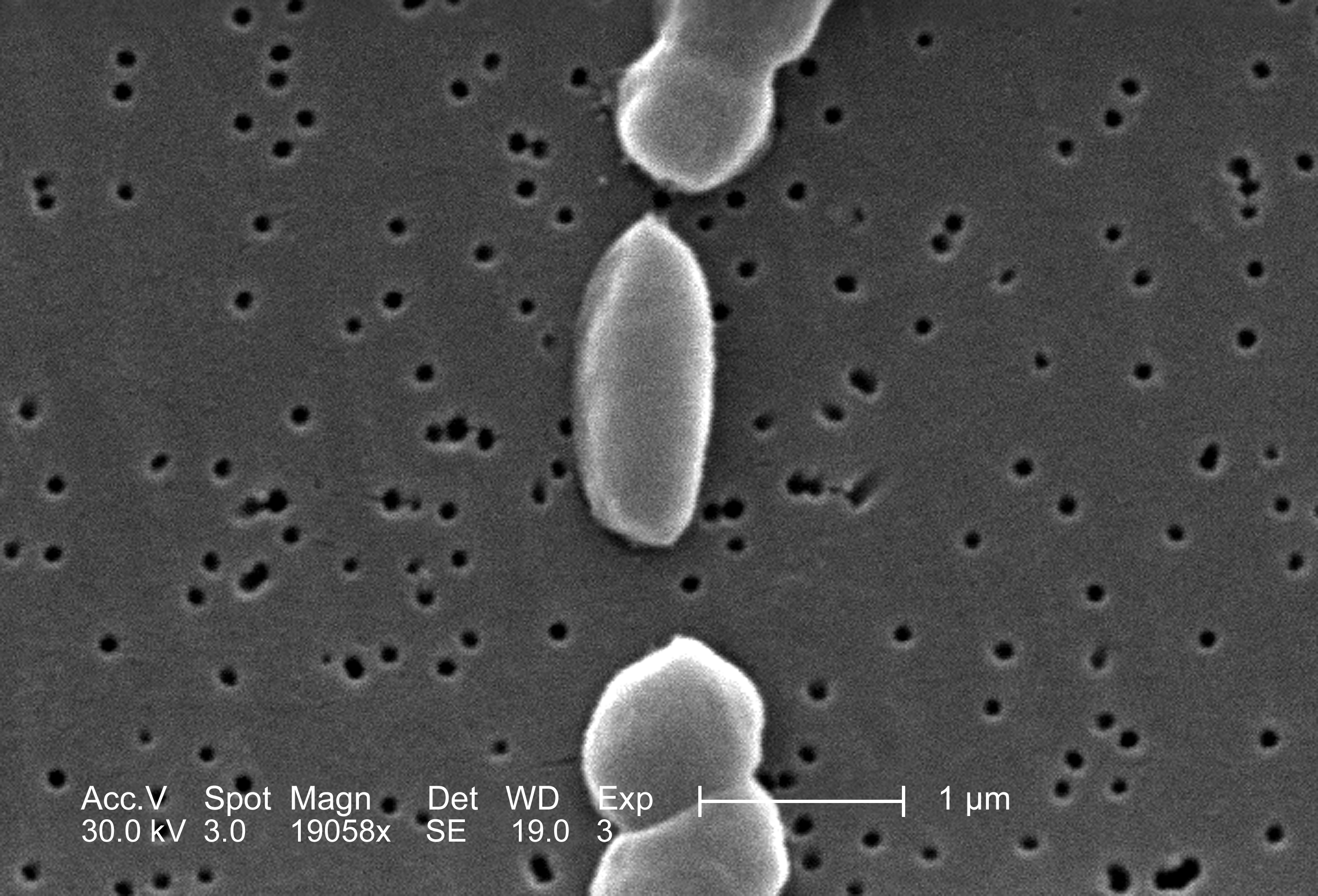
Image source: Wikipedia/Wikimedia
| Ecology, Host, and Life Cycle | |
|---|---|
| Oxygen requirements | Facultative anaerobe |
| Optimal temperature | 20 |
| Temperature range | Mesophilic |
| Habitat | Aquatic |
| Biotic relationship | Free living |
| Host(s) | Not Available |
| Cell arrangement | Singles |
| Sporulation | Not Available |
| Energy source | Heterotroph |
| Pathogenicity | Not Available |
Gene Summary
Adenine Count
512262 bp
Thymine Count
508020 bp
Guanine Count
419811 bp
Cytosine Count
421241 bp
Genome Length
1861334 bp
Protein-coding Genes
1636 genes
Non-Coding Genes
28 genes
# of Chromosomes/Plasmids
2
Genes
| Name | Locus Tag | UniProt ID | Strand Orientation | Gene Start/End | Protein Molecular Weight |
|---|---|---|---|---|---|
| cell division protein zapa | HK86_RS14975 | Not Available | Positive | 3198049 - 3198357 | 11397.6 |
| Ncrna_class:other | Not Available | Not Available | Positive | 3198366 - 3198550 | Not Available |
| 5-formyltetrahydrofolate cyclo-ligase | HK86_RS14980 | Not Available | Positive | 3198570 - 3199163 | 22768.5 |
| ribose-5-phosphate isomerase rpia | HK86_RS14985 | Not Available | Positive | 3199223 - 3199879 | 23171.9 |
| phosphoglycerate dehydrogenase | HK86_RS14990 | Not Available | Positive | 3200154 - 3201386 | 44688.8 |
| oxidative stress defense protein | HK86_RS14995 | Not Available | Negative | 3201451 - 3202143 | 25270.1 |
| lysr family transcriptional regulator argp | HK86_RS15000 | Not Available | Negative | 3202367 - 3203263 | 34011.9 |
| lyse/argo family amino acid transporter | HK86_RS15005 | Not Available | Positive | 3203403 - 3204032 | 22359.9 |
| ybak/ebsc family protein | HK86_RS15010 | Not Available | Positive | 3204057 - 3204539 | 17916.8 |
| small-conductance mechanosensitive channel mscs | HK86_RS15015 | Not Available | Negative | 3204588 - 3205454 | 30977.0 |
Pathways
0 pathways
No pathways found
No metabolic pathways have been associated with this bacterium yet.
Health Effects
No health effects information available for this bacterium.


