
Kingdom
Pseudomonadati
Phylum
Pseudomonadota
Class
Gammaproteobacteria
Order
Vibrionales
Family
Vibrionaceae
Genus
Vibrio
Description
Taxonomy
| Kingdom | Pseudomonadati |
|---|---|
| Phylum | Pseudomonadota |
| Class | Gammaproteobacteria |
| Order | Vibrionales |
| Family | Vibrionaceae |
| Genus | Vibrio |
| Species | Vibrio parahaemolyticus |
| Strain | O1:Kuk FDA_R31 |
Profile
| Physiology | |
|---|---|
| Gram staining properties | Negative |
| Shape | Rod |
| Mobility | Yes |
| Flagellar presence | Yes |
| Number of membranes | 2 |
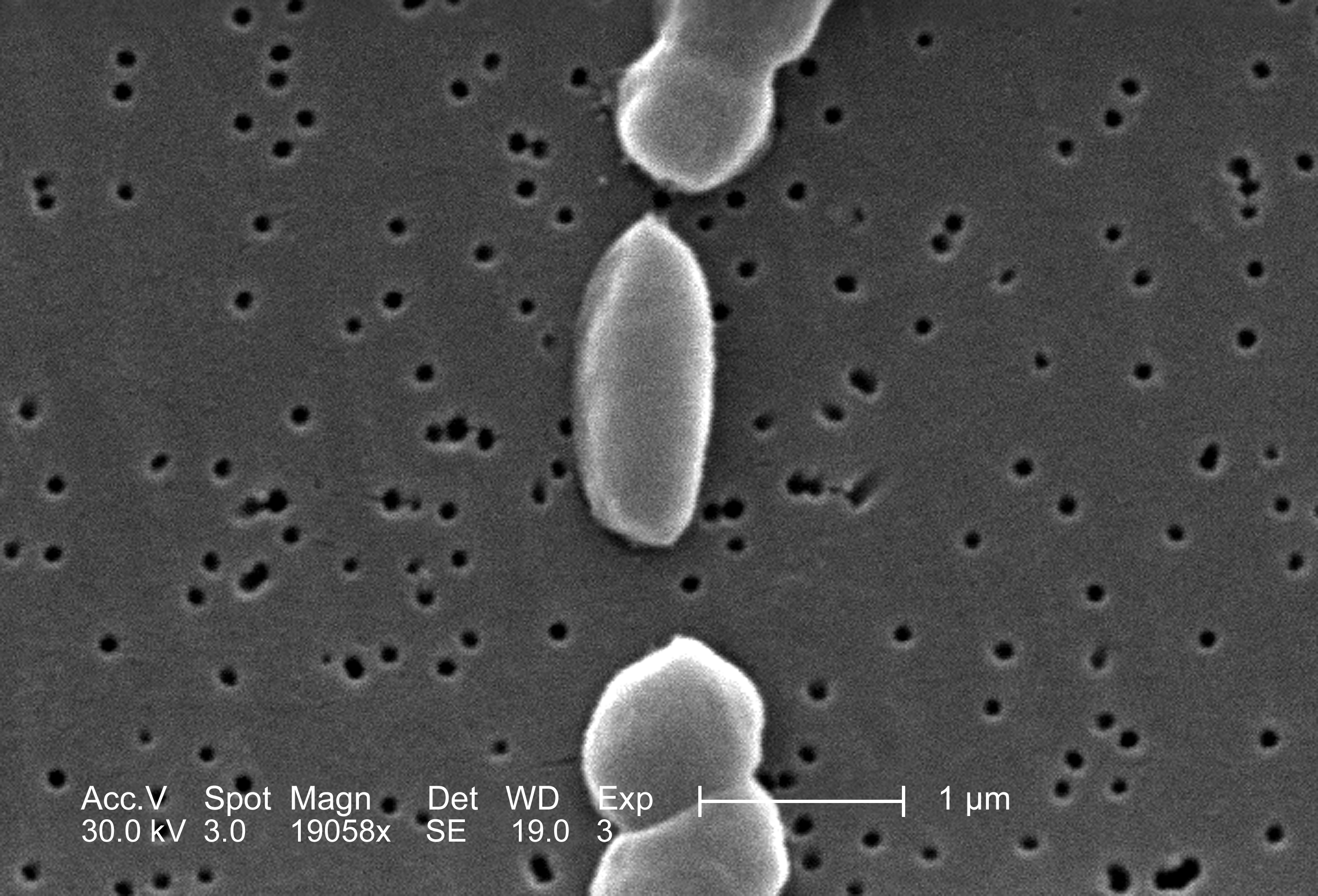
Image source: Wikipedia/Wikimedia
| Ecology, Host, and Life Cycle | |
|---|---|
| Oxygen requirements | Facultative anaerobe |
| Optimal temperature | 20 |
| Temperature range | Mesophilic |
| Habitat | Aquatic |
| Biotic relationship | Free living |
| Host(s) | Not Available |
| Cell arrangement | Singles |
| Sporulation | Not Available |
| Energy source | Heterotroph |
| Pathogenicity | Not Available |
Gene Summary
Adenine Count
512262 bp
Thymine Count
508020 bp
Guanine Count
419811 bp
Cytosine Count
421241 bp
Genome Length
1861334 bp
Protein-coding Genes
1636 genes
Non-Coding Genes
28 genes
# of Chromosomes/Plasmids
2
Genes
| Name | Locus Tag | UniProt ID | Strand Orientation | Gene Start/End | Protein Molecular Weight |
|---|---|---|---|---|---|
| trna(met) cytidine acetyltransferase tmca | HK86_RS17700 | Not Available | Negative | 450143 - 452164 | 75866.6 |
| parb/repb/spo0j family partition protein | HK86_RS17705 | Not Available | Negative | 452289 - 453263 | 35664.8 |
| aaa family atpase | HK86_RS17710 | Not Available | Negative | 453271 - 454488 | 45977.0 |
| replication initiator protein rctb domain-containing protein | HK86_RS17720 | Not Available | Positive | 455741 - 457711 | 75327.5 |
| hypothetical protein | HK86_RS17725 | Not Available | Negative | 458001 - 458468 | 18152.3 |
| abc transporter atp-binding protein | HK86_RS17730 | Not Available | Negative | 458468 - 459400 | 34859.9 |
| transposase | HK86_RS17735 | Not Available | Negative | 459397 - 460226 | 30417.4 |
| pa3496 family putative envelope integrity protein | HK86_RS17740 | Not Available | Positive | 460589 - 460789 | 7698.14 |
| gtp cyclohydrolase ii | HK86_RS25290 | Not Available | Positive | 461034 - 462095 | 40119.9 |
| substrate-binding periplasmic protein | HK86_RS17755 | Not Available | Negative | 462198 - 462953 | 28643.2 |
Pathways
0 pathways
No pathways found
No metabolic pathways have been associated with this bacterium yet.
Health Effects
No health effects information available for this bacterium.


