
Kingdom
Pseudomonadati
Phylum
Pseudomonadota
Class
Gammaproteobacteria
Order
Vibrionales
Family
Vibrionaceae
Genus
Vibrio
Description
Taxonomy
| Kingdom | Pseudomonadati |
|---|---|
| Phylum | Pseudomonadota |
| Class | Gammaproteobacteria |
| Order | Vibrionales |
| Family | Vibrionaceae |
| Genus | Vibrio |
| Species | Vibrio parahaemolyticus |
| Strain | O1:Kuk FDA_R31 |
Profile
| Physiology | |
|---|---|
| Gram staining properties | Negative |
| Shape | Rod |
| Mobility | Yes |
| Flagellar presence | Yes |
| Number of membranes | 2 |
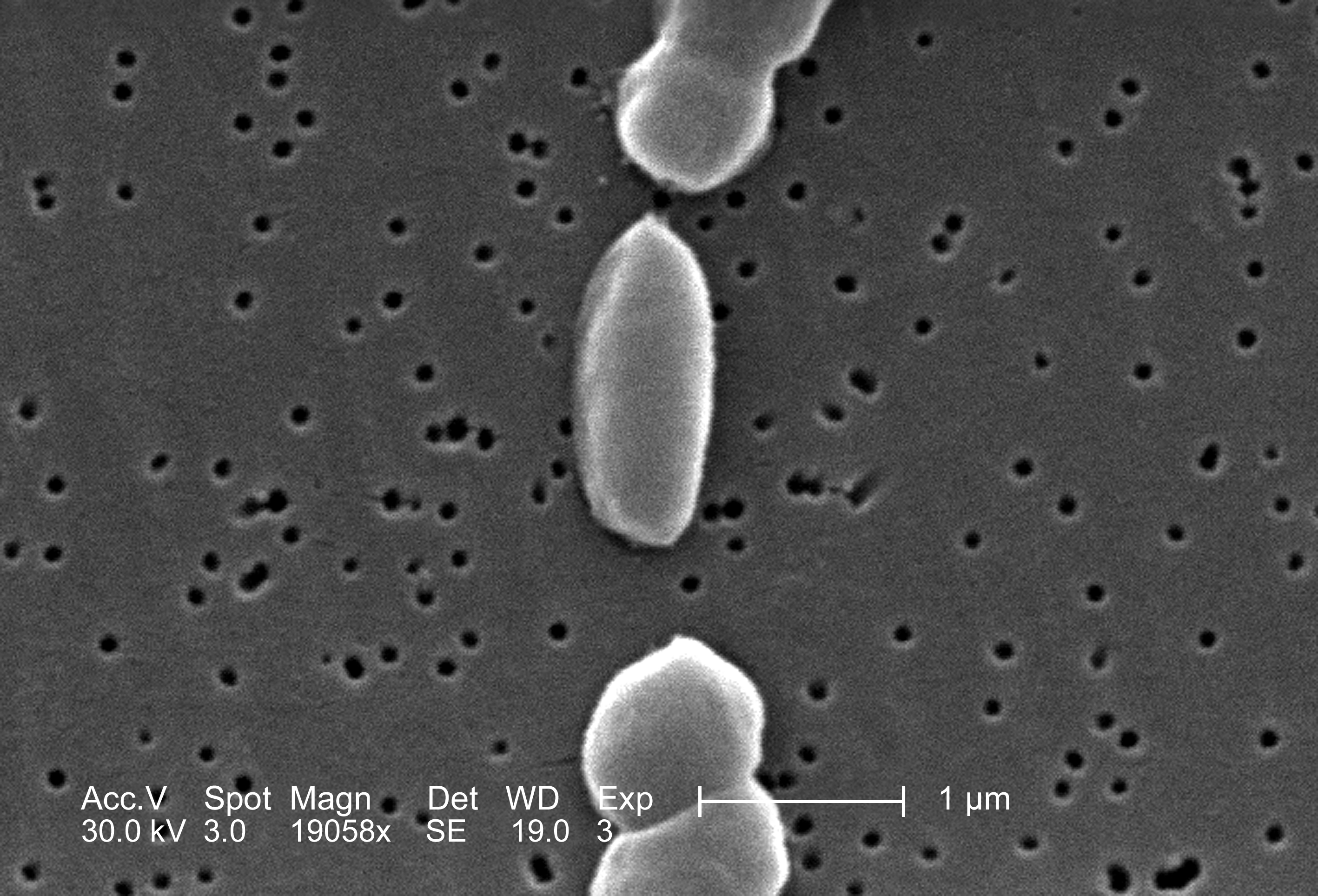
Image source: Wikipedia/Wikimedia
| Ecology, Host, and Life Cycle | |
|---|---|
| Oxygen requirements | Facultative anaerobe |
| Optimal temperature | 20 |
| Temperature range | Mesophilic |
| Habitat | Aquatic |
| Biotic relationship | Free living |
| Host(s) | Not Available |
| Cell arrangement | Singles |
| Sporulation | Not Available |
| Energy source | Heterotroph |
| Pathogenicity | Not Available |
Gene Summary
Adenine Count
512262 bp
Thymine Count
508020 bp
Guanine Count
419811 bp
Cytosine Count
421241 bp
Genome Length
1861334 bp
Protein-coding Genes
1636 genes
Non-Coding Genes
28 genes
# of Chromosomes/Plasmids
2
Genes
| Name | Locus Tag | UniProt ID | Strand Orientation | Gene Start/End | Protein Molecular Weight |
|---|---|---|---|---|---|
| n-acetylglucosamine-specific pts transporter subunit iibc | HK86_RS05985 | Not Available | Positive | 1259318 - 1260889 | 54608.9 |
| glutamine--trna ligase | HK86_RS05990 | Not Available | Positive | 1261125 - 1262795 | 64026.7 |
| ferric iron uptake transcriptional regulator fcrx | HK86_RS05995 | Not Available | Negative | 1262965 - 1263414 | 16771.8 |
| duf4442 domain-containing protein | HK86_RS06000 | Not Available | Positive | 1263614 - 1264117 | 19687.9 |
| flavodoxin flda | HK86_RS06005 | Not Available | Negative | 1264168 - 1264701 | 19850.1 |
| duf2788 domain-containing protein | HK86_RS06010 | Not Available | Negative | 1264750 - 1264971 | 8105.28 |
| alpha/beta fold hydrolase | HK86_RS06015 | Not Available | Negative | 1265084 - 1265851 | 28575.4 |
| replication initiation negative regulator seqa | HK86_RS06020 | Not Available | Positive | 1265944 - 1266486 | 20088.2 |
| phosphoglucomutase (alpha-d-glucose-1,6-bisphosphate-dependent) | HK86_RS06025 | Not Available | Positive | 1266581 - 1268227 | 59256.2 |
| duf1853 family protein | HK86_RS06030 | Not Available | Negative | 1268292 - 1269062 | 29809.4 |
Pathways
0 pathways
No pathways found
No metabolic pathways have been associated with this bacterium yet.
Health Effects
No health effects information available for this bacterium.


