
Kingdom
Pseudomonadati
Phylum
Pseudomonadota
Class
Gammaproteobacteria
Order
Vibrionales
Family
Vibrionaceae
Genus
Vibrio
Description
Taxonomy
| Kingdom | Pseudomonadati |
|---|---|
| Phylum | Pseudomonadota |
| Class | Gammaproteobacteria |
| Order | Vibrionales |
| Family | Vibrionaceae |
| Genus | Vibrio |
| Species | Vibrio parahaemolyticus |
| Strain | O1:Kuk FDA_R31 |
Profile
| Physiology | |
|---|---|
| Gram staining properties | Negative |
| Shape | Rod |
| Mobility | Yes |
| Flagellar presence | Yes |
| Number of membranes | 2 |
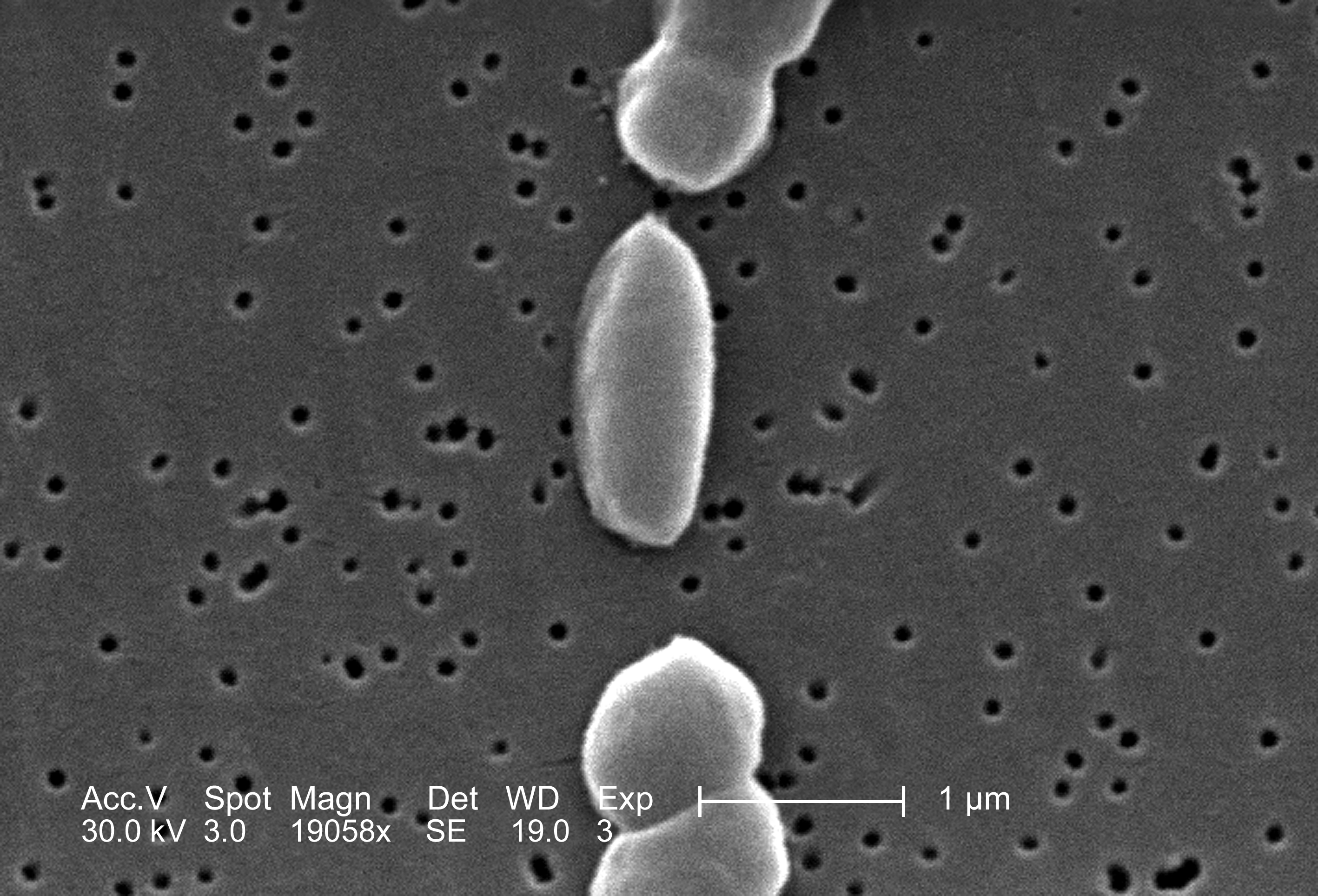
Image source: Wikipedia/Wikimedia
| Ecology, Host, and Life Cycle | |
|---|---|
| Oxygen requirements | Facultative anaerobe |
| Optimal temperature | 20 |
| Temperature range | Mesophilic |
| Habitat | Aquatic |
| Biotic relationship | Free living |
| Host(s) | Not Available |
| Cell arrangement | Singles |
| Sporulation | Not Available |
| Energy source | Heterotroph |
| Pathogenicity | Not Available |
Gene Summary
Adenine Count
512262 bp
Thymine Count
508020 bp
Guanine Count
419811 bp
Cytosine Count
421241 bp
Genome Length
1861334 bp
Protein-coding Genes
1636 genes
Non-Coding Genes
28 genes
# of Chromosomes/Plasmids
2
Genes
| Name | Locus Tag | UniProt ID | Strand Orientation | Gene Start/End | Protein Molecular Weight |
|---|---|---|---|---|---|
| atp-dependent protease subunit hslv | HK86_RS03155 | Not Available | Negative | 649980 - 650531 | 19554.2 |
| cell division protein ftsn | HK86_RS03160 | Not Available | Negative | 650696 - 651241 | 20760.3 |
| dna-binding transcriptional regulator cytr | HK86_RS03165 | Not Available | Negative | 651418 - 652464 | 38447.4 |
| primosomal protein n' | HK86_RS03170 | Not Available | Negative | 652758 - 654962 | 82234.4 |
| 50s ribosomal protein l31 | HK86_RS03175 | Not Available | Positive | 655257 - 655478 | 8055.57 |
| 30s ribosomal protein s10 | HK86_RS03180 | Not Available | Positive | 655936 - 656247 | 11721.4 |
| 50s ribosomal protein l3 | HK86_RS03185 | Not Available | Positive | 656262 - 656891 | 22375.0 |
| 50s ribosomal protein l4 | HK86_RS03190 | Not Available | Positive | 656909 - 657511 | 21889.5 |
| 50s ribosomal protein l23 | HK86_RS03195 | Not Available | Positive | 657508 - 657810 | 11128.7 |
| 50s ribosomal protein l2 | HK86_RS03200 | Not Available | Positive | 657826 - 658650 | 29951.4 |
Pathways
0 pathways
No pathways found
No metabolic pathways have been associated with this bacterium yet.
Health Effects
No health effects information available for this bacterium.


