
Kingdom
Pseudomonadati
Phylum
Pseudomonadota
Class
Gammaproteobacteria
Order
Vibrionales
Family
Vibrionaceae
Genus
Vibrio
Description
Taxonomy
| Kingdom | Pseudomonadati |
|---|---|
| Phylum | Pseudomonadota |
| Class | Gammaproteobacteria |
| Order | Vibrionales |
| Family | Vibrionaceae |
| Genus | Vibrio |
| Species | Vibrio parahaemolyticus |
| Strain | O1:Kuk FDA_R31 |
Profile
| Physiology | |
|---|---|
| Gram staining properties | Negative |
| Shape | Rod |
| Mobility | Yes |
| Flagellar presence | Yes |
| Number of membranes | 2 |
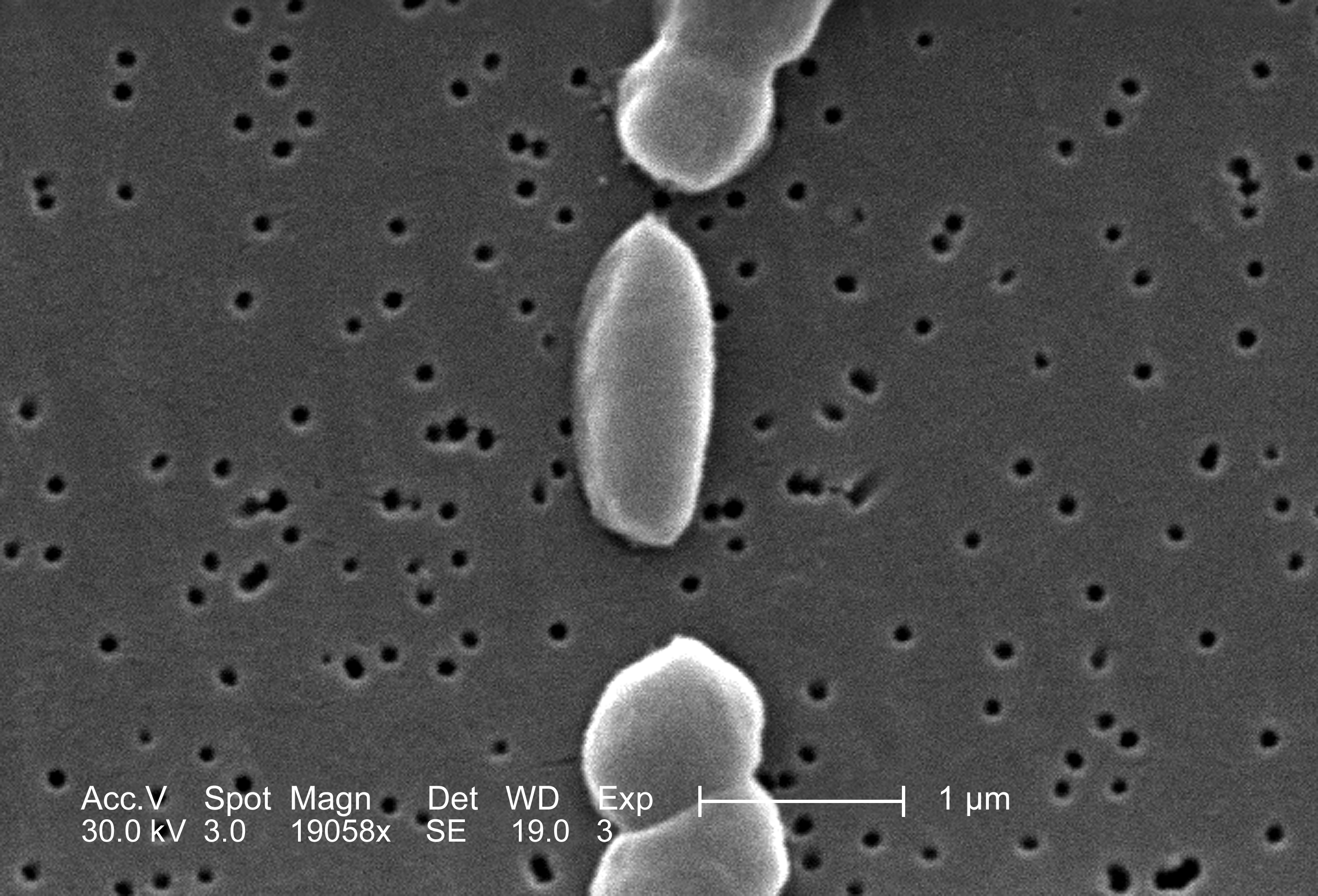
Image source: Wikipedia/Wikimedia
| Ecology, Host, and Life Cycle | |
|---|---|
| Oxygen requirements | Facultative anaerobe |
| Optimal temperature | 20 |
| Temperature range | Mesophilic |
| Habitat | Aquatic |
| Biotic relationship | Free living |
| Host(s) | Not Available |
| Cell arrangement | Singles |
| Sporulation | Not Available |
| Energy source | Heterotroph |
| Pathogenicity | Not Available |
Gene Summary
Adenine Count
512262 bp
Thymine Count
508020 bp
Guanine Count
419811 bp
Cytosine Count
421241 bp
Genome Length
1861334 bp
Protein-coding Genes
1636 genes
Non-Coding Genes
28 genes
# of Chromosomes/Plasmids
2
Genes
| Name | Locus Tag | UniProt ID | Strand Orientation | Gene Start/End | Protein Molecular Weight |
|---|---|---|---|---|---|
| aminotransferase class v-fold plp-dependent enzyme | HK86_RS16560 | Not Available | Negative | 192521 - 193927 | 52903.4 |
| superoxide dismutase family protein | HK86_RS16565 | Not Available | Positive | 194473 - 194988 | 17487.7 |
| sensor histidine kinase | HK86_RS16570 | Not Available | Negative | 195016 - 196389 | 51318.6 |
| response regulator transcription factor | HK86_RS16575 | Not Available | Negative | 196414 - 197145 | 27645.6 |
| spondin domain-containing protein | HK86_RS16580 | Not Available | Negative | 197318 - 198013 | 24410.4 |
| spondin domain-containing protein | HK86_RS16585 | Not Available | Negative | 198023 - 198706 | 23174.2 |
| hypothetical protein | HK86_RS16590 | Not Available | Positive | 198927 - 199400 | 18494.9 |
| lysr family transcriptional regulator | HK86_RS16595 | Not Available | Positive | 199478 - 200407 | 34472.7 |
| voc family protein | HK86_RS16600 | Not Available | Positive | 200400 - 200783 | 14554.3 |
| pepsy-associated tm helix domain-containing protein | HK86_RS16605 | Not Available | Negative | 200831 - 202270 | 53338.6 |
Pathways
0 pathways
No pathways found
No metabolic pathways have been associated with this bacterium yet.
Health Effects
No health effects information available for this bacterium.


