
Kingdom
Pseudomonadati
Phylum
Pseudomonadota
Class
Gammaproteobacteria
Order
Moraxellales
Family
Moraxellaceae
Genus
Acinetobacter
Description
Taxonomy
| Kingdom | Pseudomonadati |
|---|---|
| Phylum | Pseudomonadota |
| Class | Gammaproteobacteria |
| Order | Moraxellales |
| Family | Moraxellaceae |
| Genus | Acinetobacter |
| Species | Acinetobacter baumannii |
| Strain | 1571545 |
Profile
| Physiology | |
|---|---|
| Gram staining properties | Negative |
| Shape | Rod |
| Mobility | No |
| Flagellar presence | Yes |
| Number of membranes | 2 |
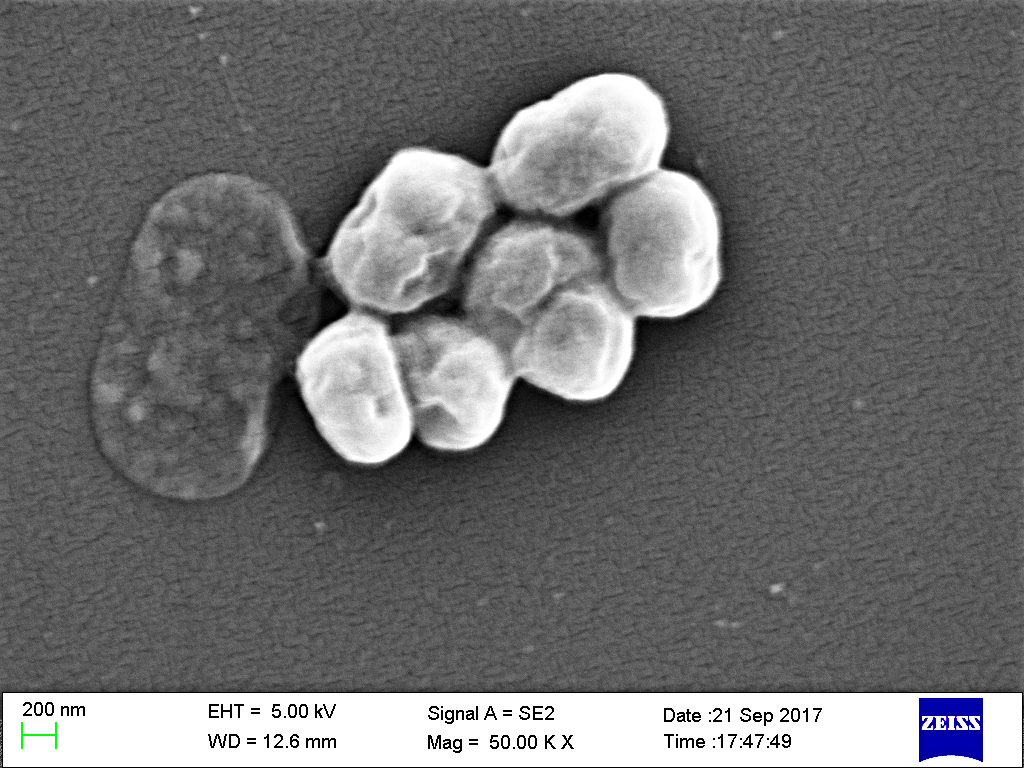
Image source: Wikipedia/Wikimedia
| Ecology, Host, and Life Cycle | |
|---|---|
| Oxygen requirements | Aerobe |
| Optimal temperature | 37 |
| Temperature range | Mesophilic |
| Habitat | Multiple |
| Biotic relationship | Free living |
| Host(s) | Not Available |
| Cell arrangement | Singles |
| Sporulation | Not Available |
| Energy source | Heterotroph - Chemoheterotroph |
| Pathogenicity | Not Available |
Gene Summary
Adenine Count
1364416 bp
Thymine Count
1356432 bp
Guanine Count
854271 bp
Cytosine Count
885439 bp
Genome Length
4460558 bp
Protein-coding Genes
4140 genes
Non-Coding Genes
366 genes
# of Chromosomes/Plasmids
1
Genes
| Name | Locus Tag | UniProt ID | Strand Orientation | Gene Start/End | Protein Molecular Weight |
|---|---|---|---|---|---|
| hypothetical protein | J715_4091 | Not Available | Positive | 4100189 - 4100794 | 23537.4 |
| helix-turn-helix family protein | J715_4092 | Not Available | Positive | 4101388 - 4101705 | 11922.5 |
| hipa n-terminal domain protein | J715_4093 | Not Available | Positive | 4101702 - 4102991 | 49225.8 |
| helicase domain protein | J715_4094 | Not Available | Negative | 4103010 - 4106234 | 124661.0 |
| putative hipa domain-containing protein | J715_4095 | Not Available | Positive | 4106422 - 4106550 | 4548.58 |
| pts system, fru family, iib component domain protein | J715_4096 | Not Available | Negative | 4106870 - 4108552 | 58755.0 |
| 1-phosphofructokinase | J715_4097 | Not Available | Negative | 4108557 - 4109489 | 33373.9 |
| putative phosphotransferase system, fructose-specific ei/hpr/eiia component | J715_4098 | Not Available | Negative | 4109496 - 4109906 | 14644.7 |
| phosphoenolpyruvate-dependent sugar phosphotransferase system, eiia 2 family protein | J715_4099 | Not Available | Negative | 4109907 - 4110278 | 13704.6 |
| pilin inverting domain protein | J715_4100 | Not Available | Positive | 4110442 - 4110576 | 5066.42 |
Pathways
0 pathways
No pathways found
No metabolic pathways have been associated with this bacterium yet.
Health Effects
No health effects information available for this bacterium.

