
Kingdom
Pseudomonadati
Phylum
Pseudomonadota
Class
Gammaproteobacteria
Order
Moraxellales
Family
Moraxellaceae
Genus
Acinetobacter
Description
Taxonomy
| Kingdom | Pseudomonadati |
|---|---|
| Phylum | Pseudomonadota |
| Class | Gammaproteobacteria |
| Order | Moraxellales |
| Family | Moraxellaceae |
| Genus | Acinetobacter |
| Species | Acinetobacter baumannii |
| Strain | 496487 |
Profile
| Physiology | |
|---|---|
| Gram staining properties | Negative |
| Shape | Rod |
| Mobility | No |
| Flagellar presence | Yes |
| Number of membranes | 2 |
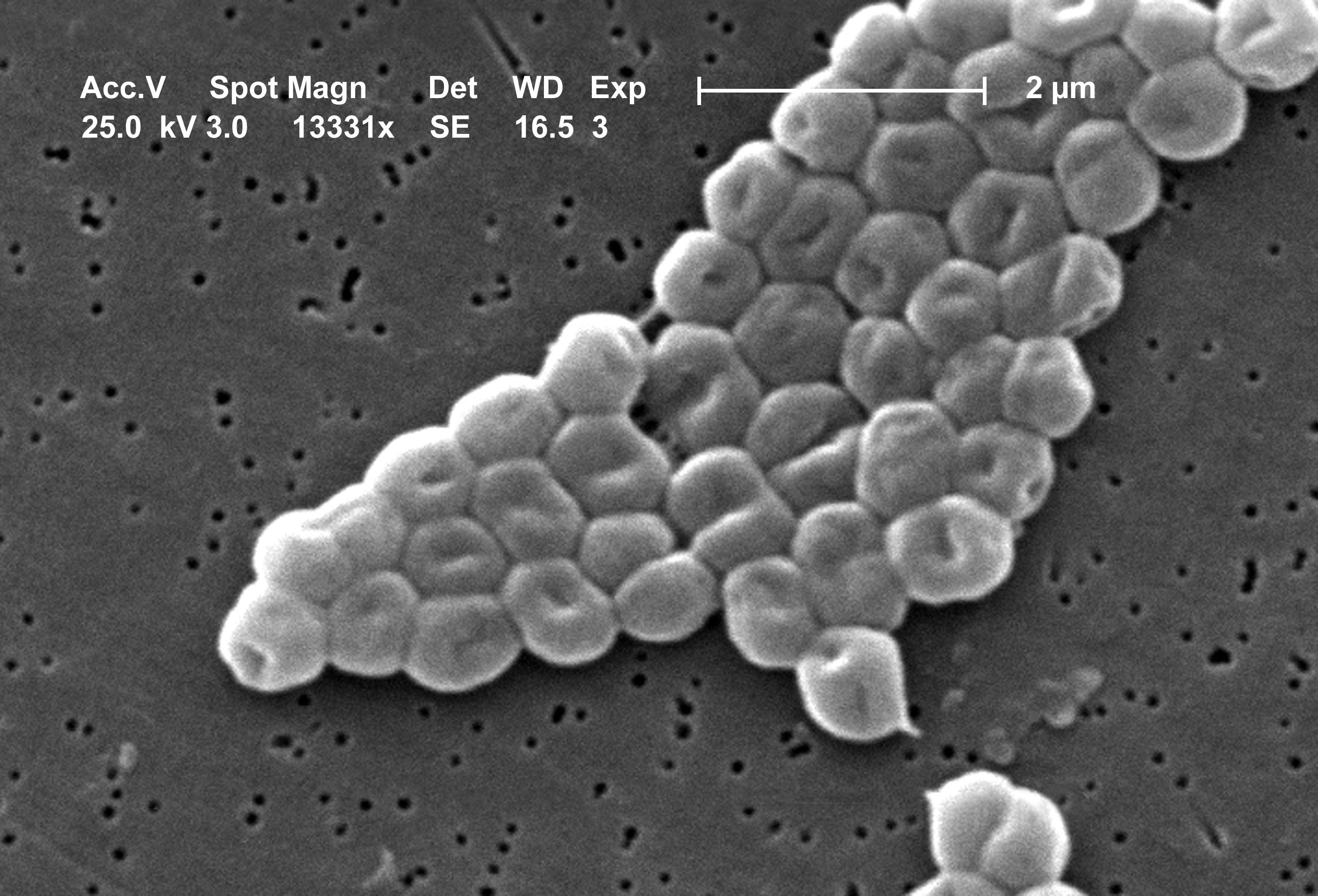
Image source: Wikipedia/Wikimedia
| Ecology, Host, and Life Cycle | |
|---|---|
| Oxygen requirements | Aerobe |
| Optimal temperature | 37 |
| Temperature range | Mesophilic |
| Habitat | Multiple |
| Biotic relationship | Free living |
| Host(s) | Not Available |
| Cell arrangement | Singles |
| Sporulation | Not Available |
| Energy source | Heterotroph - Chemoheterotroph |
| Pathogenicity | Not Available |
Gene Summary
Adenine Count
1311415 bp
Thymine Count
1318792 bp
Guanine Count
822672 bp
Cytosine Count
852869 bp
Genome Length
4305748 bp
Protein-coding Genes
4297 genes
Non-Coding Genes
225 genes
# of Chromosomes/Plasmids
1
Genes
| Name | Locus Tag | UniProt ID | Strand Orientation | Gene Start/End | Protein Molecular Weight |
|---|---|---|---|---|---|
| aaa domain family protein | J524_1586 | Not Available | Positive | 1637041 - 1638312 | 48386.4 |
| bestrophin, rfp-tm, chloride channel family protein | J524_1587 | Not Available | Positive | 1638382 - 1639293 | 34405.1 |
| zinc-binding dehydrogenase family protein | J524_1588 | Not Available | Negative | 1639340 - 1640398 | 37692.6 |
| diacetyl reductase | J524_1589 | Not Available | Negative | 1640428 - 1641213 | 27665.2 |
| dihydrolipoyl dehydrogenase | J524_1590 | Not Available | Negative | 1641240 - 1642643 | 49967.4 |
| 2-oxoacid dehydrogenases acyltransferase family protein | J524_1591 | Not Available | Negative | 1642654 - 1644144 | 52742.0 |
| 2,6-dichlorophenolindophenol oxidoreductase subunit beta | J524_1592 | Not Available | Negative | 1644191 - 1645210 | 36593.0 |
| 2,6-dichlorophenolindophenol oxidoreductase subunit alpha | J524_1593 | Not Available | Negative | 1645224 - 1646186 | 34376.9 |
| lipoyl synthase | J524_1594 | Not Available | Positive | 1646551 - 1647537 | 37449.4 |
| putative transcriptional regulatory protein | J524_1595 | Not Available | Positive | 1647695 - 1648834 | 42780.3 |
Pathways
0 pathways
No pathways found
No metabolic pathways have been associated with this bacterium yet.
Health Effects
No health effects information available for this bacterium.

