
Kingdom
Pseudomonadati
Phylum
Pseudomonadota
Class
Gammaproteobacteria
Order
Vibrionales
Family
Vibrionaceae
Genus
Vibrio
Description
Taxonomy
| Kingdom | Pseudomonadati |
|---|---|
| Phylum | Pseudomonadota |
| Class | Gammaproteobacteria |
| Order | Vibrionales |
| Family | Vibrionaceae |
| Genus | Vibrio |
| Species | Vibrio parahaemolyticus |
| Strain | 901128 |
Profile
| Physiology | |
|---|---|
| Gram staining properties | Negative |
| Shape | Rod |
| Mobility | Yes |
| Flagellar presence | Yes |
| Number of membranes | 2 |
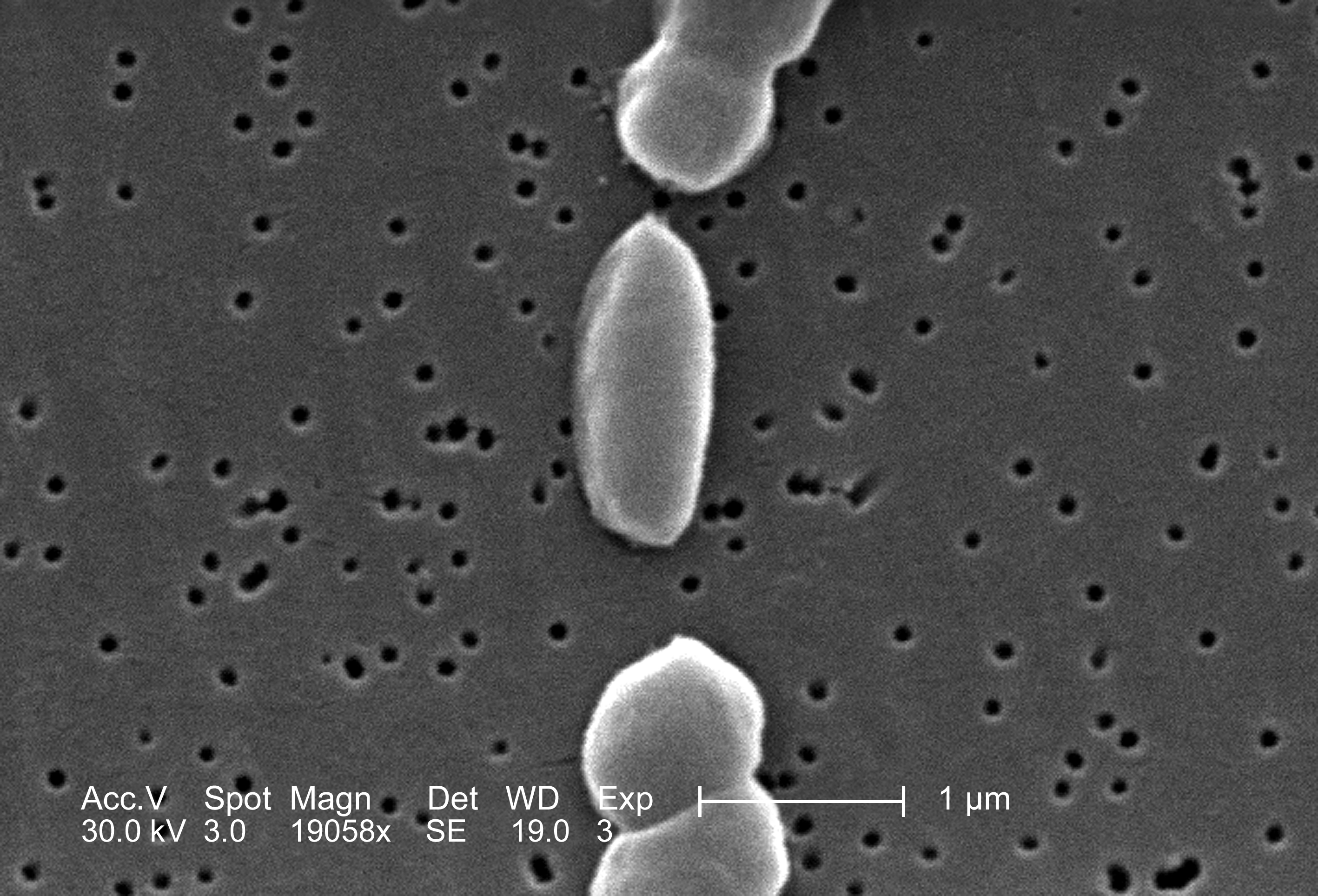
Image source: Wikipedia/Wikimedia
| Ecology, Host, and Life Cycle | |
|---|---|
| Oxygen requirements | Facultative anaerobe |
| Optimal temperature | 20 |
| Temperature range | Mesophilic |
| Habitat | Aquatic |
| Biotic relationship | Free living |
| Host(s) | Not Available |
| Cell arrangement | Singles |
| Sporulation | Not Available |
| Energy source | Heterotroph |
| Pathogenicity | Not Available |
Gene Summary
Adenine Count
1440855 bp
Thymine Count
1439608 bp
Guanine Count
1185633 bp
Cytosine Count
1187058 bp
Genome Length
5255365 bp
Protein-coding Genes
4294 genes
Non-Coding Genes
42 genes
# of Chromosomes/Plasmids
1
Genes
| Name | Locus Tag | UniProt ID | Strand Orientation | Gene Start/End | Protein Molecular Weight |
|---|---|---|---|---|---|
| imidazoleglycerol-phosphate dehydratase | H334_05035 | Not Available | Negative | 3654130 - 3655203 | 39829.7 |
| histidinol-phosphate aminotransferase | H334_05040 | Not Available | Negative | 3655269 - 3656309 | 38177.9 |
| bifunctional histidinal dehydrogenase/ histidinol dehydrogenase | H334_05045 | Not Available | Negative | 3656325 - 3657620 | 46101.2 |
| atp phosphoribosyltransferase | H334_05050 | Not Available | Negative | 3657626 - 3658522 | 32847.1 |
| atpase aaa | H334_05055 | Not Available | Positive | 3659125 - 3660081 | 35765.5 |
| hypothetical protein | H334_05060 | Not Available | Positive | 3660258 - 3662642 | 87293.1 |
| hypothetical protein | H334_05065 | Not Available | Negative | 3662750 - 3664351 | 56458.5 |
| dna-binding protein | H334_05070 | Not Available | Positive | 3665243 - 3665650 | 15076.8 |
| inosine/guanosine kinase | H334_05075 | Not Available | Negative | 3665749 - 3667053 | 48480.3 |
| hypothetical protein | H334_05080 | Not Available | Negative | 3667171 - 3667440 | 10306.5 |
Pathways
0 pathways
No pathways found
No metabolic pathways have been associated with this bacterium yet.
Health Effects
No health effects information available for this bacterium.


