
Kingdom
Pseudomonadati
Phylum
Pseudomonadota
Class
Gammaproteobacteria
Order
Vibrionales
Family
Vibrionaceae
Genus
Vibrio
Description
Taxonomy
| Kingdom | Pseudomonadati |
|---|---|
| Phylum | Pseudomonadota |
| Class | Gammaproteobacteria |
| Order | Vibrionales |
| Family | Vibrionaceae |
| Genus | Vibrio |
| Species | Vibrio parahaemolyticus |
| Strain | 901128 |
Profile
| Physiology | |
|---|---|
| Gram staining properties | Negative |
| Shape | Rod |
| Mobility | Yes |
| Flagellar presence | Yes |
| Number of membranes | 2 |
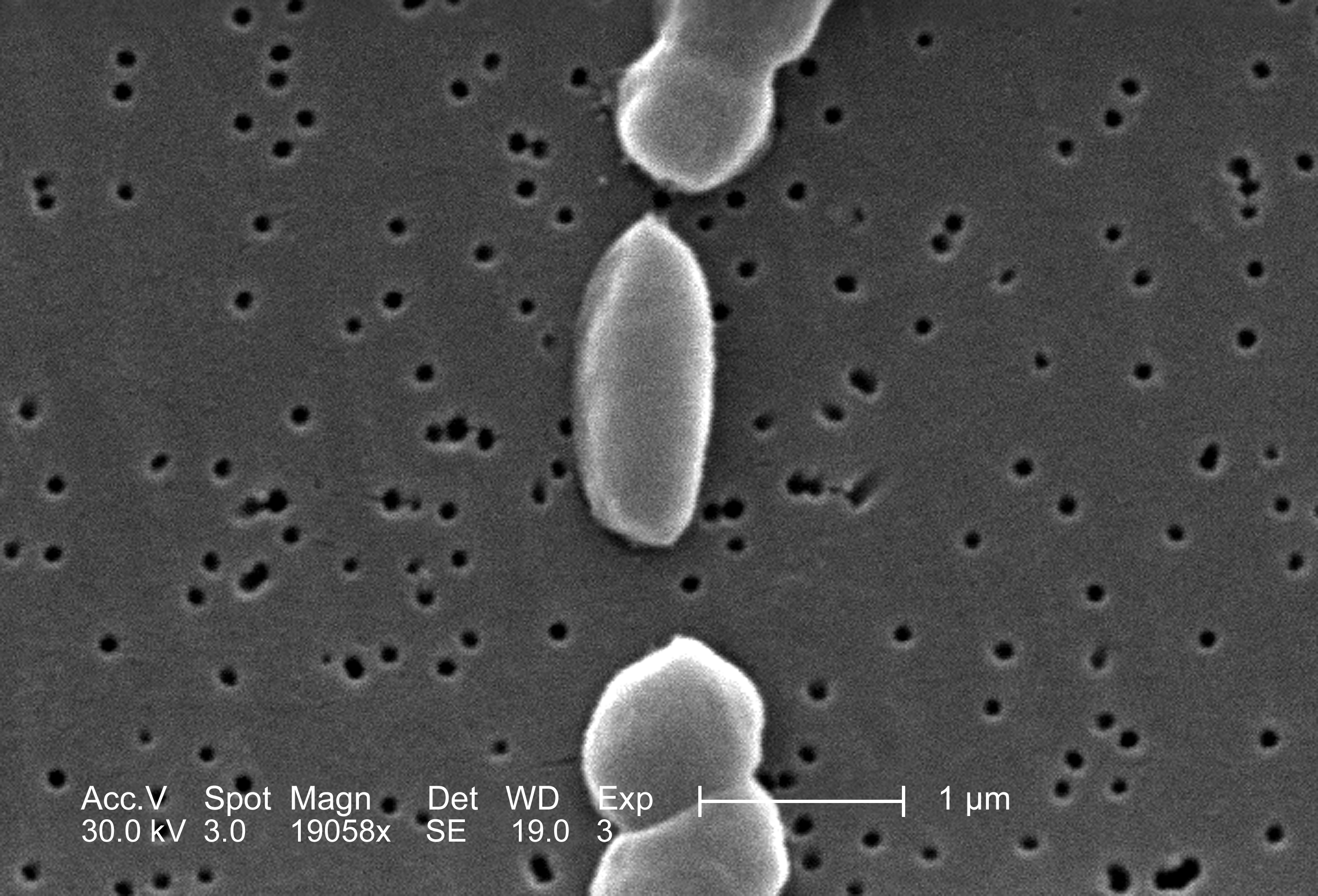
Image source: Wikipedia/Wikimedia
| Ecology, Host, and Life Cycle | |
|---|---|
| Oxygen requirements | Facultative anaerobe |
| Optimal temperature | 20 |
| Temperature range | Mesophilic |
| Habitat | Aquatic |
| Biotic relationship | Free living |
| Host(s) | Not Available |
| Cell arrangement | Singles |
| Sporulation | Not Available |
| Energy source | Heterotroph |
| Pathogenicity | Not Available |
Gene Summary
Adenine Count
1440855 bp
Thymine Count
1439608 bp
Guanine Count
1185633 bp
Cytosine Count
1187058 bp
Genome Length
5255365 bp
Protein-coding Genes
4294 genes
Non-Coding Genes
42 genes
# of Chromosomes/Plasmids
1
Genes
| Name | Locus Tag | UniProt ID | Strand Orientation | Gene Start/End | Protein Molecular Weight |
|---|---|---|---|---|---|
| amidophosphoribosyltransferase | H334_18495 | Not Available | Negative | 1749059 - 1750573 | 56014.6 |
| bacteriocin production protein | H334_18500 | Not Available | Negative | 1750610 - 1751101 | 17867.9 |
| dedd protein | H334_18505 | Not Available | Negative | 1751163 - 1751771 | 22781.2 |
| acetyl-coa carboxylase carboxyl transferase subunit beta | H334_18515 | Not Available | Negative | 1753102 - 1754028 | 34032.3 |
| hypothetical protein | H334_18525 | Not Available | Negative | 1755111 - 1756044 | 34195.3 |
| threonine synthase | H334_18535 | Not Available | Negative | 1756756 - 1758036 | 46443.4 |
| homoserine kinase | H334_18540 | Not Available | Negative | 1758033 - 1758989 | 34437.4 |
| bifunctional aspartokinase i/homoserine dehydrogenase i | H334_18545 | Not Available | Negative | 1759010 - 1761469 | 88477.8 |
| ribonuclease activity regulator protein rraa | H334_18550 | Not Available | Positive | 1762083 - 1762553 | 17511.3 |
| ribonuclease | H334_18555 | Not Available | Negative | 1762550 - 1763032 | 17668.2 |
Pathways
0 pathways
No pathways found
No metabolic pathways have been associated with this bacterium yet.
Health Effects
No health effects information available for this bacterium.


