Kingdom
Pseudomonadati
Phylum
Pseudomonadota
Class
Gammaproteobacteria
Order
Enterobacterales
Family
Yersiniaceae
Genus
Yersinia
Description
Taxonomy
| Kingdom | Pseudomonadati |
|---|---|
| Phylum | Pseudomonadota |
| Class | Gammaproteobacteria |
| Order | Enterobacterales |
| Family | Yersiniaceae |
| Genus | Yersinia |
| Species | Yersinia pekkanenii |
| Strain | No strain |
Profile
| Physiology | |
|---|---|
| Gram staining properties | Not Available |
| Shape | Rod |
| Mobility | Not Available |
| Flagellar presence | Yes |
| Number of membranes | Not Available |

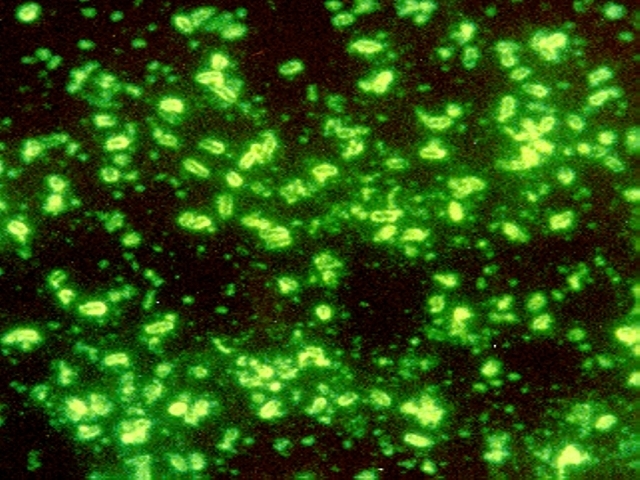
Image source: Wikipedia/Wikimedia
| Ecology, Host, and Life Cycle | |
|---|---|
| Oxygen requirements | aerobic |
| Optimal temperature | Not Available |
| Temperature range | Not Available |
| Habitat | Not Available |
| Biotic relationship | Not Available |
| Host(s) | Homo sapiens, Metazoa |
| Cell arrangement | Not Available |
| Sporulation | Not Available |
| Energy source | Not Available |
| Pathogenicity | Not Available |
Gene Summary
Adenine Count
1333324 bp
Thymine Count
1323157 bp
Guanine Count
1185576 bp
Cytosine Count
1203682 bp
Genome Length
5046986 bp
Protein-coding Genes
4472 genes
Non-Coding Genes
386 genes
# of Chromosomes/Plasmids
1
Genes
| Name | Locus Tag | UniProt ID | Strand Orientation | Gene Start/End | Protein Molecular Weight |
|---|---|---|---|---|---|
| aminotransferase | ERS008529_03626 | Not Available | Positive | 3836662 - 3837897 | 45978.4 |
| putative b-type cytochrome | ERS008529_03627 | Not Available | Positive | 3838085 - 3838609 | 20300.3 |
| antitoxin hicb | ERS008529_03628 | Not Available | Negative | 3839010 - 3839441 | 15908.1 |
| curli production assembly/transport component csgg | ERS008529_03629 | Not Available | Positive | 3839953 - 3840624 | 23910.5 |
| putative lipoprotein | ERS008529_03630 | Not Available | Positive | 3840654 - 3841010 | 12956.7 |
| putative lipoprotein | ERS008529_03631 | Not Available | Positive | 3841007 - 3841663 | 22888.6 |
| tord family cytoplasmic chaperone | ERS008529_03632 | Not Available | Negative | 3842082 - 3842699 | 23607.5 |
| anaerobic dimethyl sulfoxide reductase subunit b | ERS008529_03633 | Not Available | Negative | 3842804 - 3843580 | 27491.7 |
| dimethylsulfoxide reductase subunit b | ERS008529_03634 | Not Available | Negative | 3843582 - 3844199 | 22919.4 |
| dimethyl sulfoxide reductase chain a protein | ERS008529_03635 | Not Available | Negative | 3844211 - 3846634 | 89370.3 |
Pathways
0 pathways
No pathways found
No metabolic pathways have been associated with this bacterium yet.
Health Effects
No health effects information available for this bacterium.