Kingdom
Pseudomonadati
Phylum
Pseudomonadota
Class
Gammaproteobacteria
Order
Enterobacterales
Family
Yersiniaceae
Genus
Yersinia
Description
Taxonomy
| Kingdom | Pseudomonadati |
|---|---|
| Phylum | Pseudomonadota |
| Class | Gammaproteobacteria |
| Order | Enterobacterales |
| Family | Yersiniaceae |
| Genus | Yersinia |
| Species | Yersinia pekkanenii |
| Strain | No strain |
Profile
| Physiology | |
|---|---|
| Gram staining properties | Not Available |
| Shape | Rod |
| Mobility | Not Available |
| Flagellar presence | Yes |
| Number of membranes | Not Available |

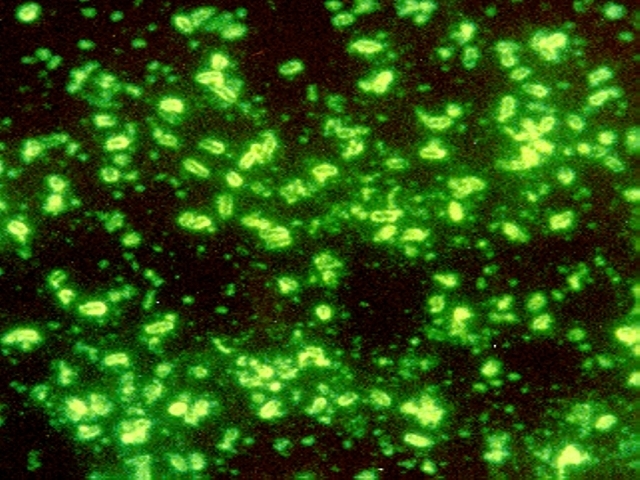
Image source: Wikipedia/Wikimedia
| Ecology, Host, and Life Cycle | |
|---|---|
| Oxygen requirements | aerobic |
| Optimal temperature | Not Available |
| Temperature range | Not Available |
| Habitat | Not Available |
| Biotic relationship | Not Available |
| Host(s) | Homo sapiens, Metazoa |
| Cell arrangement | Not Available |
| Sporulation | Not Available |
| Energy source | Not Available |
| Pathogenicity | Not Available |
Gene Summary
Adenine Count
1333324 bp
Thymine Count
1323157 bp
Guanine Count
1185576 bp
Cytosine Count
1203682 bp
Genome Length
5046986 bp
Protein-coding Genes
4472 genes
Non-Coding Genes
386 genes
# of Chromosomes/Plasmids
1
Genes
| Name | Locus Tag | UniProt ID | Strand Orientation | Gene Start/End | Protein Molecular Weight |
|---|---|---|---|---|---|
| transglycosylase associated protein | ERS008529_03544 | Not Available | Negative | 3747447 - 3747695 | 8629.02 |
| suppressor of fused protein (sufu) | ERS008529_03545 | Not Available | Negative | 3747839 - 3748942 | 41215.3 |
| hnh endonuclease | ERS008529_03546 | Not Available | Positive | 3749339 - 3749680 | 13109.2 |
| adenylate cyclase 2 | ERS008529_03547 | Not Available | Negative | 3749741 - 3750280 | 19932.9 |
| d-lactate dehydrogenase | ERS008529_03548 | Not Available | Positive | 3750619 - 3752331 | 64340.0 |
| d-alanyl-d-alanine endopeptidase | ERS008529_03549 | Not Available | Negative | 3752434 - 3753369 | 33966.4 |
| uncharacterised protein | ERS008529_03550 | Not Available | Positive | 3753786 - 3753962 | 6220.92 |
| pp_03383 | ERS008529_03551 | Not Available | Negative | 3754098 - 3755030 | Not Available |
| atp-dependent rna helicase rhle | ERS008529_03552 | Not Available | Negative | 3755235 - 3756596 | 49554.5 |
| putative membrane fusion protein (mfp) component of efflux pump%2c membrane anchor protein ybhg | ERS008529_03553 | Not Available | Positive | 3756953 - 3757939 | 35817.4 |
Pathways
0 pathways
No pathways found
No metabolic pathways have been associated with this bacterium yet.
Health Effects
No health effects information available for this bacterium.