Kingdom
Pseudomonadati
Phylum
Pseudomonadota
Class
Gammaproteobacteria
Order
Enterobacterales
Family
Yersiniaceae
Genus
Yersinia
Description
Taxonomy
| Kingdom | Pseudomonadati |
|---|---|
| Phylum | Pseudomonadota |
| Class | Gammaproteobacteria |
| Order | Enterobacterales |
| Family | Yersiniaceae |
| Genus | Yersinia |
| Species | Yersinia pekkanenii |
| Strain | No strain |
Profile
| Physiology | |
|---|---|
| Gram staining properties | Not Available |
| Shape | Rod |
| Mobility | Not Available |
| Flagellar presence | Yes |
| Number of membranes | Not Available |

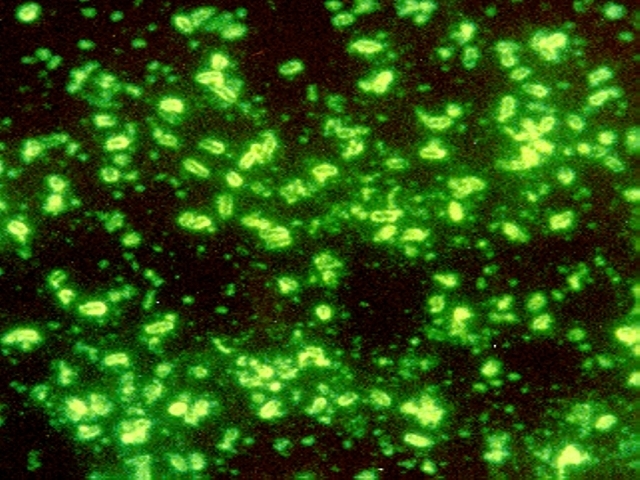
Image source: Wikipedia/Wikimedia
| Ecology, Host, and Life Cycle | |
|---|---|
| Oxygen requirements | aerobic |
| Optimal temperature | Not Available |
| Temperature range | Not Available |
| Habitat | Not Available |
| Biotic relationship | Not Available |
| Host(s) | Homo sapiens, Metazoa |
| Cell arrangement | Not Available |
| Sporulation | Not Available |
| Energy source | Not Available |
| Pathogenicity | Not Available |
Gene Summary
Adenine Count
1333324 bp
Thymine Count
1323157 bp
Guanine Count
1185576 bp
Cytosine Count
1203682 bp
Genome Length
5046986 bp
Protein-coding Genes
4472 genes
Non-Coding Genes
386 genes
# of Chromosomes/Plasmids
1
Genes
| Name | Locus Tag | UniProt ID | Strand Orientation | Gene Start/End | Protein Molecular Weight |
|---|---|---|---|---|---|
| putative type i secretion protein | ERS008529_02802 | Not Available | Positive | 2981059 - 2982234 | 42426.0 |
| abc transporter atp-binding protein | ERS008529_02803 | Not Available | Positive | 2982224 - 2984200 | 70759.3 |
| putative outer-membrane efflux lipoprotein | ERS008529_02804 | Not Available | Positive | 2984197 - 2985624 | 52866.4 |
| putative acyl-carrier-protein | ERS008529_02805 | Not Available | Positive | 2985621 - 2986871 | 44527.6 |
| maoc like domain | ERS008529_02806 | Not Available | Positive | 2986874 - 2987695 | 30382.1 |
| acyl carrier protein | ERS008529_02807 | Not Available | Positive | 2987710 - 2987958 | 9429.51 |
| acyl-carrier protein | ERS008529_02808 | Not Available | Positive | 2987978 - 2988697 | 25700.2 |
| putative extracellular solute-binding protein | ERS008529_02809 | Not Available | Negative | 2988951 - 2989715 | 27710.2 |
| putative aminotransferase | ERS008529_02810 | Not Available | Negative | 2989728 - 2990891 | 42587.4 |
| potassium transport protein kup | ERS008529_02811 | Not Available | Positive | 2991315 - 2993228 | 69131.6 |
Pathways
0 pathways
No pathways found
No metabolic pathways have been associated with this bacterium yet.
Health Effects
No health effects information available for this bacterium.