Kingdom
Pseudomonadati
Phylum
Pseudomonadota
Class
Gammaproteobacteria
Order
Enterobacterales
Family
Yersiniaceae
Genus
Yersinia
Description
Taxonomy
| Kingdom | Pseudomonadati |
|---|---|
| Phylum | Pseudomonadota |
| Class | Gammaproteobacteria |
| Order | Enterobacterales |
| Family | Yersiniaceae |
| Genus | Yersinia |
| Species | Yersinia pekkanenii |
| Strain | No strain |
Profile
| Physiology | |
|---|---|
| Gram staining properties | Not Available |
| Shape | Rod |
| Mobility | Not Available |
| Flagellar presence | Yes |
| Number of membranes | Not Available |

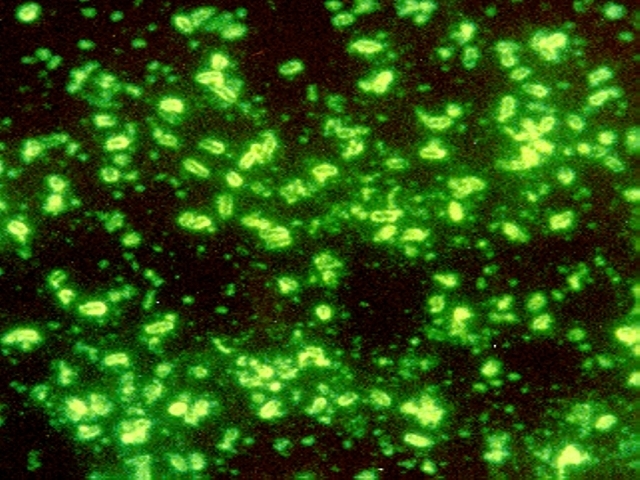
Image source: Wikipedia/Wikimedia
| Ecology, Host, and Life Cycle | |
|---|---|
| Oxygen requirements | aerobic |
| Optimal temperature | Not Available |
| Temperature range | Not Available |
| Habitat | Not Available |
| Biotic relationship | Not Available |
| Host(s) | Homo sapiens, Metazoa |
| Cell arrangement | Not Available |
| Sporulation | Not Available |
| Energy source | Not Available |
| Pathogenicity | Not Available |
Gene Summary
Adenine Count
1333324 bp
Thymine Count
1323157 bp
Guanine Count
1185576 bp
Cytosine Count
1203682 bp
Genome Length
5046986 bp
Protein-coding Genes
4472 genes
Non-Coding Genes
386 genes
# of Chromosomes/Plasmids
1
Genes
| Name | Locus Tag | UniProt ID | Strand Orientation | Gene Start/End | Protein Molecular Weight |
|---|---|---|---|---|---|
| elab protein | ERS008529_02129 | Not Available | Negative | 2301233 - 2301541 | 11395.6 |
| glutathione-regulated potassium-efflux system protein | ERS008529_02130 | Not Available | Negative | 2302112 - 2302603 | 17459.9 |
| uncharacterised protein | ERS008529_02131 | Not Available | Negative | 2302749 - 2303612 | 32810.9 |
| major facilitator superfamily | ERS008529_02132 | Not Available | Negative | 2303744 - 2304358 | 21181.8 |
| lysr family transcriptional regulator | ERS008529_02133 | Not Available | Positive | 2304396 - 2305067 | 24971.8 |
| nadh:ubiquinone oxidoreductase subunit n | ERS008529_02134 | Not Available | Negative | 2305127 - 2306584 | 52001.4 |
| nadh dehydrogenase subunit m | ERS008529_02135 | Not Available | Negative | 2306591 - 2308129 | 56931.4 |
| nadh dehydrogenase subunit l | ERS008529_02136 | Not Available | Negative | 2308148 - 2309992 | 66996.8 |
| nadh dehydrogenase subunit k | ERS008529_02137 | Not Available | Negative | 2309989 - 2310291 | 10879.9 |
| nadh dehydrogenase subunit j | ERS008529_02138 | Not Available | Negative | 2310288 - 2310833 | 19324.2 |
Pathways
0 pathways
No pathways found
No metabolic pathways have been associated with this bacterium yet.
Health Effects
No health effects information available for this bacterium.