Kingdom
Pseudomonadati
Phylum
Pseudomonadota
Class
Gammaproteobacteria
Order
Enterobacterales
Family
Yersiniaceae
Genus
Yersinia
Description
Taxonomy
| Kingdom | Pseudomonadati |
|---|---|
| Phylum | Pseudomonadota |
| Class | Gammaproteobacteria |
| Order | Enterobacterales |
| Family | Yersiniaceae |
| Genus | Yersinia |
| Species | Yersinia pekkanenii |
| Strain | No strain |
Profile
| Physiology | |
|---|---|
| Gram staining properties | Not Available |
| Shape | Rod |
| Mobility | Not Available |
| Flagellar presence | Yes |
| Number of membranes | Not Available |

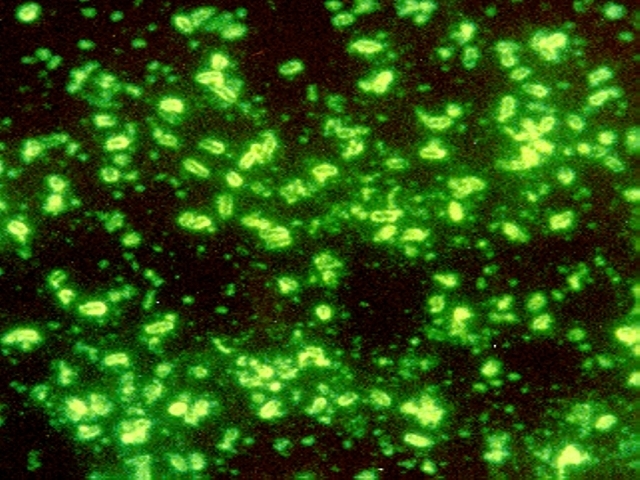
Image source: Wikipedia/Wikimedia
| Ecology, Host, and Life Cycle | |
|---|---|
| Oxygen requirements | aerobic |
| Optimal temperature | Not Available |
| Temperature range | Not Available |
| Habitat | Not Available |
| Biotic relationship | Not Available |
| Host(s) | Homo sapiens, Metazoa |
| Cell arrangement | Not Available |
| Sporulation | Not Available |
| Energy source | Not Available |
| Pathogenicity | Not Available |
Gene Summary
Adenine Count
1333324 bp
Thymine Count
1323157 bp
Guanine Count
1185576 bp
Cytosine Count
1203682 bp
Genome Length
5046986 bp
Protein-coding Genes
4472 genes
Non-Coding Genes
386 genes
# of Chromosomes/Plasmids
1
Genes
| Name | Locus Tag | UniProt ID | Strand Orientation | Gene Start/End | Protein Molecular Weight |
|---|---|---|---|---|---|
| putative lipoprotein | ERS008529_01801 | Not Available | Negative | 1933591 - 1933854 | 9505.44 |
| putative biotin biosynthesis protein | ERS008529_01802 | Not Available | Negative | 1934180 - 1934956 | 28522.3 |
| gluconate periplasmic binding protein | ERS008529_01803 | Not Available | Positive | 1935194 - 1935877 | 26130.5 |
| putative dna uptake protein | ERS008529_01804 | Not Available | Positive | 1935937 - 1936512 | 21063.1 |
| 4-alpha-glucanotransferase | ERS008529_01805 | Not Available | Negative | 1936974 - 1939070 | 78246.6 |
| phosphorylase | ERS008529_01806 | Not Available | Negative | 1939083 - 1941488 | 91028.0 |
| transcriptional regulator malt | ERS008529_01807 | Not Available | Positive | 1941807 - 1944518 | 103159.0 |
| thiosulfate sulfurtransferase | ERS008529_01808 | Not Available | Positive | 1944684 - 1945010 | 12334.4 |
| intramembrane serine protease glpg | ERS008529_01809 | Not Available | Positive | 1945192 - 1946028 | 31377.3 |
| dna-binding transcriptional repressor glpr | ERS008529_01810 | Not Available | Positive | 1946064 - 1946822 | 28152.8 |
Pathways
0 pathways
No pathways found
No metabolic pathways have been associated with this bacterium yet.
Health Effects
No health effects information available for this bacterium.