Kingdom
Pseudomonadati
Phylum
Pseudomonadota
Class
Gammaproteobacteria
Order
Enterobacterales
Family
Yersiniaceae
Genus
Yersinia
Description
Taxonomy
| Kingdom | Pseudomonadati |
|---|---|
| Phylum | Pseudomonadota |
| Class | Gammaproteobacteria |
| Order | Enterobacterales |
| Family | Yersiniaceae |
| Genus | Yersinia |
| Species | Yersinia pekkanenii |
| Strain | No strain |
Profile
| Physiology | |
|---|---|
| Gram staining properties | Not Available |
| Shape | Rod |
| Mobility | Not Available |
| Flagellar presence | Yes |
| Number of membranes | Not Available |

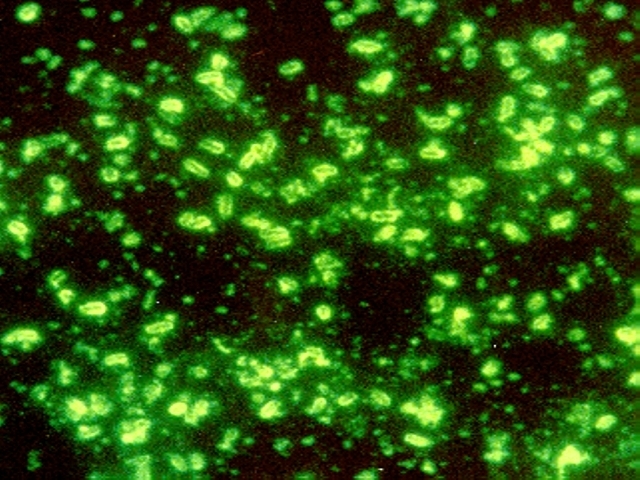
Image source: Wikipedia/Wikimedia
| Ecology, Host, and Life Cycle | |
|---|---|
| Oxygen requirements | aerobic |
| Optimal temperature | Not Available |
| Temperature range | Not Available |
| Habitat | Not Available |
| Biotic relationship | Not Available |
| Host(s) | Homo sapiens, Metazoa |
| Cell arrangement | Not Available |
| Sporulation | Not Available |
| Energy source | Not Available |
| Pathogenicity | Not Available |
Gene Summary
Adenine Count
1333324 bp
Thymine Count
1323157 bp
Guanine Count
1185576 bp
Cytosine Count
1203682 bp
Genome Length
5046986 bp
Protein-coding Genes
4472 genes
Non-Coding Genes
386 genes
# of Chromosomes/Plasmids
1
Genes
| Name | Locus Tag | UniProt ID | Strand Orientation | Gene Start/End | Protein Molecular Weight |
|---|---|---|---|---|---|
| Hypothetical protein | ERS008529_03042 | Not Available | Positive | 3232946 - 3233293 | 13110.2 |
| Phage terminase large subunit | ERS008529_03043 | Not Available | Positive | 3233349 - 3234290 | 36103.6 |
| Portal protein | ERS008529_03044 | Not Available | Positive | 3234290 - 3236455 | 81807.7 |
| Capsid and scaffolding protein | ERS008529_03045 | Not Available | Positive | 3236469 - 3237377 | 33177.6 |
| Coat protein | ERS008529_03046 | Not Available | Positive | 3237377 - 3238660 | 45833.3 |
| Hypothetical protein | ERS008529_03047 | Not Available | Positive | 3238701 - 3238892 | 7335.85 |
| Ejection protein | ERS008529_03048 | Not Available | Positive | 3238940 - 3239221 | 9413.45 |
| Bifunctional tail protein | ERS008529_03049 | Not Available | Positive | 3239313 - 3241295 | 71607.8 |
| uncharacterised protein | ERS008529_03050 | Not Available | Negative | 3241336 - 3243162 | 69822.5 |
| 4-amino-4-deoxy-l-arabinose-phosphoundecaprenol flippase subunit arne | ERS008529_03051 | Not Available | Negative | 3243175 - 3243513 | 12340.8 |
Pathways
0 pathways
No pathways found
No metabolic pathways have been associated with this bacterium yet.
Health Effects
No health effects information available for this bacterium.