
Kingdom
Pseudomonadati
Phylum
Spirochaetota
Class
Spirochaetia
Order
Brachyspirales
Family
Brachyspiraceae
Genus
Brachyspira
Description
Taxonomy
| Kingdom | Pseudomonadati |
|---|---|
| Phylum | Spirochaetota |
| Class | Spirochaetia |
| Order | Brachyspirales |
| Family | Brachyspiraceae |
| Genus | Brachyspira |
| Species | Brachyspira hampsonii |
| Strain | No strain |
Profile
| Physiology | |
|---|---|
| Gram staining properties | Negative |
| Shape | Spirilla |
| Mobility | Yes |
| Flagellar presence | Yes |
| Number of membranes | Not Available |
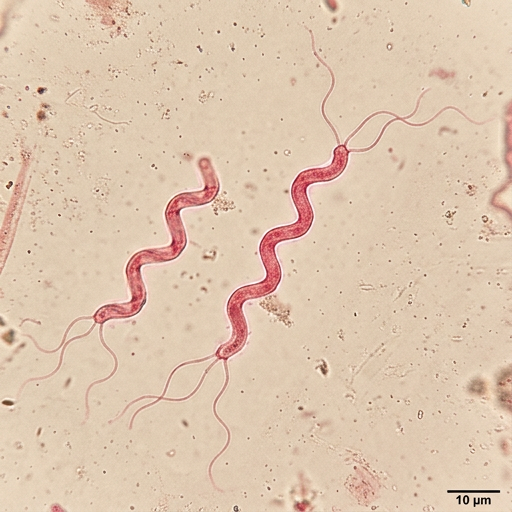
AI-generated image based on bacteria physiology
| Ecology, Host, and Life Cycle | |
|---|---|
| Oxygen requirements | Not Available |
| Optimal temperature | 37 |
| Temperature range | Mesophilic |
| Habitat | Animal intestinal microflora |
| Biotic relationship | Not Available |
| Host(s) | Not Available |
| Cell arrangement | Not Available |
| Sporulation | Nonsporulating |
| Energy source | Chemoheterotroph |
| Pathogenicity | Not Available |
Gene Summary
Adenine Count
1153268 bp
Thymine Count
1155562 bp
Guanine Count
445223 bp
Cytosine Count
432570 bp
Genome Length
3186631 bp
Protein-coding Genes
2755 genes
Non-Coding Genes
50 genes
# of Chromosomes/Plasmids
1
Genes
| Name | Locus Tag | UniProt ID | Strand Orientation | Gene Start/End | Protein Molecular Weight |
|---|---|---|---|---|---|
| hypothetical protein | BFL38_02955 | Not Available | Positive | 2376969 - 2378999 | 78440.9 |
| histidine--trna ligase | BFL38_02960 | Not Available | Positive | 2379027 - 2380277 | 47417.9 |
| aminodeoxychorismate lyase | BFL38_02965 | Not Available | Positive | 2380303 - 2381310 | 38110.2 |
| tryptophan--trna ligase | BFL38_02970 | Not Available | Negative | 2381360 - 2382358 | 38006.7 |
| hypothetical protein | BFL38_02975 | Not Available | Negative | 2382477 - 2383463 | 37554.1 |
| hypothetical protein | BFL38_02980 | Not Available | Positive | 2383657 - 2384265 | 24148.9 |
| hemolysin iii | BFL38_02985 | Not Available | Positive | 2384405 - 2385079 | 25787.6 |
| trna 2-selenouridine(34) synthase mnmh | BFL38_02990 | Not Available | Positive | 2385140 - 2386168 | 40082.3 |
| chemotaxis protein | BFL38_02995 | Not Available | Negative | 2386232 - 2388361 | 77608.2 |
| trna n6-adenosine(37)-n6-threonylcarbamoyltransferase complex dimerization subunit tsab | BFL38_03000 | Not Available | Negative | 2388516 - 2389211 | 26139.2 |
Pathways
0 pathways
No pathways found
No metabolic pathways have been associated with this bacterium yet.
Health Effects
No health effects information available for this bacterium.