
Kingdom
Pseudomonadati
Phylum
Pseudomonadota
Class
Gammaproteobacteria
Order
Lysobacterales
Family
Lysobacteraceae
Genus
Xanthomonas
Description
Taxonomy
| Kingdom | Pseudomonadati |
|---|---|
| Phylum | Pseudomonadota |
| Class | Gammaproteobacteria |
| Order | Lysobacterales |
| Family | Lysobacteraceae |
| Genus | Xanthomonas |
| Species | Xanthomonas translucens |
| Strain | pv. translucens DSM 18974 |
Profile
| Physiology | |
|---|---|
| Gram staining properties | Not Available |
| Shape | Rod |
| Mobility | Not Available |
| Flagellar presence | Yes |
| Number of membranes | Not Available |
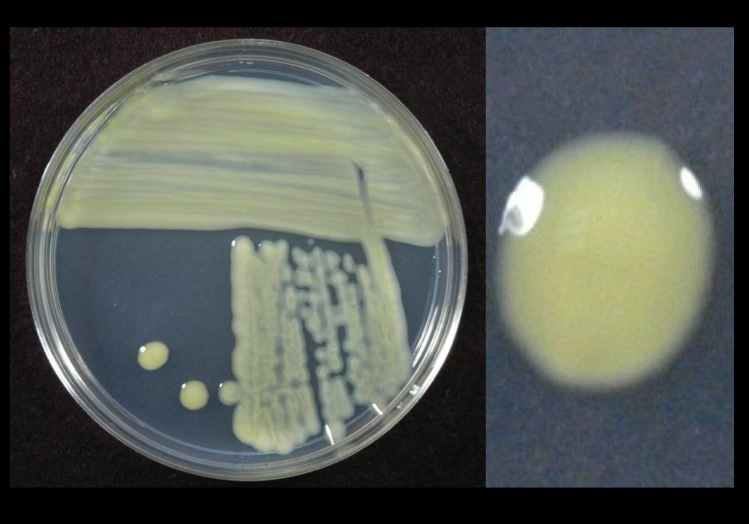
Image source: Wikipedia/Wikimedia
| Ecology, Host, and Life Cycle | |
|---|---|
| Oxygen requirements | Not Available |
| Optimal temperature | Not Available |
| Temperature range | Not Available |
| Habitat | Not Available |
| Biotic relationship | Not Available |
| Host(s) | Not Available |
| Cell arrangement | Not Available |
| Sporulation | Not Available |
| Energy source | Not Available |
| Pathogenicity | Not Available |
Gene Summary
Adenine Count
761023 bp
Thymine Count
761004 bp
Guanine Count
1595345 bp
Cytosine Count
1597985 bp
Genome Length
4715357 bp
Protein-coding Genes
4033 genes
Non-Coding Genes
65 genes
# of Chromosomes/Plasmids
1
Genes
| Name | Locus Tag | UniProt ID | Strand Orientation | Gene Start/End | Protein Molecular Weight |
|---|---|---|---|---|---|
| class i sam-dependent methyltransferase | BFP94_RS17275 | Not Available | Positive | 4138005 - 4138673 | 25365.3 |
| fasciclin domain-containing protein | BFP94_RS17280 | Not Available | Positive | 4138975 - 4139565 | 19927.4 |
| udgx family uracil-dna binding protein | BFP94_RS17285 | Not Available | Negative | 4139684 - 4141126 | 53314.7 |
| putative dna modification/repair radical sam protein | BFP94_RS17290 | Not Available | Negative | 4141564 - 4142808 | 46444.0 |
| class iii extradiol ring-cleavage dioxygenase | BFP94_RS17295 | Not Available | Negative | 4142908 - 4143714 | 28839.8 |
| lysr family transcriptional regulator | BFP94_RS17300 | Not Available | Positive | 4143895 - 4144803 | 33029.9 |
| flavodoxin family protein | BFP94_RS17305 | Not Available | Positive | 4144932 - 4145501 | 19824.1 |
| mannitol dehydrogenase family protein | BFP94_RS22150 | Not Available | Negative | 4145708 - 4146169 | 16779.2 |
| aldo/keto reductase | BFP94_RS22155 | Not Available | Positive | 4146237 - 4146653 | 14708.9 |
| aldo/keto reductase | BFP94_RS17320 | Not Available | Positive | 4146899 - 4147894 | 35814.7 |
Pathways
0 pathways
No pathways found
No metabolic pathways have been associated with this bacterium yet.
Health Effects
No health effects information available for this bacterium.