
Kingdom
Pseudomonadati
Phylum
Pseudomonadota
Class
Gammaproteobacteria
Order
Lysobacterales
Family
Lysobacteraceae
Genus
Xanthomonas
Description
Taxonomy
| Kingdom | Pseudomonadati |
|---|---|
| Phylum | Pseudomonadota |
| Class | Gammaproteobacteria |
| Order | Lysobacterales |
| Family | Lysobacteraceae |
| Genus | Xanthomonas |
| Species | Xanthomonas translucens |
| Strain | pv. translucens DSM 18974 |
Profile
| Physiology | |
|---|---|
| Gram staining properties | Not Available |
| Shape | Rod |
| Mobility | Not Available |
| Flagellar presence | Yes |
| Number of membranes | Not Available |
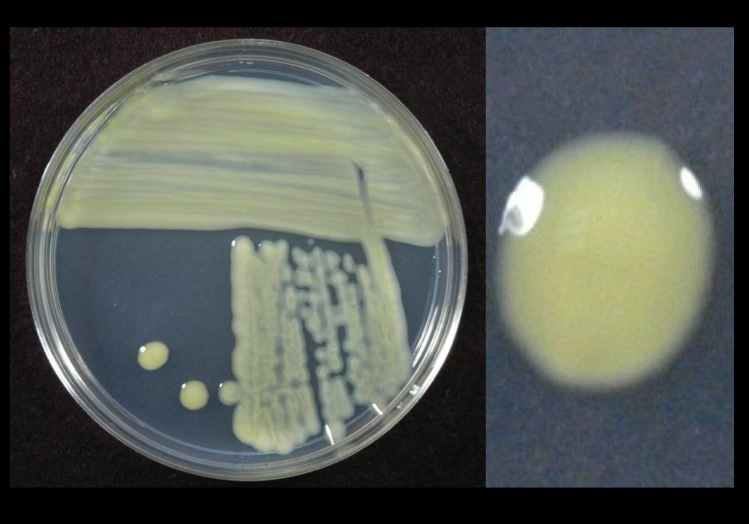
Image source: Wikipedia/Wikimedia
| Ecology, Host, and Life Cycle | |
|---|---|
| Oxygen requirements | Not Available |
| Optimal temperature | Not Available |
| Temperature range | Not Available |
| Habitat | Not Available |
| Biotic relationship | Not Available |
| Host(s) | Not Available |
| Cell arrangement | Not Available |
| Sporulation | Not Available |
| Energy source | Not Available |
| Pathogenicity | Not Available |
Gene Summary
Adenine Count
761023 bp
Thymine Count
761004 bp
Guanine Count
1595345 bp
Cytosine Count
1597985 bp
Genome Length
4715357 bp
Protein-coding Genes
4033 genes
Non-Coding Genes
65 genes
# of Chromosomes/Plasmids
1
Genes
| Name | Locus Tag | UniProt ID | Strand Orientation | Gene Start/End | Protein Molecular Weight |
|---|---|---|---|---|---|
| general secretion pathway protein gspk | BFP94_RS16540 | Not Available | Negative | 3970313 - 3971173 | 29877.4 |
| type ii secretion system protein j | BFP94_RS16545 | Not Available | Negative | 3971170 - 3971820 | 23458.5 |
| type ii secretion system protein xpsi | BFP94_RS16550 | Not Available | Negative | 3971817 - 3972233 | 15090.3 |
| type ii secretion system protein xpsh | BFP94_RS16555 | Not Available | Negative | 3972230 - 3972679 | 16124.6 |
| type ii secretion system major pseudopilin gspg | BFP94_RS16560 | Not Available | Negative | 3972759 - 3973193 | 15233.4 |
| type ii secretion system protein xpsf | BFP94_RS16565 | Not Available | Negative | 3973662 - 3974876 | 43910.1 |
| type ii secretion system atpase gspe | BFP94_RS16570 | Not Available | Negative | 3974992 - 3976722 | 63575.0 |
| s8 family peptidase | BFP94_RS16575 | Not Available | Negative | 3977071 - 3978963 | 63681.9 |
| espr-type extended signal peptide-containing protein | BFP94_RS16580 | Not Available | Negative | 3979122 - 3983561 | 139470.0 |
| hypothetical protein | BFP94_RS16585 | Not Available | Negative | 3984743 - 3985873 | 41916.7 |
Pathways
0 pathways
No pathways found
No metabolic pathways have been associated with this bacterium yet.
Health Effects
No health effects information available for this bacterium.