
Kingdom
Pseudomonadati
Phylum
Pseudomonadota
Class
Gammaproteobacteria
Order
Lysobacterales
Family
Lysobacteraceae
Genus
Xanthomonas
Description
Taxonomy
| Kingdom | Pseudomonadati |
|---|---|
| Phylum | Pseudomonadota |
| Class | Gammaproteobacteria |
| Order | Lysobacterales |
| Family | Lysobacteraceae |
| Genus | Xanthomonas |
| Species | Xanthomonas translucens |
| Strain | pv. translucens DSM 18974 |
Profile
| Physiology | |
|---|---|
| Gram staining properties | Not Available |
| Shape | Rod |
| Mobility | Not Available |
| Flagellar presence | Yes |
| Number of membranes | Not Available |
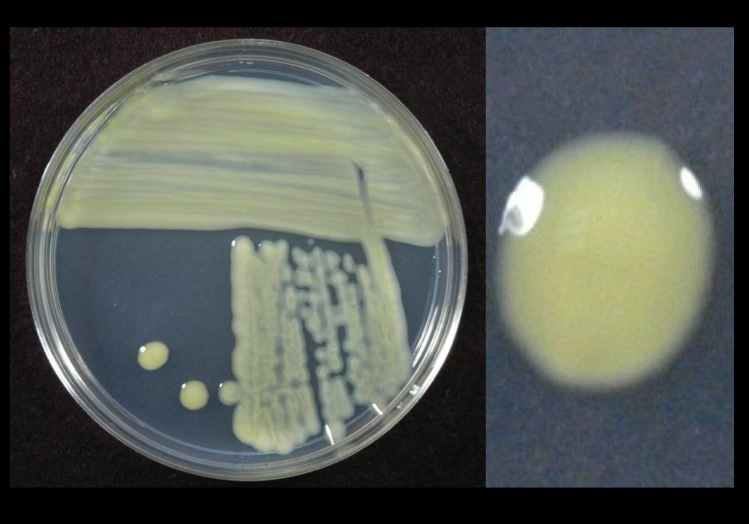
Image source: Wikipedia/Wikimedia
| Ecology, Host, and Life Cycle | |
|---|---|
| Oxygen requirements | Not Available |
| Optimal temperature | Not Available |
| Temperature range | Not Available |
| Habitat | Not Available |
| Biotic relationship | Not Available |
| Host(s) | Not Available |
| Cell arrangement | Not Available |
| Sporulation | Not Available |
| Energy source | Not Available |
| Pathogenicity | Not Available |
Gene Summary
Adenine Count
761023 bp
Thymine Count
761004 bp
Guanine Count
1595345 bp
Cytosine Count
1597985 bp
Genome Length
4715357 bp
Protein-coding Genes
4033 genes
Non-Coding Genes
65 genes
# of Chromosomes/Plasmids
1
Genes
| Name | Locus Tag | UniProt ID | Strand Orientation | Gene Start/End | Protein Molecular Weight |
|---|---|---|---|---|---|
| glycosyltransferase | BFP94_RS16490 | Not Available | Negative | 3957819 - 3958664 | 31188.5 |
| phosphotransferase enzyme family protein | BFP94_RS16495 | Not Available | Positive | 3959034 - 3960182 | 42232.1 |
| tonb-dependent siderophore receptor | BFP94_RS16500 | Not Available | Positive | 3960336 - 3962498 | 78189.2 |
| nicotinamide riboside transporter pnuc | BFP94_RS16505 | Not Available | Positive | 3962930 - 3963505 | 21466.6 |
| utra domain-containing protein | BFP94_RS16510 | Not Available | Positive | 3963621 - 3964358 | 26917.3 |
| glycosyltransferase family 2 protein | BFP94_RS16515 | Not Available | Negative | 3964475 - 3965308 | 29652.5 |
| type ii secretion system secretin gspd | BFP94_RS16520 | Not Available | Negative | 3965315 - 3967651 | 79965.7 |
| type ii secretion system protein xpsn | BFP94_RS16525 | Not Available | Negative | 3967663 - 3968445 | 27245.6 |
| type ii secretion system protein gspm | BFP94_RS16530 | Not Available | Negative | 3968435 - 3969211 | 27334.9 |
| piln domain-containing protein | BFP94_RS16535 | Not Available | Negative | 3969192 - 3970316 | 41186.5 |
Pathways
0 pathways
No pathways found
No metabolic pathways have been associated with this bacterium yet.
Health Effects
No health effects information available for this bacterium.